
Every site that accepts contributions publishes a page of rules. Almost nobody reads them as evidence.
I read twenty of them in full on 21 November 2026 and wrote down what each one asked for. The rules turn out to be the most reliable thing on the whole site, because a guidelines page is written for writers rather than for buyers, and nobody bothers to dress it up.
The page ranking first for guest post guidelines has a price list on it.
What I did
I searched Google for guest post guidelines and listed every result off the page. Nineteen across page one and page two.
Then I read twenty guidelines pages end to end, including the one ranking first, and recorded ten things about each: whether money changes hands and in which direction, how many links are allowed, whether the page says what kind of link you get, the word count, whether it asks for anchor text, whether a person is named, whether you get a byline, whether the work has to be unpublished, whether AI content is mentioned, and whether you pitch first or send a finished article.
Sixteen of those twenty were a site's own rules. The other four were articles advising other people how to handle guest posts. Where I give a count below, the denominator is sixteen when the question only makes sense for a site setting its own rules.
Here is what ranked.
| What the result was | How many |
|---|---|
| A site's own guidelines or write for us page | 16 |
| An advice article about writing guidelines | 2 |
| A guidelines template | 1 |
Two of those sixteen belong to link building agencies rather than publications. One result, on page two, sits at a URL ending copy-of-partner-with-us, a page duplicated inside a site builder and never renamed.
So this search returns mostly the real thing: actual sites publishing their actual rules. That is unusual, and it is why the page is worth reading properly rather than skimming.
The page ranking first sells links for $150, and prices the extras
Position one is kingofdigitalmarketing.com, under the heading "Guest Post Guidelines".
It reads like editorial policy for about half its length. Original content only. Minimum 800 to 1,200 words. "We do not accept AI-generated, plagiarized, or spun content." "Final decision regarding publication rests with our editorial team."
Then, under a subheading called Pricing, this:
Guest Post (with 1 do-follow link): ₹11,000 / $150
Extra Link: ₹1,500 / $20 each
And below that: "Turnaround Time: 1-3 days after content approval and payment." Further up the page, under Fees & Payment: "A guest post fee will be paid in advance."
So the product is a followed link, the price is $150, additional links are $20 apiece, and the article appears within three days of the money arriving. None of that is hidden. It is set out under a heading, in two currencies, on a page that also talks about grammar and reader value.
This is the most useful thing about guidelines pages. A site that sells placements will usually tell you, because it needs you to know the price.
The question guidelines almost never answer
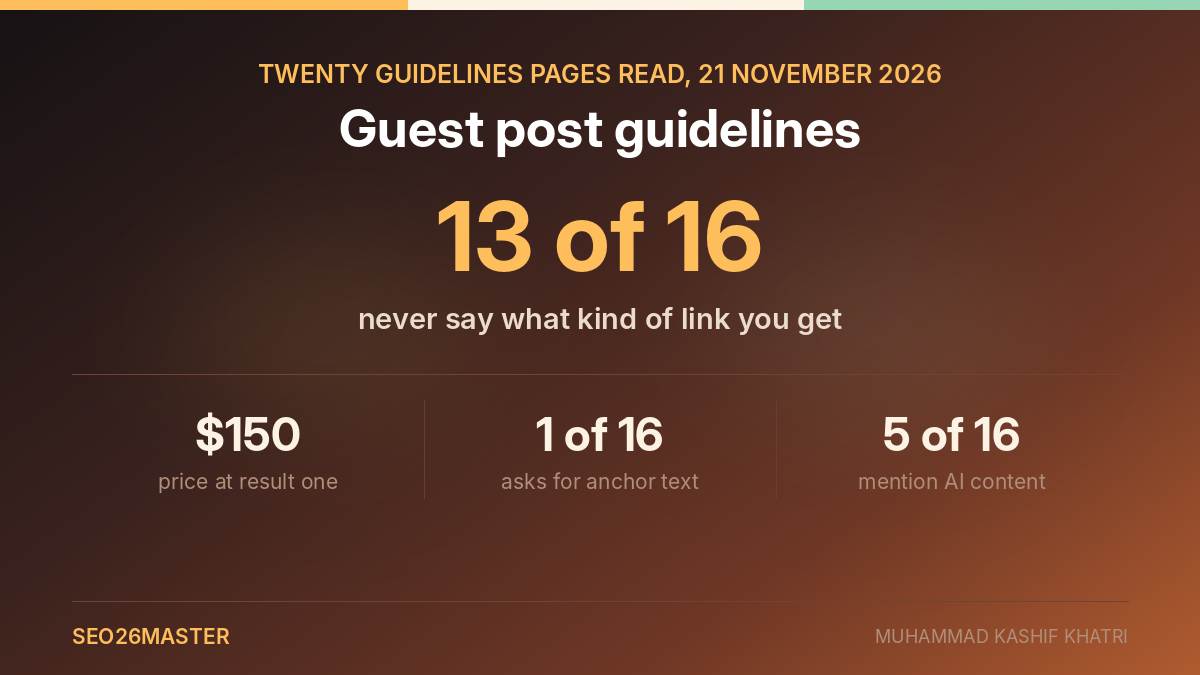
Of the sixteen pages I read that were a site's own rules, three say what kind of link you get.
| What the page states about link attributes | How many of 16 |
|---|---|
| Says dofollow, nofollow or sponsored about contributor links | 3 |
| Says nothing at all about link attributes | 13 |
Thirteen out of sixteen. The thing that determines whether a placement carries ranking value, and whether it sits inside Google's rules, is the thing guidelines pages are quietest about.
The three that do say it do not agree with each other.
Twine says "Authors are permitted 2 dofollow backlinks per article" and then, a little later, "All external links will be made nofollow by default", and asks contributors to "highlight which links you would like to be dofollow in your draft." So the default is nofollow and you have to ask.
html-online.com takes the opposite line and addresses it to the contributor: "Don't underestimate the value of nofollow links to maintain a natural-looking backlink profile." Then: "Webmasters know their own sites best, let them handle inbound links."
The third is kingofdigitalmarketing, where the followed link is the thing you are buying.
Why this one detail changes the whole transaction is in dofollow vs nofollow guest post. It decides whether you bought advertising or bought a problem.
Anchor text is the tell
This is the clearest single signal I found, and it takes two seconds to check.
Count how many of the sixteen ask the contributor to submit anchor text and a target URL. One does. It is the one with the price list.
Its submission instructions read:
Please share: Your article (or topic ideas) · Your preferred anchor text and link · Author bio (optional)
Every other page asks what you want to write about. Orbit Media goes the other way and reserves the right to overrule you: "We may edit anchor text and links that are not relevant."
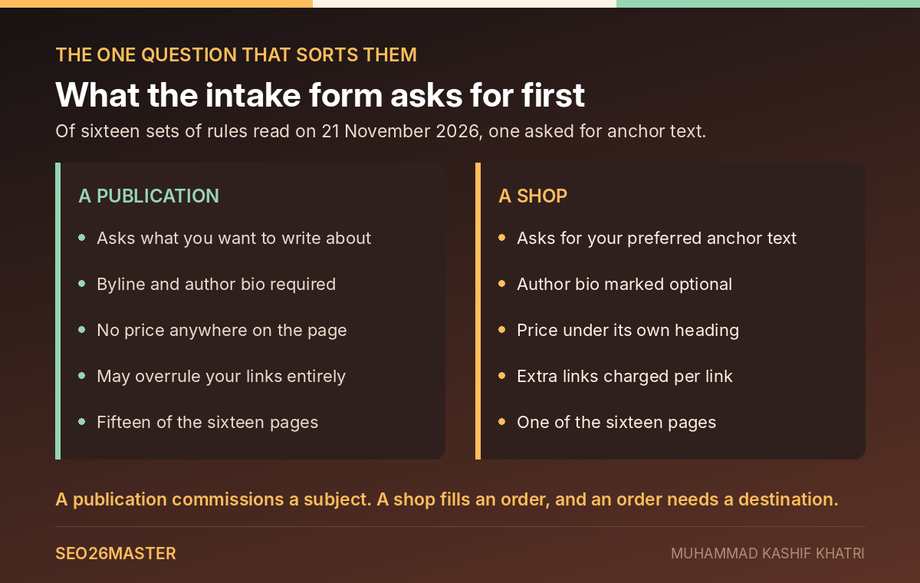
The logic is simple once you see it. A publication is commissioning a subject. A shop is filling an order, and an order needs a destination and the words that point at it. If the intake asks for anchor text before it asks for a topic, it is a shop, whatever the heading says. What happens when those anchors are chosen badly is in guest post anchor text.
The byline test
Look again at that submission list. "Author bio (optional)."
On a publication the bio is the point. Young Upstarts requires "a full bio and a profile picture" plus a LinkedIn profile. Orbit Media caps it: "Author bio should be 50 words max." Lilach Bullock lists it under a heading called What you get: "A byline and the credibility of an established, high-traffic blog."
On the page selling links for $150, your name is optional.
That tracks exactly with something I documented last week. In the guest post outreach service market, the two biggest sellers both describe the product on their own sales pages as a ghost post rather than a guest post. Young Upstarts, meanwhile, puts three words in its guidelines: "no ghostwriters please."
Two industries, same vocabulary, opposite positions. One sells the absence of your name as a feature. The other refuses it as a condition.
One page states the whole problem out loud
Jobicy, a remote jobs site, publishes guidelines I would call unusually honest. Three sentences, taken verbatim and in the order they appear on the page.
Articles may contain up to 3 relevant, dofollow links within the article body, subject to editorial approval.
Guest posts do not ordinarily display a visible sponsored label unless disclosure is required by applicable law or our editorial policies.
The publication fee and any optional services are shown before payment.
Read them together. You pay a fee. You get up to three followed links. The post does not normally carry a sponsored label.
Google's own documentation on how to qualify your outbound links is specific about this case. "Mark links that are advertisements or paid placements (commonly called paid links) with the sponsored value." It adds that nofollow "is still an acceptable way to flag them, though sponsored is preferred."
I am not accusing Jobicy of hiding anything. The opposite. They have written down, in plain English on a public page, the arrangement most of this market runs on without saying so. The reason I can describe it precisely is that they published it.
What it means for the buyer is in google link scheme, and the version I have to write carefully because I sell placements is is buying backlinks safe.
Some hosts add their own paid links to your article
Young Upstarts allows the contributor "one single non-commercial link within the article".
Then, separately, the same page says this:
We do add affiliate links and paid links to guest posts.
So you supply the article and get one non-commercial link. The host inserts its own commercial links into your piece afterwards.
I have not seen that stated anywhere else, and I went looking. It is a reasonable thing for a publisher to do, and better said than not. But it changes what you are writing. Your article becomes inventory for somebody else's link sales, and the anchors in it may point somewhere you have never heard of.
So before you pitch anywhere, open three of that site's existing guest posts and see what the outbound links in the body point at. The method is in how to vet guest post sites, and you can run any domain through my free guest post site checker first.
What the rules do cover: word counts and AI
Twelve of the sixteen state a word count. It is the single most commonly stated rule, more common than link rules and far more common than anything about money.
| Site | Word count stated |
|---|---|
| Young Upstarts | 600 to 800 best, up to 2,000 accepted |
| TCK Publishing | 750 to 2,000 |
| The Write Practice | 750 or more preferred |
| kingofdigitalmarketing | 800 to 1,200 minimum |
| html-online | 800 or more |
| Twine | 1,000 to 2,000 preferred |
| Lilach Bullock | 1,000 to 1,800 typical |
| designing.rutgers.edu | 1,000 to 3,000 |
| Sender | at least 1,200 |
| Orbit Media | 1,500 minimum |
| WordStream | 1,500 minimum |
| ScalaHosting | at least 1,500 |
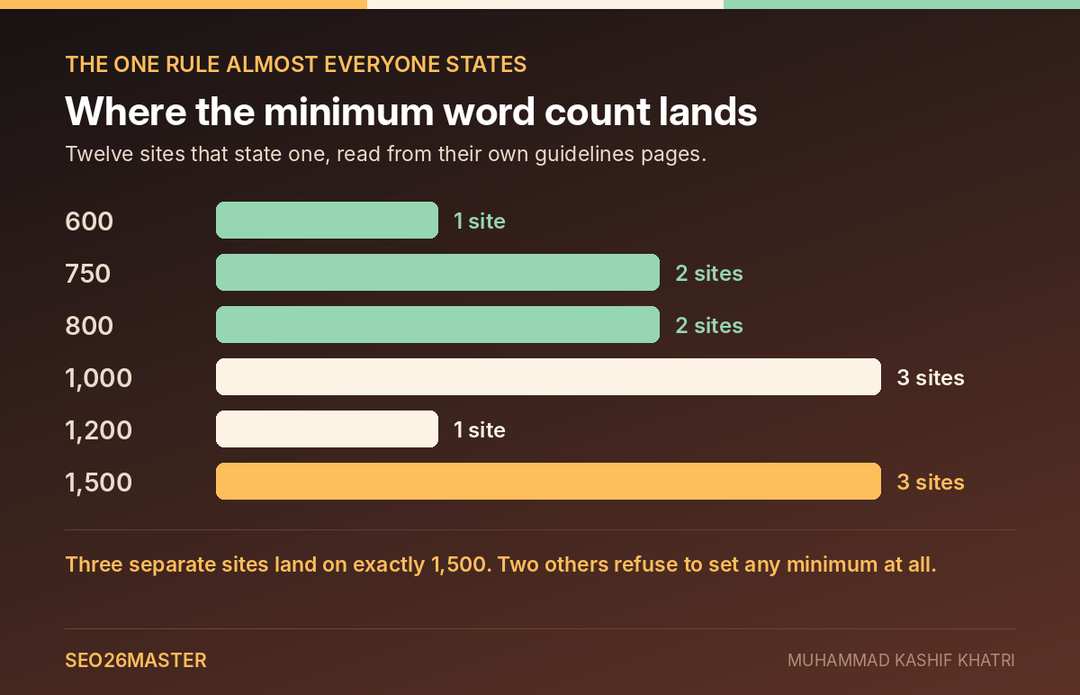
The minimums run from 600 to 1,500. Three separate sites land on exactly 1,500, which is as close to an industry standard as this market has. Two pages refuse to set one: ManageWP says "We don't mind how long (or short) your article is", and A Smart Bear asks only for "appropriate length and grammar".
One counts in the wrong unit. Jobicy asks for "between 1,000 and 15,000 characters", roughly 170 to 2,500 words. I have never seen another publication specify characters. What length actually suits a placement is in guest post word count.
AI is the newer question, and most of these pages have not got to it yet.
| What the page says about AI content | How many of 16 |
|---|---|
| Rules out or restricts AI-generated content | 5 |
| Says nothing about AI | 11 |
Five, in late 2026. The wording varies more than the count suggests. ScalaHosting: "we don't accept AI-generated content". kingofdigitalmarketing: "We do not accept AI-generated, plagiarized, or spun content." Jobicy bans "Unedited, inaccurate, repetitive, or low-effort AI-generated content" and asks contributors to "Review and edit any AI-assisted material before submission", which is a rule about effort rather than origin.
And then Sender, which sets a number:
Articles must contain no more than 5% AI-generated content.
I cannot work out how that would be measured, and the page does not say. No tool returns a reliable percentage, and 5% of a 1,200 word article is sixty words. I am recording it because it is on the page, not because it describes anything checkable.
A rule a host cannot measure gets applied by impression instead, which is worth knowing before you submit. More of that in why guest posts get rejected.
Only two of sixteen name a person
Two pages give a human being as the contact.
A Smart Bear, which belongs to Jason Cohen, says "contact me" and links to his own page. Its instruction is the bluntest thing in the whole sample: "Have the post fully written before you contact me." No word count, no link rules, no bio, no form.
WordStream names an editor: "Send an email to Stephanie."
The other fourteen route you to a form, a shared inbox, "our editorial team", "our marketing team", or "our editors". That is not sinister on its own, and plenty of real publications work that way. But a named editor is a person who can be asked a question and who answers for the decision. A form is a queue.
When I read submissions myself, the pitches that get through are the ones addressed to someone. That is most of what sites that accept guest posts is about.
A university arts school is running a sponsored post desk
One page in this sample is not what its domain suggests.
designing.rutgers.edu is the site for Design at Mason Gross, part of Rutgers University's Mason Gross School of the Arts. It carries the school's branding, navigation and a 2026 copyright footer.
It is also publishing a page headed "Write for Us Sponsored Posts!", posted May 2025. The rules on it:
To discuss your ideas for contributing please send an email to netherlandsmark@proton.me
Your article must be between 1000 and 3000 words
After approval the article takes 2-4 days to be published in your desired website
You can insert up to 3 outbound links in the body of your article.
The contact is a ProtonMail address, not a Rutgers one. And look at the third quote. "Your desired website." A publication publishes on itself. Whoever wrote that is placing articles across a set of sites and letting the buyer pick, which makes it a broker page sitting on a university subdomain.
This is the sixth domain I have now recorded carrying this industry's marketing without being in the industry. The others, documented in link building reseller and buy guest posts, were a cancer charity, an arts centre, a racing fabrication workshop, and two university Canvas portfolio systems, one Spanish and one in Islamabad, both empty when I opened them.
Guidelines pages are a good place to find this pattern, because the giveaway is a phrase nobody would write about their own site.
The advice layer is selling too
Four of the pages I read are not guidelines at all. They are articles telling other people how to handle guest posts, and two come from companies with something to sell.
Loganix has a write for us page ranking on page one of this search, and separately a long article advising others on writing guidelines. That article's list of things guidelines normally include has this item: "Any cost to have a guest post published." Loganix's own navigation sells link building, guest posts, niche edits, brand mentions and press releases. So a company that sells placements treats a publication fee as an ordinary line in editorial policy.
Nexcess, the managed hosting brand, advises blog owners from the other side. Its worked example: "you can book four guest posts at $500 per post per month", with a cheaper option of twelve at $250 each. It does warn that "charging money for guest posts could limit the reach of your guest posts."
Put those beside the $150 price list at position one, and the going rate implied by this one search sits a long way below the marketplace figures I collected in guest post pricing. The gap is the reseller margin.
Seven questions to ask any guidelines page
This is how I read one now, in order, and it takes about ninety seconds.
1. Does the page name a price, anywhere? Look for a Pricing heading and search the page for a currency symbol. Position one in this search hides nothing. It just puts the price below the editorial language.
2. Does it ask for anchor text? If the intake asks for anchor text and a target URL before it asks for a topic, it is an order form.
3. Is the byline required or optional? Optional means the article is not the product.
4. Does it say what kind of link you get? Thirteen of sixteen do not. If it does not say, ask in writing before you write anything.
5. Is a person named? Two of sixteen. A name is worth more than a form.
6. Does it reserve the right to add links to your article? One of sixteen said so out loud. Check three published posts to find out about the rest.
7. Does it say whether the post is labelled? One of sixteen, and the answer there was no.
None of these require a tool. All of them are on the page already.
Where I sit in this
I sell guest post placements, so weigh all of this accordingly.
I am an editor at ILLUMINATION on Medium, which has 324,000 readers, and at four other publications. I read submissions, and I say no to a fair number of them. That is the reason this particular article was possible: I have spent a long time on the receiving side of the inbox, and I know which of these rules exist to protect readers and which exist to describe a transaction.
My own terms are on guest post campaigns, and they would fail at least one of the seven questions above, because the byline is required rather than optional and that rules out a chunk of the market. I think that is the right trade. You may not.
What I could not check
My browser's site permissions stopped me opening most of the ranked results, so the two samples in this article are different things and I want to be plain about that. For the nineteen ranked results I am reporting titles, URLs and the result type, read straight off the results page, and nothing more. I opened and read only the first of them. The twenty pages I quote from came from a wider search for the same term, and all twenty are listed in the sources below so you can check every quote. Loganix is the only domain appearing in both samples, and the two Loganix pages are different URLs.
I did not pay any of these sites, submit anything, or test whether the rules are applied as written. Every quote is what a page said on 21 November 2026.
I could not establish whether Rutgers University knows about the sponsored posts page on its Mason Gross design subdomain, who posted it, or whether anyone there has approved it. I am reporting that the page is there and what it says.
I could not establish whether the publication fee on any page is the price actually charged, or whether the named prices are negotiable.
On the 5% AI figure, I have no idea what method would produce that number and the page does not offer one.
I ran this search once, from Pakistan, on one day. Results move by country and by hour, and guidelines pages get edited.
Questions people ask
What should guest post guidelines include?
At minimum: the subject range, a word count, how many links are allowed and where, what attribute those links carry, whether the byline is published, and whether any money changes hands. Across the sixteen sets of rules I read, word count was the most commonly stated of those and link attribute the least.
Do guest post guidelines mention payment?
Rarely. Of the sixteen, two stated a fee the contributor pays, one stated "There is no cost", and one stated "We do not pay for guest posts at this time." The other twelve said nothing about money either way.
How can I tell if a site sells links rather than publishing guest posts?
The fastest signal is the intake form. If it asks for anchor text and a target URL, and treats the author bio as optional, you are buying a link. A site that wants an article asks what the article is about.
How long should a guest post be?
Twelve of the sixteen gave a figure, with minimums from 600 to 1,500 words. Three separate sites said 1,500. With no other information, 1,500 words is the safest guess.
Do guest post guidelines say anything about AI content?
Five of sixteen did, in November 2026. The wording ranged from a flat refusal to a cap of "no more than 5% AI-generated content", which I do not believe can be measured.
Will my guest post be labelled as sponsored?
One page of sixteen addressed it, and the answer was that posts "do not ordinarily display a visible sponsored label". Google's documentation asks for paid placements to be marked with rel="sponsored". If money is changing hands and you want to stay inside that, this is the question to ask in writing.
Should I pitch first or send a finished article?
It depends on the site, and the guidelines usually tell you. Three required topic approval before writing. Two preferred a finished draft, in one case bluntly: "Have the post fully written before you contact me."
Sources
- Search for "guest post guidelines" run 21 November 2026, 19 results across two pages listed from the results page
- Twenty guidelines pages read in full on 21 November 2026: kingofdigitalmarketing.com/guest-posting-guidelines.aspx, designing.rutgers.edu/?p=10000, blog.asmartbear.com/guest-post-rules.html, managewp.com/guest-posting-guidelines, tckpublishing.com/guest-post-guidelines/, jobicy.com/write-for-jobicy, orbitmedia.com/guidelines/, sender.net/guest-blogging-guidelines/, twine.net/blog/twine-guest-post-guidelines, thewritepractice.com/guest-post/, youngupstarts.com/guidelines-for-guest-post-submissions, wordstream.com/guest-posting-guidelines, html-online.com/articles/?p=2481, scalahosting.com/blog/?p=61682, loganix.com/guest-blogging-guidelines/, nexcess.net/blog/accepting-guest-posts, cirrusinsight.com/hubfs/Guest Posting FAQs.pdf, c-sharpcorner.com/blogs/what-are-the-guidelines-for-submitting-a-guest-post, lilachbullock.com/write-for-us-writing/, techsauryacom1.odoo.com/blog/1/write-for-us-guest-post-guidelines-12
- Google Search Central, Qualify your outbound links to Google: https://developers.google.com/search/docs/crawling-indexing/qualify-outbound-links
Leave a Reply