
I sell guest post placements. That is my business. You should know that before you read another word of this, because it is the thing almost nobody else answering this question tells you.
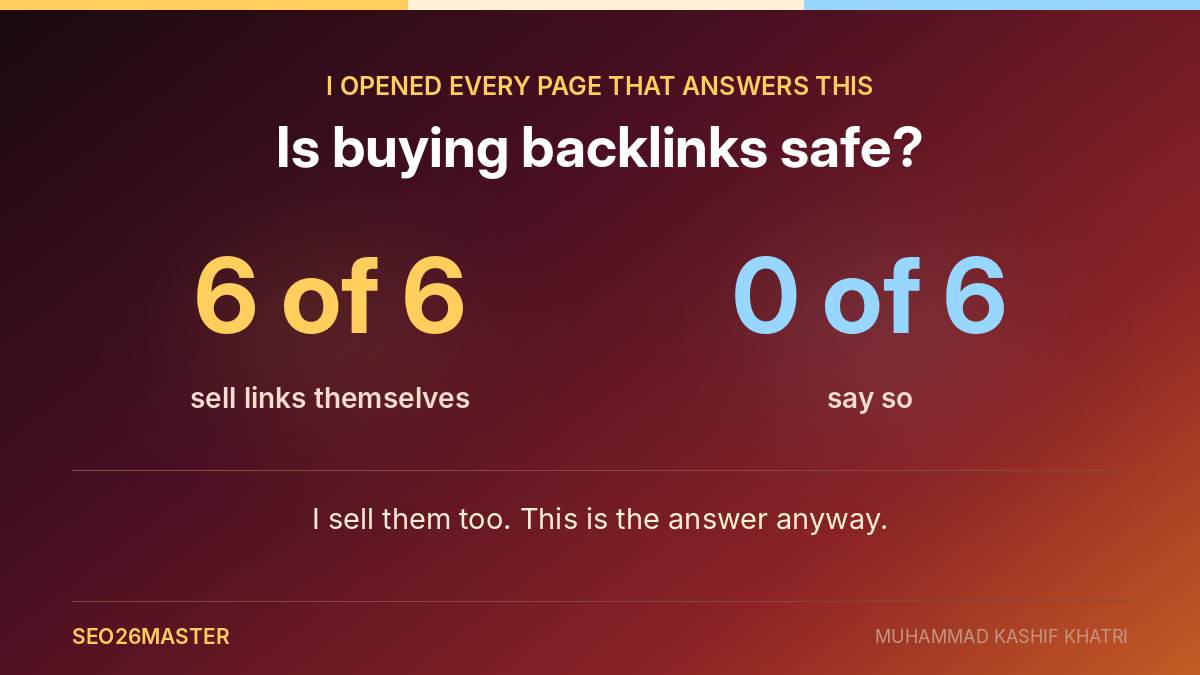
I went and opened the pages that come back when you search is buying backlinks safe. Six of them.
Every single one is published by somebody with a commercial interest in your answer.
Not one of them says so.
So here is the version written by somebody who sells the thing, and says so first.
The six pages answering this question
| Page | Who publishes it | What they sell | What they conclude | Says so? |
|---|---|---|---|---|
| Stan Ventures | Dileep Thekkethil, their Director of Marketing | Managed blogger outreach | Their own service model is "the safest way" | No |
| SEO Sherpa | James Reynolds, founder | Link building service | "practically no risk of a penalty" | No |
| Profit Parrot | Lark Begin, Co-Founder | Guest posting, listed in their menu | It is not whether you buy, it is what you buy | No |
| Editorial.Link | Dmytro Tsybuliak, Co-founder | Link building agency | Purchased links are a sign of unnatural links | No |
| Woostify | A WordPress theme company | A theme, plus links out to three link services | Safe if you treat it as risk management | No |
| Lilach Bullock | Lilach Bullock | Featured placements and guest posts on her own site | Safe if the seller is good enough | No |
Six for six. Every one has money riding on the answer and none of them mentions it.
A few are worth looking at twice.
Editorial.Link tells you that purchased links are a warning sign of unnatural links. The same site advertises "No penalties, guaranteed!" Both of those cannot be true.
SEO Sherpa says "When done properly, there's practically no risk of a penalty". Further down the same page it says "any form of link buying has some degree of risk." That article was published in January 2022 and updated in April 2026. The contradiction has had four years to get noticed.
Woostify is the strangest of the six. It is a WordPress theme company. It has no obvious reason to be publishing guidance on buying backlinks at all. Its article recommends a link building service, a guest post marketplace and a traffic tool by name. Whether those recommendations were paid for is not stated either way, and that is the problem. On a page telling you how to buy links carefully, the reader has no way to tell what the page itself is.
I am not saying any of these people are lying. Most of what they write is reasonable. I am saying that if you ask six shopkeepers whether you should shop, you should expect the answer you get.
Why every seller gives the same answer
There is a reason these six pages all land in the same place, and it is not a conspiracy. It is arithmetic.
If a seller tells you buying links is dangerous, they have no business. If a seller tells you it is completely safe, nobody believes them and they sound reckless.
So there is exactly one answer that works commercially, and all six of them found it. It is dangerous, unless you buy the way we sell.
That framing does two jobs at once. It makes the market sound risky enough to need an expert, and it makes the expert the seller you are already reading. Fear of a penalty is the single most effective sales tool in this industry, and every page selling a safe method needs the danger to be real.
Which is why the finding that matters most in this article is the quiet one. The outcome nobody warns you about is not a penalty. It is nothing happening at all. And nobody can sell you protection from nothing.
All of which comes after a question people skip. Which sites are worth paying for in the first place? I went through what separates them in high quality backlinks.
What Google actually says
This part is short, because Google has written it down and it has not changed.
From the spam policies:
Link spam is the practice of creating links to or from a site primarily for the purpose of manipulating search rankings.
The very first example on the list is:
Buying or selling links for ranking purposes.
That includes exchanging money, goods or services for links, and sending somebody a product in return for writing about it with a link.
So the simple answer to the question is no. Buying links for rankings is against Google's rules, stated plainly, with no ambiguity in the wording.
But there is a second half that most people skip, and it matters.
Google does understand that buying and selling links is a normal part of the economy of the web
Paid links are not a violation at all when they are for advertising or sponsorship, and when the link is tagged to say so.
Two words you need before the rest of this makes sense
Every link on the web is one of two kinds, and you cannot tell them apart by looking at the page.
A followed link passes ranking credit to the site it points at. That is the kind people pay for. Nothing visible marks it. It is simply a link with no instruction attached.
A tagged link carries a short instruction telling Google how to treat it. Google calls these qualified links. The instruction sits in the page code, not on the screen, and readers never see it.
To check any link yourself, right click it, choose Inspect, and look at the highlighted line of code. If there is nothing after the web address, the link is followed. If you see rel= followed by a word, it is tagged.
That is the whole mechanism, and everything below turns on it.
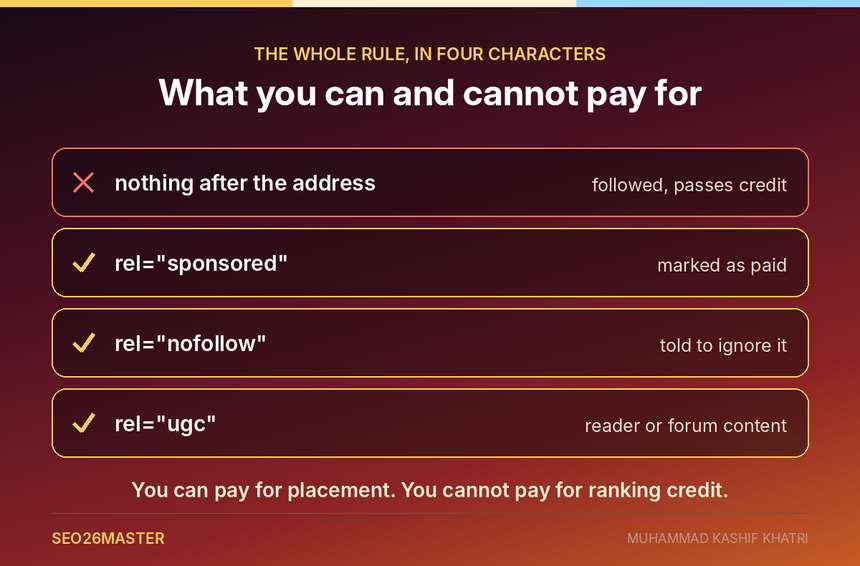
Read Google's two passages together and the rule becomes simple. You can pay for placement. You cannot pay for ranking credit. The money was never the problem. The untagged link is.
Here is what that looks like in practice.
| What the link carries | What it means | Paid placement allowed? |
|---|---|---|
| Nothing after the address | Followed. Passes ranking credit. | Not under the policy, if money changed hands |
rel="sponsored" | Marked as paid or advertising | Yes. This is the one Google asks for |
rel="nofollow" | Tells Google to ignore it | Yes |
rel="ugc" | Marked as reader or forum content | Yes, though not the right tag for a paid placement |
Almost nobody selling placements will tell you this, for an obvious reason. The three tagged versions are allowed, and they are worth far less to a buyer. The valuable one is the one against the rules. That tension is the entire market, and every seller including me is standing inside it.
If you want the policy language on this in full, I went through it line by line in what Google counts as a link scheme.
Things that count as buying links and most people do not realise
The policy list is longer than the obvious case, and several of the items catch out people who were not trying to break any rules at all.
These all come from Google's own list of link spam examples.
| What you did | Why it counts |
|---|---|
| Sent a reviewer a free product, and they linked to you | Google names this explicitly. Goods count the same as money |
| Did a link swap with a partner, and then another, and another | Excessive link exchanges and cross linking partner pages are on the list |
| Bought a sponsored article where the link text is your target keyword | Sponsored articles with optimised anchor text are on the list |
| Paid for a text link in a sidebar or inside an article | Text ads and text links that pass ranking credit are on the list |
| Put your site in a batch of low quality directories | Low quality directory links are on the list |
| Have a footer or widget link on every page of a client site | Widely distributed footer and widget links are on the list |
| Have a link in your forum signature across hundreds of posts | Forum signature links are on the list |
None of these needs anybody to have been dishonest. Product seeding in particular is standard practice in a dozen industries, and most people doing it have never read the policy.
The fix for all of them is the same, and it is boring. Tag the link. Adding rel="sponsored" takes a few seconds and turns the thing Google objects to into something Google explicitly allows.
The catch, of course, is that it also removes the ranking value, which is why so few people do it.
The loophole that is not a loophole
Every seller in this market, including people I compete with, has a version of the same line. We do not sell links. We charge an editorial fee. We charge for the writer's time. We charge for the review process.
Google has addressed this directly.
On 22 January 2021 John Mueller was asked what happens if a site owner charges for their time, or for reviewing and approving the content, and a link results. His answer:
That sounds like an unnatural link.
He added that going through every variation of the question was "kinda pedantic", because these cases are usually obvious.
That is the loophole closed. If money changes hands and a followed link appears at the end of it, what you call the invoice does not change what it is.
I am including this because it applies to me too. If you buy a placement from me and the link is followed, that is a paid link under Google's definition, whatever the invoice says.
What actually happens, which is not what you are told
Here is where almost every page in this market misleads you, and it is not usually deliberate. It is that fear sells better than indifference.
The picture you are given is a penalty. Somebody at Google reviews your site, decides against it, and your traffic falls off a cliff. That is called a manual action, and you do find out about it, because Google sends a message to Search Console, the free tool where site owners see how Google treats their site.
That does happen. It is also not the only thing that happens, and it is not the outcome you should be planning around.
What Google says it does is something much quieter. From the December 2022 link spam update:
Ranking may change as spammy links are neutralized and any credit passed by these unnatural links are lost.
And in the help documentation:
when our systems nullify spammy links, the link credit that was previously generated is lost
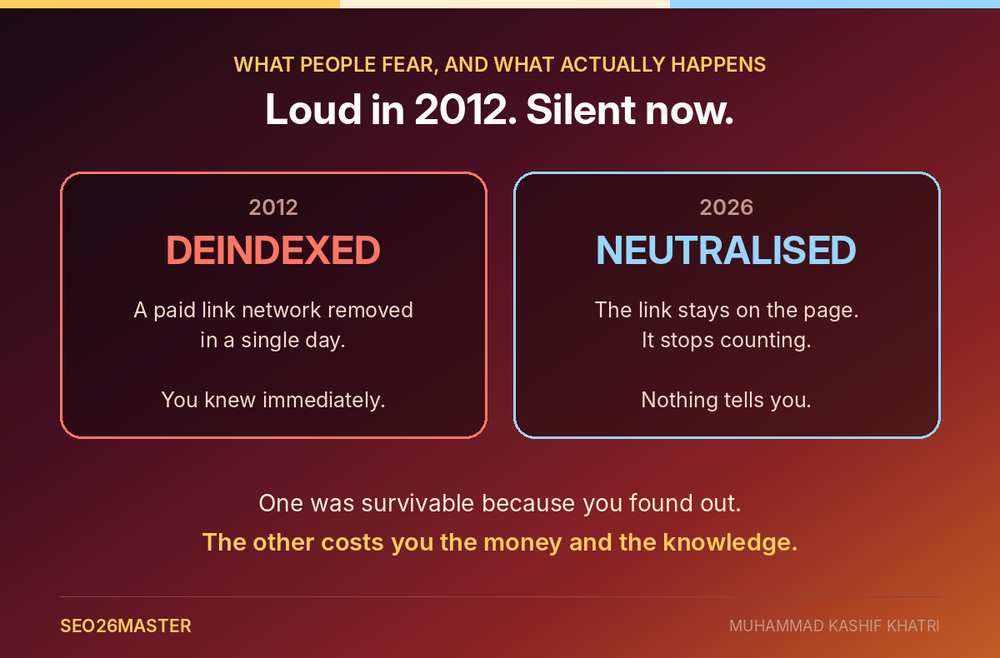
Neutralised, not punished. The link stays on the page. It still looks fine in your backlink tool. Your rankings do not collapse. The link simply stops counting, and nothing anywhere tells you that it has.
Nobody can tell you how often that happens, including Google, which does not publish it. What can be said is this. It is the one outcome you cannot detect, cannot appeal and cannot rule out. That makes it the one to plan around, whatever its frequency turns out to be.
You paid for an asset and received a decoration. There is no message, no recovery process, and no way to check, because Google does not publish which links it counts and never will.
That is the awkward part. You can check that a link is live. You can check that it is followed. You can check that Google has the page indexed. You cannot check whether it is being counted, and that is the one that decides whether your money did anything. I went through the first three checks, and why the fourth cannot be done, in how to check if a backlink is live.
The one time this market really did get hit
It is worth knowing what a penalty actually looked like, because it has happened, and because it explains why the outcome today is different.
On 19 March 2012 Google removed a paid link network called BuildMyRank from its index entirely. Not some of it. Google dropped what the company itself described as the overwhelming majority of the network, in a single day. Removed from the index means the pages stopped existing as far as Google was concerned, so every link on them stopped existing too.
BuildMyRank shut down that same day and offered refunds. What makes their closing statement worth reading is how honest it was. They had believed they were running a better quality service, something, in their words, "a bit different from other networks." Then they said plainly that "this was not the case."
Everybody who had bought links through them lost those links at once. Not quietly, not gradually. Overnight.
That is the scenario every page in this market is implicitly selling you protection from, and it is real. It happened.
But look at what has changed since.
In 2012 Google's main tool was people. Staff found networks and removed them, by hand, one at a time.
Today the main tool is SpamBrain, which is Google's own name for the machine learning system it uses to find spam. It does not work by hand and it does not need anybody to notice you. Google's description of the December 2022 link spam update says SpamBrain can detect "both sites buying links, and sites used for the purpose of passing outgoing links."
Both ends. The seller and the buyer. And what it does to what it finds is not removal. It is neutralisation.
So the 2012 scenario is the one people are sold protection from, and the 2022 mechanism is the one that is actually running. One was loud and survivable, because you knew immediately. The other is silent, and you may never know at all.
How big is the risk really
This is the question everybody wants answered with a number, and the honest reply is that nobody can give you one.
Here is why.
Google used to publish an annual report on how it fought search spam, with real figures in it. The last one was published in April 2023 and covered 2022. There has not been another one since.
So the most recent official enforcement data in this market is over three years old.
Worse, the number most commonly quoted is far older than people think. You will see "Google sent 4.3 million manual action messages" cited all over this subject, often attributed to 2019. It is from the 2015 report. It is a decade old.
Google did give one hard figure about links in that last report, and it is the one worth knowing:
we detected 50 times more link spam sites compared to the previous link spam update
Fifty times. That is not a measure of how many sites were punished, and it should not be read as one. It is a measure of how much better the detection got in a single cycle.
Which brings us back to neutralisation. Better detection does not mean more penalties. It means more links quietly not counting.
| What people quote | Where it actually comes from |
|---|---|
| 4.3 million manual action messages | Google's 2015 webspam report, often misattributed to 2019 |
| 0.22% of domains under manual action | A figure circulating since around 2013, with no clear primary source |
| 50x more link spam sites detected | Google's 2022 report, published April 2023, the most recent real figure |
| Current enforcement rates | Not published. Google stopped. |
Anybody telling you the risk is low has no data for that. Anybody telling you the risk is high has no data either. Including me. The difference is that I am telling you so.
The risk nobody prices in
Everybody in this market argues about the penalty risk. It is the wrong thing to worry about.
Here is the risk that actually costs people money, and it is not controversial at all.
In guest post pricing I went through two independent datasets covering around 300,000 websites. The average guest post is about $460.
Now put that next to neutralisation. If the link does not count, you did not buy a risky asset. You bought nothing, at full price, and you will never find out.
That is the outcome worth protecting against. Not a penalty. An invoice for a decoration.
And it stacks. A hundred placements at $460 is $46,000. If a meaningful share of those are sitting on sites Google already discounts, the money is gone and the reporting still looks healthy, because the links are all still there.
Where I draw the line, and why you should ask me about it
I sell placements. Here is what that means and does not mean, and you should hold every other seller to the same answers.
What I will not do. I will not tell you a followed paid link is within Google's guidelines, because the policy says in plain words that it is not. I will not guarantee rankings, and anybody who does is either lying or does not understand what they are selling. I will not sell you volume on sites I have not looked at.
What I actually think. The placements worth paying for are the ones that would still be worth having if the link carried no ranking weight at all. A real site, with real readers, where a mention puts you in front of somebody who might buy.
If a placement only makes sense because of the link, it is exactly the kind Google's systems are built to discount. The signals for spotting those sites are in how to spot a link farm.
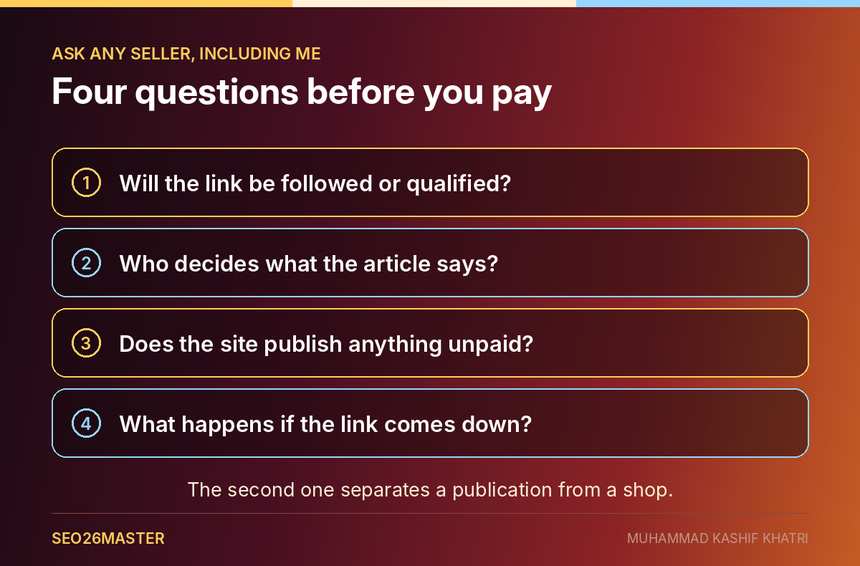
What you should ask any seller, including me. Four questions, and the answers tell you more than any price list.
| Ask this | A good answer sounds like | A bad answer sounds like |
|---|---|---|
| Will the link be followed, or tagged? | A straight yes or no, with no discomfort | Everything is editorial, or a change of subject |
| Who decides what the article says? | The editor does, and here is what they reject | You send us the text and the link |
| Does the site publish anything that is not paid for? | Yes, and here are recent examples | Silence, or a site where every post has a link out |
| What happens if the link comes down? | A stated policy, replacement or refund | It will not come down |
The fourth one matters more than people think. Links die, and the ones that pass value die fastest, which I went through in how to check if a backlink is live.
The second question is the one that separates a publication from a shop. If you write the article yourself and you choose the exact words the link sits on, there is no editor anywhere in that process, whatever the invoice calls it.
My own prices are published on the pricing page rather than quoted on request, which is partly so that this conversation can start somewhere honest. What I actually do, and the publications I edit, is on the guest posts page.
If you are going to buy anyway
Most people reading this will buy links. I would rather that was done with the facts in hand than not.
Treat it as advertising, not as SEO. If the placement is worth the money because of the audience, the ranking question becomes a bonus rather than the whole case. That reframing removes most of the risk, because you are no longer paying for something Google has said it will discount.
Buy where the link is incidental. The best placements are on sites that would have mentioned you anyway. The worst are on sites that exist to mention anybody.
Check what you bought. Is it still on the page, is it still followed, and is Google still indexing that page. Three separate things, all of which fail quietly, and the whole check takes about thirty seconds a link.
Do not buy in bulk. Volume is how people end up on networks. Every seller offering steep bulk discounts is telling you that the marginal placement costs them almost nothing, which tells you what it is worth.
Be honest in your own reporting. If you are buying links, count them as marketing spend with an uncertain return, not as an asset on a balance sheet.
Do not panic and disavow. Google has a disavow tool, which lets you tell it to ignore specific links pointing at your site. If you have not been buying links, it is not part of routine maintenance and Google has said so repeatedly. Reaching for it because some tool labelled your links toxic usually makes things worse rather than better.
So, is buying backlinks safe
No, and that is the wrong question.
Buying followed links is against Google's stated rules. That part is not debatable and no seller can make it debatable, including me.
Whether you will be punished for it is unknowable, because Google stopped publishing the figures three years ago and nobody else has any.
But the outcome you should plan for is neither of those. It is that the link quietly does not count, you never find out, and the money is gone. I cannot tell you how often that happens and neither can anybody else. What I can tell you is that it is invisible, it has no appeal, and it is the one thing nobody selling links wants to lead with.
I sell them, and I just did.
Questions people ask
Is buying backlinks safe in 2026?
Buying followed links is against Google's spam policies, which list "buying or selling links for ranking purposes" as the first example of link spam. Whether it results in a penalty is unknowable from published data, because Google's last spam report was in April 2023. The outcome worth planning for is neutralisation, where Google simply stops counting the link and tells nobody.
Will Google penalise me for buying backlinks?
It might. It can also do something much quieter instead. Google's own wording for the December 2022 link spam update is that "ranking may change as spammy links are neutralized and any credit passed by these unnatural links are lost". That is the link being ignored, not your site being punished, and there is no notification when it happens. Nobody outside Google knows how the two outcomes are split.
Does paying for an editorial fee instead of a link make it safe?
No. John Mueller was asked in January 2021 what happens when a site owner charges for their time or for reviewing content and a link results. His answer was "that sounds like an unnatural link". What the invoice says does not change what it is.
Are paid links ever allowed by Google?
Yes, when they are qualified. Google states that buying and selling links is "a normal part of the economy of the web". It is not a violation when the link is for advertising or sponsorship and carries rel="nofollow" or rel="sponsored". You can pay for placement. You cannot pay for ranking credit.
How many sites get manual actions for links?
Nobody outside Google knows. The 4.3 million figure you will see quoted is from Google's 2015 report, not 2019 as is often claimed. Google has not published an annual spam report since April 2023. Any current number you are given is an estimate dressed up as a fact.
Is it safer to buy from an agency than a marketplace?
There is no published evidence either way, and every agency answering that question sells agency services. What is checkable is the site the placement goes on, not who sold it to you. Judge the site.
What happens to links that Google ignores?
Nothing visible. The link stays on the page. It still appears in your backlink tool. Your rankings do not drop. It simply stops passing value, and there is no report anywhere that shows you which of your links are in that state.
Should I disavow links I bought?
Usually not. Google has repeatedly said the disavow tool is not part of normal site maintenance and that most people reaching for it do not need it. If a link has already been neutralised, disavowing it changes nothing, because it was already counting for nothing.
Sources
- Google, Spam policies for Google web search
- Google Search Central Blog, How we fought spam on Google Search in 2022, April 2023
- Search Engine Roundtable, Google Says Paying For Content Review Or Time With Links Is Paid Links, 25 January 2021
- Search Engine Land, Google sent 4.3 million messages to webmasters, reporting the 2015 webspam report
Leave a Reply