

I checked what six live guidelines pages actually ask for. The numbers run from 400 to 2,000, one page caps you where another one starts you, and one contradicts itself.
Somebody sends you a brief. It says 1,500 words minimum.
Your argument is finished at 900. It is clear, it has a point, and there is nothing left to say that a reader would thank you for.
So you do what everyone does. You add a history section. You add a paragraph defining a term the audience already knows. You add three subheadings that restate the one above them. You hit 1,520 and you send it.
That piece is now worse than the one you had at 900, and the reason it got worse is a number somebody typed into a guidelines page.
How long should a guest post be?
As long as the argument takes, which in practice is usually between 800 and 1,500 words.
That is the honest answer, and it is not the answer most briefs give you. So before going further, here is what live guidelines pages actually ask for right now, quoted from the pages themselves.
| Site | What it asks for |
|---|---|
| WordStream | "1,500 words minimum (but don't add fluff if you don't hit that mark)" |
| Lilach Bullock, guidelines | "The completed post should be at least 600 words long" |
| Lilach Bullock, FAQ on the same page | "Usually 1,200 to 2,000 words" |
| Bristol Creative Industries | "around 500 words (or more) in length" |
| Varn | "around 500 words (or more) in length" |
| Social Media Today | "Avoid anything over 700 words and try to aim for the 400-700 word region instead" |
| Globital, a guest post service | "500 to 600 Words" |
Read that table twice, because three things in it matter more than any advice I could give you.
The range is 400 to 2,000. One site tells you not to go over 700. Another tells you not to come in under 1,500. Both are respectable sites giving advice to the same kind of writer about the same kind of post.
One page gives two different numbers. Lilach Bullock's guidelines say at least 600 words. The FAQ on that same page says usually 1,200 to 2,000. Nobody noticed the clash, which tells you how carefully these numbers get chosen.
And two of the pages carry the identical sentence, word for word. "Around 500 words (or more) in length" appears on two unrelated sites. That tells you how much of this guidance is written and how much is copied.
What is the minimum actually for?
Three things, and only one of them is about your reader.
The first is a belief about Google. Somebody at the site read that longer content ranks better, and turned that belief into a floor. Length and ranking do move together in studies, and the reason is simple. Thorough pieces take more words. The words did not make them thorough. A floor cannot work backwards and turn a thin argument into a deep one.
The second is billing. If the site sells placements by the word, or pays writers by the word, the number is a price and not a standard. This is more common than people admit, and it is why some minimums sit at suspiciously round and suspiciously high figures.
The third is triage. A minimum filters out people who were never going to put a day into the piece. Used this way it works, and WordStream's own parenthesis admits exactly that. "1,500 words minimum (but don't add fluff if you don't hit that mark)" is a site telling you the floor is a signal of effort rather than a measurement of quality. They wrote the escape hatch into the rule.
What does padding look like from the editor's side?
It looks like a piece that takes four paragraphs to say something, and it is one of the most reliable reasons a submission gets turned down.
I edit for ILLUMINATION and four other publications, so I read submissions rather than guess at them. Padding has a shape, and once you have seen it a few hundred times you stop reading for the argument and start reading for the filler. These are the five patterns that show up most:
The history section. An article about a tool that opens with how the category began in 2004. Nobody searching for the tool needed that.
The definition nobody asked for. A piece written for practitioners that stops to define its central term, because the term is a keyword and the paragraph is 80 words.
The restated subheading. Three H2s in a row that make the same point with different nouns. This is the clearest tell, because a writer who had more to say would have said something different.
The list that became prose. Four items that would have been four lines, expanded into four paragraphs with a transition sentence on each.
The summary of what you just read. A closing section that repeats the article, added because the article ended 200 words short.
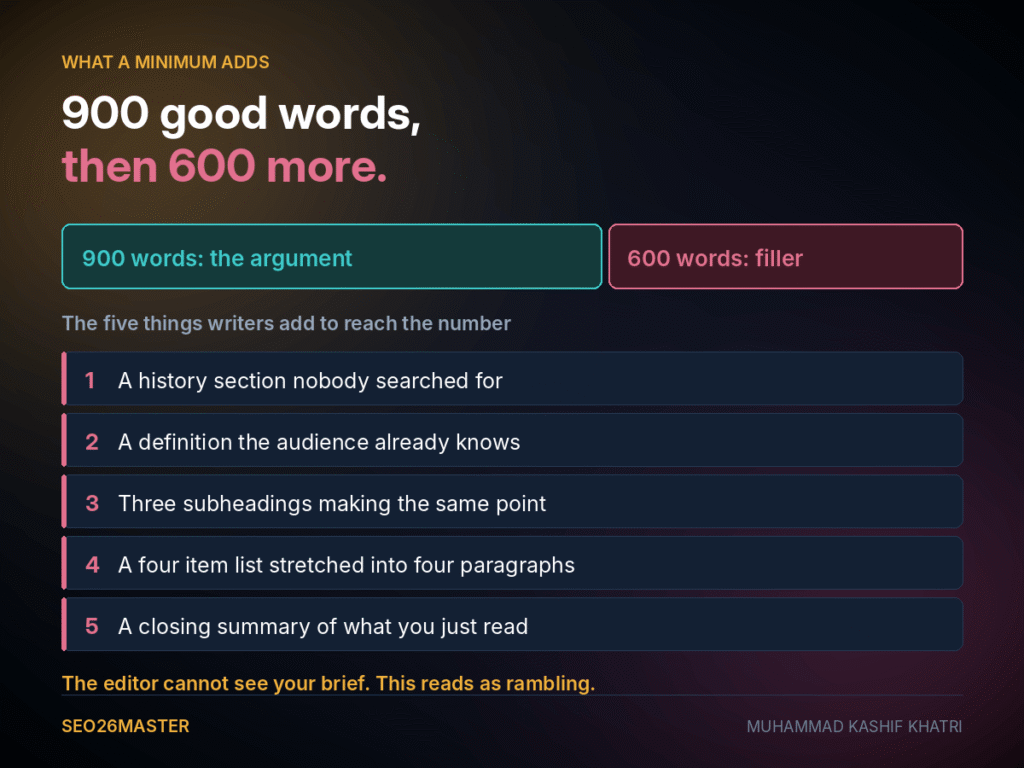
Here is the part worth sitting with. An editor cannot see your brief. We do not know that the site asked for 1,500 words, or that you wrote 900 good ones and then did your duty. We see a piece that rambles, and rambling reads as a writer who did not know what they were arguing. I wrote about the other reasons pieces come back in why guest posts get rejected, from the editor's side, and padding sits near the top of that list.
Does a longer guest post actually help your link?
Not in any way that survives the padding.
The usual argument is that a longer piece gets more depth, more subheadings, more internal relevance around your link, and therefore a better link. The first part is true of a genuinely deeper piece. It is not true of the same piece with 600 words of filler poured into it.
Filler does three things to the page your link sits on. It pushes your link further from the part a reader actually reads. It waters down what the page is about, because filler is always vaguer than the real argument. And it makes the piece less likely to be finished, which matters if you wanted the mention to do anything beyond existing.
There is also a quieter cost. A padded piece is less likely to be the one the host links to from somewhere else on their site, and a placement nobody links to tends to fade. That decay is worth understanding before you buy, not after, and it is the subject of what happens to a guest post six months after it publishes.
The other half of that link is the words you put on it. Padding pushes the link further down the page, but a badly chosen anchor can cause trouble on its own, and Google has published what it considers a bad one. I wrote that up in what Google’s policy says about guest post anchor text.
So what should you do when the minimum is too high?
Write the piece at its real length first. Then deal with the number.
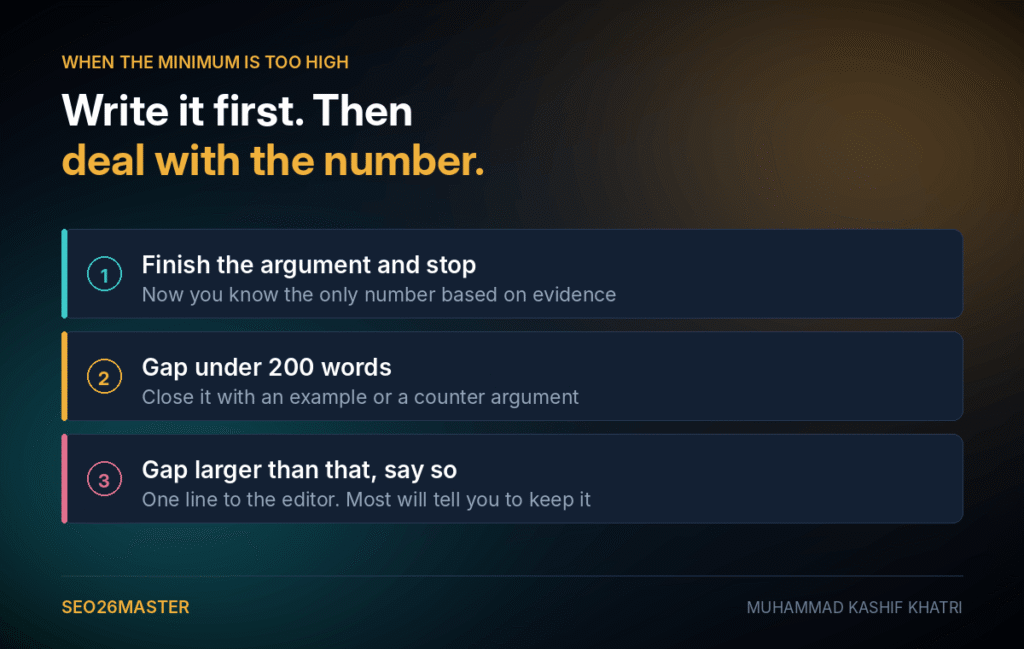
Finish the argument and stop. Write it as if no minimum existed. You now know the piece's actual length, which is the only number in this whole process that was ever based on evidence.
Compare the two figures. If the gap is small, say 200 words or less, close it with reporting rather than filler. Add an example, a counter argument, a short walkthrough. That is not padding. That is the thing the minimum was hoping for in the first place.
If the gap is large, say so. One line in the email. "This came in at 950 words because the argument finishes there. I can take it to 1,500 by adding a section on X, but I think it reads better without it. Your call." In my experience most editors say keep it. The ones who insist on the number have told you something useful about the site for free.
Count what the site actually publishes, not what it asks for. Open the three most recent articles and check their length. Plenty of sites ask for 1,500 and publish 800, because the guidelines page was written once in 2019 and nobody has looked at it since. This is the same reason it pays to read a site's recent output before you write for it, which is what I built Site Dossier to do in about twenty seconds. I built it, so weigh my opinion of it accordingly.
Never pad to hit a number you are paying for. If you are buying the placement, the minimum is a cost you are choosing to accept. You are paying for words that make your own page worse.
What this does not tell you
It does not mean short is good. A 400 word piece that asserts things without evidence is worse than a 1,800 word piece that proves them. Length is not the problem and brevity is not the virtue. The problem is a number chosen before the argument existed.
It also does not cover sites where the minimum is the actual product. Some placements are sold on length, the host knows it, the buyer knows it, and nobody is pretending the piece is editorial. That is a different transaction and this article has nothing useful to say about it.
And my sample here is six pages. Six. I picked them because they rank for this question today, not because they represent the market. The spread between them is wide enough to make the point, but a bigger sample would almost certainly find minimums both lower and higher than anything in that table.
The one sentence version
A word count minimum is a guess somebody made about length before they read your argument, and the honest move is to write the piece at the length the argument needs and then tell the host what you did.
If you would rather hand the whole problem to somebody who edits these for a living, that is what I do at SEO26MASTER content writing. Pieces come in at the length the argument takes, and I have the conversation with the host about the number so you do not have to.
Muhammad Kashif Khatri runs SEO26MASTER, builds Site Dossier, and is an editor at ILLUMINATION and four other Medium publications. He also sells guest post campaigns, which is a thing worth knowing while reading his opinion of guest post guidelines.
Leave a Reply