

Google names optimized anchor text in guest posts as link spam, and gives its own example of one. Not a single page ranking for this question quotes it.
The site writes back with the link already decided. They want the clickable words to be the exact phrase you are trying to rank for, sitting in paragraph two.
You have read enough threads to know this might be a problem. You have also read enough threads to know that nobody agrees on where the line is. One page tells you to keep exact match under 5 percent. Another says ratios are a myth. A third tells you to study your competitors.
So you guess, because guessing is what the available advice leaves you with.
Here is the odd part. Google wrote the rule down, published it, and gave an example. I read the pages currently ranking for this question and not one of them quotes it.
What does Google actually say about anchor text in guest posts?
It names the practice directly in its spam policies for Google web search, in the section on link spam.
The bullet reads: "Advertorials or native advertising where payment is received for articles that include links that pass ranking credit, or links with optimized anchor text in articles, guest posts, or press releases distributed on other sites."
Read the second half of that sentence again. Optimized anchor text in guest posts sits inside the definition of link spam, in Google's own words, on Google's own page.
Two phrases in there need translating, because the rest of this article depends on them. A link that "passes ranking credit" is an ordinary link, the kind that helps the page it points at. An "optimized" anchor is one chosen for the search phrase rather than for the reader.
Google even supplies an example of what it means. The page illustrates the problem with this sentence:
There are many wedding rings on the market.
The bolded phrase is the link. That is the shape Google is describing. A commercial phrase, dropped into a sentence that exists to hold it.
The same page also gives the way out. Buying and selling links is "a normal part of the economy of the web for advertising and sponsorship purposes". It stops being a violation "as long as they are qualified with a rel="nofollow" or rel="sponsored" attribute".
In plain terms, that is a small tag added to the link in the page's code. The reader never sees it. It tells Google the link was paid for, so the link stops passing credit and stops being a problem.
Some platforms decide this for you. Medium writes its own rel value on every outbound link, so the anchor is the only part you still control there. I checked the exact tag in are Medium links nofollow.
So is there a safe percentage?
No. Google has never published one, and the pages that quote percentages are quoting each other.
This matters, because it is the question everybody asks and it is the wrong one. Read the policy wording again. Two things decide it. Did money change hands, and is the link still helping the page it points at. The percentage of your links that use one anchor or another is not in that sentence at all.
To be fair to the pages ranking for this, the better ones say the same thing in their own way. One of them states plainly that there is "no universal, one-size-fits-all ratio" and tells you to stop chasing a magic number. That page is right. It just stops before the part that would help you, which is what the policy actually turns on.
So the useful question is not what percentage. It is this. Did somebody pay for this placement, and is the link still passing credit? If both are true, the anchor is the smallest of your problems, and swapping it for something vague does not fix anything.
What does an unpaid anchor actually look like?
I have a direct answer to this, because I built a tool that lists a site's outbound links together with the anchor text exactly as written.
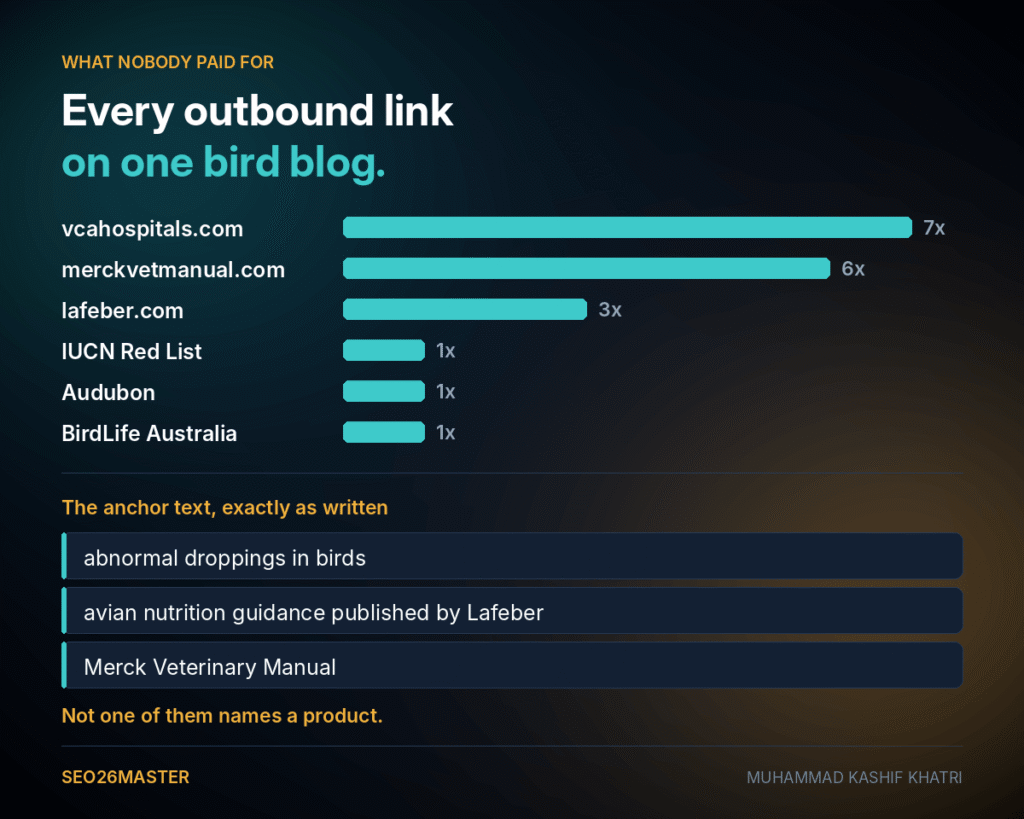
The first site I ran it on was a small blog about parrots and wild birds. Here is what its outbound links looked like.
The destinations were vcahospitals.com seven times, merckvetmanual.com six times, lafeber.com three times, plus the IUCN Red List, Audubon and BirdLife Australia.
The anchor text read like this:
abnormal droppings in birds
avian nutrition guidance published by Lafeber
Merck Veterinary Manual
Look at what those have in common. They describe the thing at the other end. The first one is a symptom a reader would actually be worried about. The second names the organisation and what it published. The third is just the name of the reference.
Nobody was paid for any of those. You can tell, and you can tell without a tool, because that is not how a bought link reads.
What does a paid one look like?
The opposite of all three, and the three usually turn up together.
The destination repeats. The same few commercial domains show up across unrelated articles, because the same few people are buying.
The anchor is a product phrase rather than a description. It names what someone sells, not what the page contains.
The sentence is built around the link rather than the other way round. Google's wedding rings example is exactly this, and once you have seen a few you stop needing the example.
This is the check I run before paying for a placement myself, and it is the one that tells you most about a site in the least time. I wrote the longer version of it up in how to vet guest post sites before you pay.
What do I use in my own placements?
Descriptive anchors and the brand name. Nothing else.
I published a placement on a friend's site this month and it carries two links. One anchor is "how to vet guest post sites before you pay", which is the title of the article it points at. The other is "Site Dossier", which is the name of the tool it points at.
Neither is a keyword I am chasing. Both tell a reader exactly where they are about to go. That is the whole job of anchor text, and it is the one part of it that has never changed.
There is a second reason I do it this way, and it has nothing to do with spam. A guest post on a stronger domain can outrank your own page for the phrase you put in the anchor. You can win the term and lose the page, which is a strange way to spend money.
What does an editor do with your anchor?
Changes it, cuts it, or publishes it and remembers you.
I edit for ILLUMINATION and four other publications, so this part I see from the other side. An anchor gets noticed when the sentence around it is doing nothing else. A paragraph that exists to hold a link reads differently from one that happens to contain a link. It is obvious in a way that is hard to describe until you have read a few hundred submissions.
What usually happens next is quiet. The editor does not write back to argue about anchor text. They either rewrite the sentence, drop the link, or publish it and think less of the next piece you send. None of those outcomes reach you as feedback, which is why writers keep doing it.
If you want the whole picture of why pieces come back, I wrote that up separately in why guest posts get rejected, from the editor's side.
What if the site asks you for an exact match anchor?
Then you have learned something about the site, and it is worth more than the link.
A publication with editorial control cares how the sentence reads. A site that specifies the anchor phrase in the brief is selling link placement, whatever the invoice calls it. That is not automatically a reason to walk away, but it changes what you are buying and it should change what you are willing to pay.
The practical move is to offer the descriptive version and see what happens. "I have linked it as the article title because that reads better in the sentence. Happy to discuss if you need something specific." The answer to that email tells you everything.
Watch for the pair. A site that specifies the anchor and also sets a minimum word count is usually running a price list rather than a publication. I wrote about the second half of that signal in why word count minimums quietly ruin guest posts.
If the same seller is also charging extra for a followed link, those two requests belong in one conversation. I covered that in dofollow or nofollow: what you are actually buying.
Before you send the draft
Four things, about two minutes.
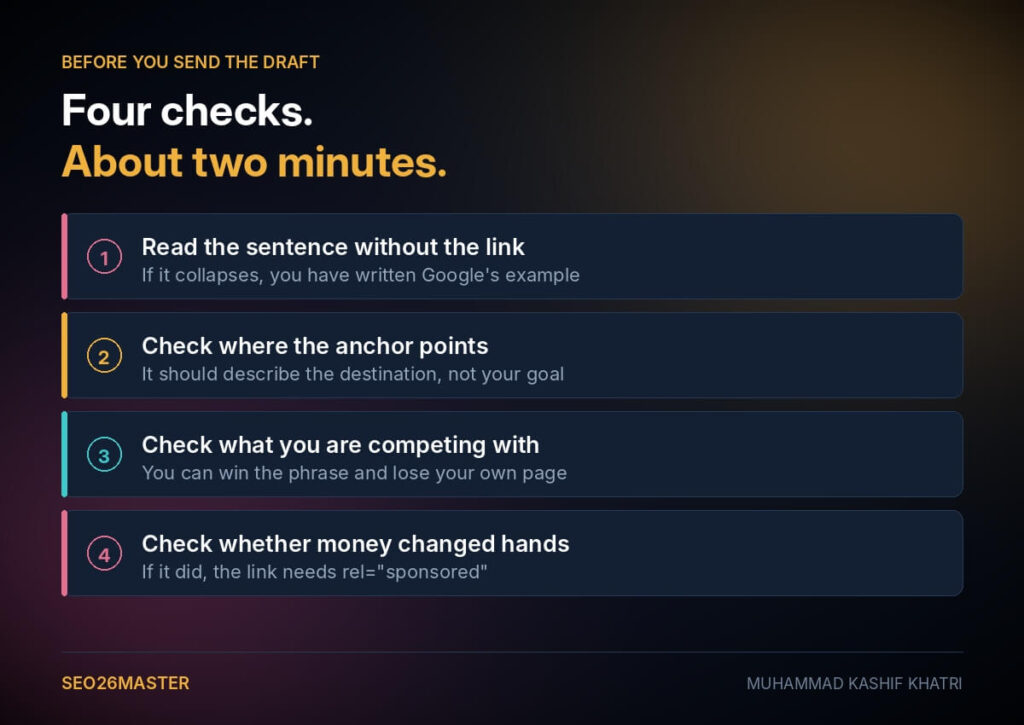
Read the sentence without the link. If it still says something a reader needed, the anchor is fine. If the sentence collapses, the link is the sentence and you have written Google's example.
Check where the anchor points. It should describe the page at the other end, not the phrase you want to rank for. Quite often those turn out to be the same words anyway, and then you have nothing to worry about.
Check what you are competing with. If the anchor is a phrase your own page ranks for, you may be handing that phrase to a stronger domain.
Check whether money changed hands. If it did, the link needs rel="sponsored" on it, and that is Google's own published position rather than my opinion.
What this does not tell you
It does not tell you what Google does in practice, only what Google says. Those are not always the same thing, and nobody outside Google can close that gap.
It does not cover links you did not place. A site can change your anchor after publication, add a rel attribute, or remove the link, and none of that reaches you unless you go and look. That is worth checking a few weeks after publication, along with whether the piece is still reachable at all, which I covered in what happens to a guest post six months after it publishes.
And my unpaid example here is one site. One. It matched what I expected to see, which is exactly the condition under which you should trust an example least.
The short version
Google has published the rule and an example of breaking it. The deciding factor is not the percentage of exact match anchors in your profile. It is whether the placement was paid for and whether the link still passes credit.
If you want to see a site's outbound links and the anchor text on them before you commit, that is what I built Site Dossier to show, and it is free. I built it, so weigh my opinion of it accordingly.
Muhammad Kashif Khatri runs SEO26MASTER, builds Site Dossier, and is an editor at ILLUMINATION and four other Medium publications. He sells guest post campaigns, which is a thing worth knowing while reading his opinion of guest post links.
Leave a Reply