
Your piece came back. The note said it was not a fit. You read it again and the research holds, the structure works, nothing is wrong with it.
That is usually because nothing was wrong with it.
I read submissions every week at ILLUMINATION and four other Medium publications. Most of what I return is competently written. The reason it comes back is almost never the writing.
The five reasons I return work most often are these. An image with no credit line. Two submissions on the same day. A title that promises more than the piece delivers. Private notes switched off in the writer's settings. The same story sent to two publications at once. Only the third of those is a judgement about the writing itself.
Each one takes about ten minutes to fix. Nobody tells the writer which one it was.
Why is the advice about this always about pitching?
Because almost all of it describes a different process.
Search this topic and you get advice about cold email. Subject lines. Follow-up timing. How to prove you read the blog. That advice is sound for what it covers, which is sending an idea to a site that does not know you.
A submission is not that. On a Medium publication you are made a writer first, then you send the finished draft. There is no pitch. The editor opens the piece and decides.
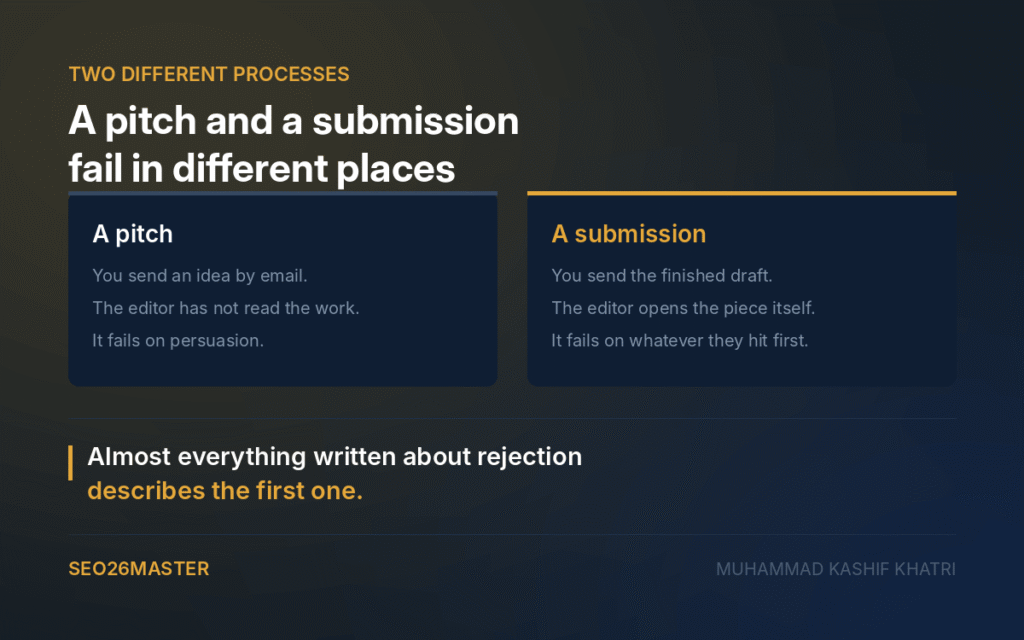
That difference moves where things fail. A pitch fails on persuasion. A submission fails on whatever the editor hits while reading, and that is often not a sentence at all.
One note on the numbers you will see quoted. The figure that editorial rejection rates rose 33% comes from a link-building marketplace's outreach benchmark, republished by a link-building agency. No sample size is given. No methodology is published. It may well be true. It is not evidence from editors, and I have not found any that is.
What are the five reasons work comes back?
An image with no credit line
Most publications ask for a caption crediting the source under every image. It is a one-line fix, and it is the single most common reason I return otherwise good work.
Worth being precise about where this rule sits. Medium itself does not require image captions. Individual publications do, and most of the larger ones put it in their guidelines. Check that line first when you submit somewhere new.
The writer who used their own photograph gets caught as often as the writer who did not. There is no way for me to tell them apart.
Two submissions on the same day
Publications that take a high volume set a daily limit, so that one writer cannot fill the queue.
Send three pieces in a day and two come back, whatever is in them. The writer sees three decisions. Only one was made.
A title that promises more than the piece delivers
This one is a real editorial judgement, and it is the one writers argue with.
If the title says you tested something, and the piece summarises what other people found, I return it. Not because the summary is weak. Because the reader who arrived from that title has been promised something the piece does not give them.
Private notes switched off
This is the one that quietly costs people the most, and almost nobody knows it exists.
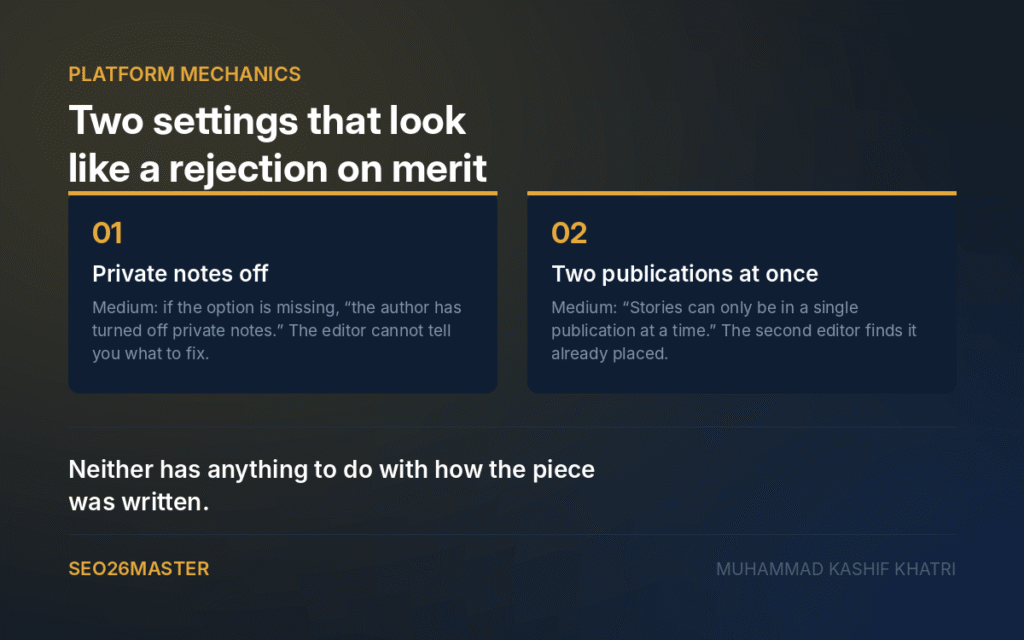
Medium lets you turn off private notes in your settings. If you have, an editor cannot leave a note on your draft. Medium's own help page says it plainly: if the option to leave a note is missing, "the author has turned off private notes."
So an editor who wants to say "change the title and send it back" has no way to say it. The writer gets a rejection with no explanation, and draws the obvious conclusion about their work.
The same story sent to two publications at once
This is platform mechanics, and it catches careful people.
Medium's documentation states it directly: "Stories can only be in a single publication at a time."
Send the same draft to two publications. One accepts it. The second editor now opens a story that is already placed, and there is nothing for them to do but return it.
The writer ends up with an acceptance and a rejection on the same piece, and no reason to connect the two.
Is the writing ever the problem?
Sometimes, and I should not pretend otherwise.
A piece that covers four things adequately instead of one thing properly comes back. So does a piece assembled from what is already available elsewhere, however well assembled, because a reader has no reason to prefer that version over the original.
Those are real editorial decisions. They are the ones worth arguing with.
But they are not most of what I return. And they are not what writers assume happened. Nearly every writer who asks me why their piece came back has already decided it was the writing.
What should you check before you submit?
Five things. None of them require you to change a word.
Open your Medium settings and confirm private notes are on. If they are off, no editor can tell you what to fix.
Read the publication's guidelines for two lines: a submissions-per-day limit, and whether an image credit is required. Both are usually near the top.
Check that nothing else of yours is sitting in another publication's queue. If it is, wait for that decision before you submit anywhere else.
Read your own title against your own piece. If the title claims first-hand work, the piece needs first-hand work in it.
Then submit once, to one publication, and wait.
What this does not tell you
I read for five publications, and this is what I see in those queues. Editors elsewhere have different rules, different limits and different tolerances. I cannot tell you which of these apply where you are sending work.
The two Medium mechanics hold anywhere on the platform. The editorial judgements are mine.
What I can tell you is this. If your work keeps coming back and you cannot see what is wrong with it, the answer is more likely to be on this list than in your sentences. That is better news than it sounds, because everything on the list is fixable in an afternoon.
The five publications I read for are listed on the publications page, with what each one takes. If you want pieces written to clear an editorial bar rather than fill a slot, that is what the content writing work is.
Related: What happens to a guest post six months after it publishes
Muhammad Kashif Khatri is an editor at ILLUMINATION and four other Medium publications, and reads submissions every week.
Sources
Leave a Reply