
You searched for sites that accept guest posts. You got lists.
Three hundred websites. Four hundred websites. Five thousand websites, free, just leave your email.
Open two of them and the same names start appearing. I compared the two biggest ones ranking for this search, and Money Crashers and Business 2 Community sit on both. The lists copy each other, because the easiest way to write a list of five hundred sites is to read somebody else's list of four hundred.
A guest post, if the term is new to you, is an article you write and somebody else publishes on their site. There is usually a link back to yours somewhere in it.
This article is not another list. It is the method I use to find sites that accept guest posts, and it finds sites that no list has, which is the entire point.
First, the part nobody writing those lists wants to explain.
What is actually wrong with the lists
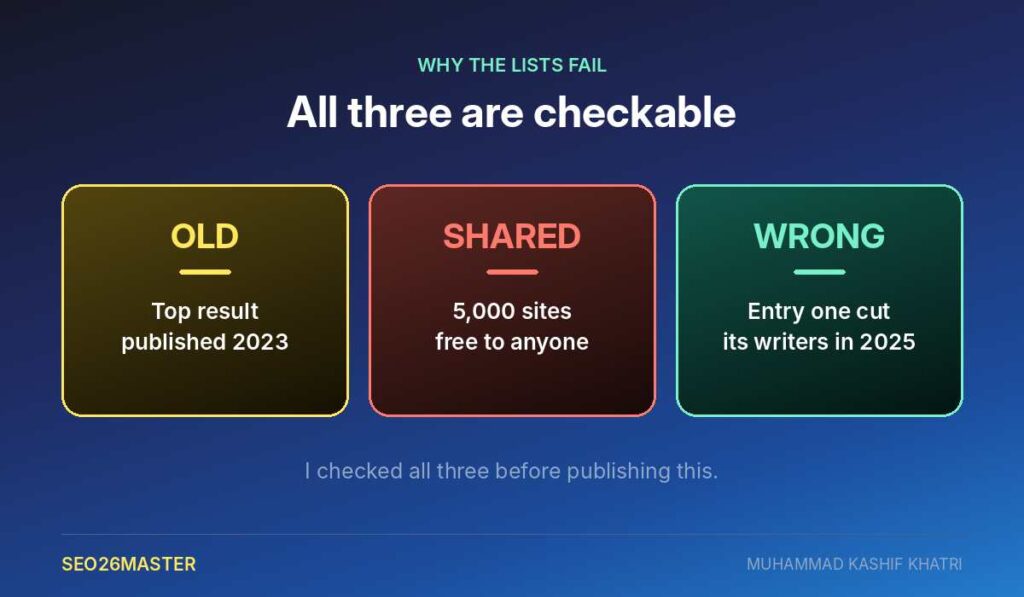
Three things, and all of them are checkable in a few minutes. I checked them before writing this.
They are old
The page sitting at the top of this search result for me was published on 1 May 2023. It carries no update date. Its title promises more than three hundred sites. Count the rows and there are about 276, and several sites appear in more than one table, so the real number is lower again.
The page is honest about one thing, to its credit. It warns that the sites listed "might have changed the rules and guidelines." That sentence is doing a lot of work for a list that has sat untouched since 2023.
Another list ranking for the same search was published on 14 June 2026 and last modified on 12 October 2026. Inside the body, the text tells you these sites are worth pitching "in 2024".
The date on the page was refreshed. The content behind it was not.
They are shared
This is the part that matters most and it gets no mention anywhere.
One of those pages offers a free list of more than five thousand websites in exchange for your email address.
Think about what that means. Every person who wanted a shortcut this year has the same five thousand sites you have. They emailed the same editors. They used the same template. The editor at site number 412 has now received the same pitch four hundred times.
A list is not a secret. A published list is the opposite of a secret. The moment a site appears on a popular list, it stops being an opportunity and becomes a queue.
They are wrong
The list I mentioned opens with Forbes.
In the week before 8 December 2025, Forbes cut dozens of contributing writers. Profiles across the site were updated to read "former contributor." A Forbes spokesperson described it this way.
"As part of this routine process, we are ending contracts with some of our contributors."
The same spokesperson added that Forbes had welcomed more than two hundred new contributors that year, so the programme has not vanished. But it is smaller than it was, and contributors there are signed to contracts. It is not a place where an unknown writer sends a cold email and gets published.
That is entry number one on the list that ranks first. Nobody checked.
Why nobody checks
It is worth understanding the business behind these pages, because it explains why they will never improve.
A list of five thousand sites is not content. It is bait. You hand over an email address and you receive a spreadsheet, and the spreadsheet cost the publisher nothing after the first time they assembled it.
Checking five thousand sites, on the other hand, would cost somebody weeks of work every year. Nobody is going to do weeks of work to improve a free giveaway that already converts.
So the incentive runs the wrong way. The list gets longer, because a bigger number makes a better headline. It does not get checked, because checking does not make the number bigger.
That is not a criticism of any particular writer. It is just the shape of the thing, and it is why the method below will always beat the download.
The method that works instead
Here is the idea the lists are built to avoid.
Any site that has ever published a guest post has left a trace of it in its own words, somewhere on the page. Authors get introduced. Bylines get explained. Editors write little lines like "this is a guest post by" and then a name.
Those phrases are searchable. So instead of looking for lists of sites that accept guest posts, you look for the sentences those sites have already written. Because almost nobody searches this way, what you find is not in anybody's queue.
The search that does most of the work
Type this into Google, replacing the subject with yours.
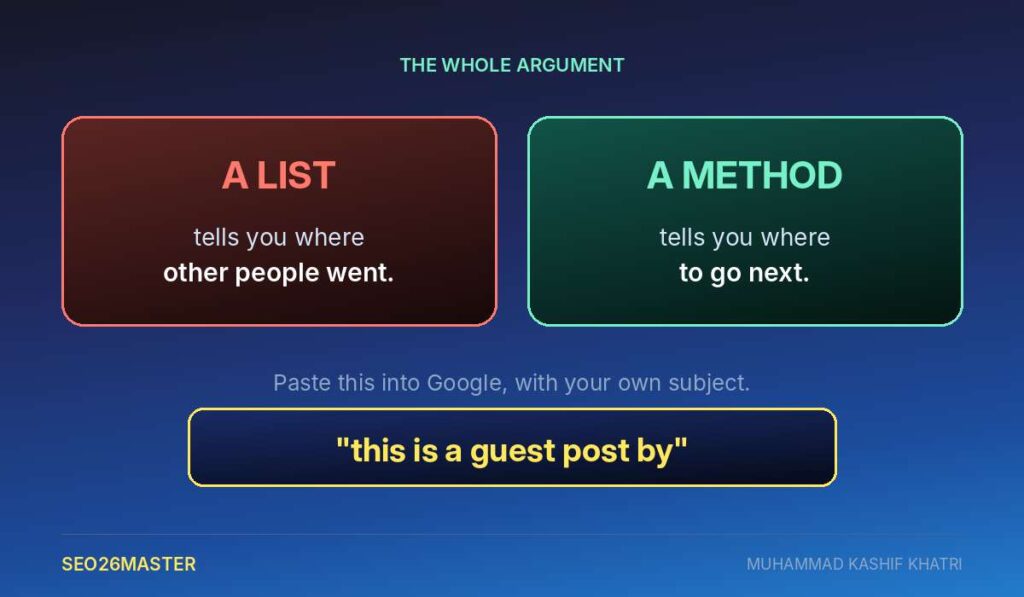
"this is a guest post by" your subjectI ran that search for email marketing before writing this, so what follows is a real result rather than a claim. Email marketing is a crowded, competitive subject, which is the point of choosing it.
The search took about ten seconds and returned six candidates. Then I opened all six, which is the step this whole article is about, and here is exactly what I found.
Campaign Monitor has a live page asking for guest contributors. It wants at least 1,500 words, written for a consumer marketing audience, with at least three links out to sources and no more than one link back to you.
SendPulse publishes contributor guidelines. At least 1,500 words, the topic agreed with an editor before you write, a maximum of three links including the one in your bio. The page also states plainly that there are no sponsored articles on the blog, which tells you a great deal about the publication in one sentence.
Postalytics explains how to submit by email, asks for original work of 1,500 words or more, and allows one link in the article and one in your author bio. Review takes up to two weeks.
AWeber runs a submission form. It asks for your idea first and specifically tells you not to send a finished draft. That is the opposite of what most publications want, and it is exactly why you read the page before you write anything.
SmartrMail had guest post guidelines when the search indexed them. The page is gone now and the address lands on the blog index.
EmailOctopus was a false positive. The search matched a blog article, not a contributions page.
So four of the six were real, current opportunities. One had quietly closed. One was never what it looked like.
That is worth saying out loud, because it is this article's own argument landing on this article. Even a search you ran yourself ten seconds ago needs checking before you act on it. The difference is that checking six results takes four minutes, and checking five thousand does not happen at all.
Four live publications inside one subject, each with its rules written down, found in under five minutes. Not one of the six appears on either of the two big lists I examined.
Now do the same with your own subject. If you sell accounting software, the phrase stays the same and the subject becomes accounting. If you run a dental practice, it becomes dentistry. The phrase does the work, not the industry.
Four more phrases worth trying
Each of these catches a different kind of site, because different publications phrase the same thing differently.
"guest contributor" your subject"contributed by" your subject blog"guest author" your subject"write for us" your subjectUse the last one knowing what it is. A site with a write for us page is advertising, which means everybody has already found it. It is still worth collecting, because advertised pages tell you the rules in plain language. Just understand that you are joining a queue there, and that the first three phrases are where the quieter opportunities live.
Find where your competitors were published
This one takes longer and is worth more than all the others combined.
Pick three companies that sell something close to what you sell. Search each one like this.
"guest post by" competitor name"contributed by" competitor nameWhat you are looking for is not the article. It is the publication. A site that published somebody in your industry will publish somebody else in your industry, and it has already proved it. No list can tell you that.
This also tells you something a list never will, which is whether a publisher takes money. A competitor scattered across twenty unrelated sites in a few months bought those placements. A competitor who appears on three sites that all cover your industry properly earned them, and those three are the ones worth your time.
The thing to check before you pitch anything
A site that accepts guest posts is not the same as a site worth being published on.
Plenty of the pages you find with these searches will be places you should walk away from. The write for us page I came across while testing the interior design version of this search belonged to a music and celebrity news site. It had added a home decor section and a page inviting home decor writers. It offers two links, pays nothing, and asks writers not to be promotional while offering them a link in the bio.
That is not a design magazine. That is a music site renting out a corner.
Before you pitch, run the checks. Three of them are quick. Look at what the domain used to be, count how many different subjects it publishes, and see where the commercial links in its articles point. There are six checks in total, each tied to a line Google has published, and I went through all of them in how to spot a link farm.
If running those checks by hand across a list of candidates sounds slow, it is. I built a free guest post site checker to do the slow parts. It reads up to 60 of the site's recent articles, tells you how many are actually in your niche and when the last one ran, groups the commercial links going out of those articles by where they point, and shows you the anchor text exactly as written. No signup.
How to read a contributions page properly
Once you have a candidate, its guidelines page tells you more than most people take from it. Four things are worth finding before you write anything, and a fifth is worth noticing by its absence.
What they say about links. Look for the exact number and the exact place. "Up to two links in the body" is a different offer from "one link in your author bio". A bio link sits at the very bottom in a small block most readers never reach. A link inside a sentence is read. The two are not worth the same and the guidelines page tells you which one you are getting.
What they say about promotion. Almost every page bans promotional content. Read it as a description of the article rather than a ban on mentioning yourself. You can cite your own data. You cannot write a sales page.
Whether they pay. This is the most useful signal on the page and it points in both directions. A site that pays writers has an editor and a budget, which means a real publication. A site that charges writers is selling placements, whatever the page calls it. A site that does neither is the ordinary case and tells you nothing either way.
When the guidelines were last touched. If the page still refers to a year that has passed, or names an editor whose email bounces, the programme may have quietly stopped. Check the blog for a recent contributed article before you spend an evening writing.
There is a fifth thing to look for and it is usually absent. Almost no contributions page tells you whether your link will be followed or tagged. That silence is normal. It also means you cannot promise yourself anything about the link before publication, which is a good reason to pick publications whose readers you want rather than publications whose scores you want.
What to actually send
Finding the site is half of it. I spend a lot of my week on the other half. I am an editor at ILLUMINATION on Medium, which has 324,000 readers, and at four other publications. Submissions arrive every day and most of them are turned down in under a minute.
Here is what the rejections have in common.
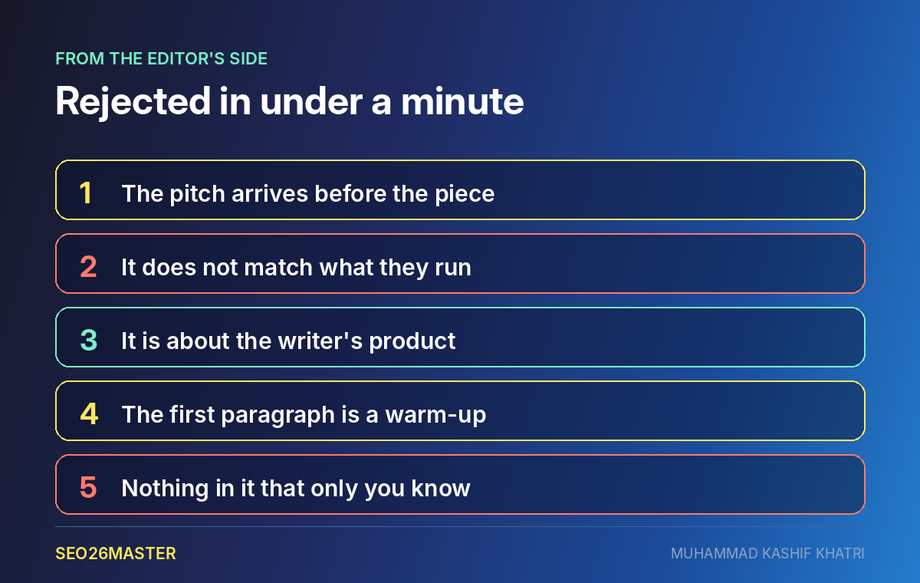
The pitch arrives before the piece. An editor's problem is almost never a shortage of ideas. It is a shortage of things ready to publish. A finished article that fits beats a brilliant idea that has not been written, every time, and it is not close.
It does not match what the publication runs. Every rejected piece I see could have been checked against five recent articles in two minutes. Most were not.
It is about the writer's product. A piece that explains why the writer's software solves everything is an advertisement. Editors recognise it in the first paragraph because it is the most common thing they receive.
The first paragraph is a warm-up. Three sentences of throat clearing before the point arrives. An editor reads the first paragraph and stops. That is the whole review.
There is nothing in it that only this writer knows. A number, a result, a mistake, a thing you tried that failed. Anything that could not have been assembled from the first page of search results.
The opposite of all five is a short note, a finished article attached, in the publication's subject, with one fact in it that the editor has not read somewhere else that week. That gets opened.
The note itself
Here is the shape that works. It is short on purpose.
Subject: Submission: [the article's actual title]

Hello [editor's name],

I read [specific recent article on their site] and noticed you had not
covered [the specific gap].

I have written that piece. It is attached, 1,400 words, and it includes
[the one specific thing: a figure, a test you ran, a result].

If it is not right for you, no reply needed.

[Your name]
[One line on who you are and why you would know this]
Four things are doing the work there and each one is a decision.
The subject line says submission, not pitch. An editor sorting a full inbox is deciding what is work and what is reading. A finished piece is reading.
The first line proves you opened the site. Naming one recent article takes two minutes and it separates you from every templated email that week. This is the single highest return sentence in the whole message.
The article is attached, already written. This is the part people argue with and it is the part that matters. Yes, you might write something nobody takes. You will also get read by editors who would never have replied to a question.
You give them an exit. "No reply needed" sounds like you are giving something away. What it actually does is remove the social cost of ignoring you, which makes people more willing to open the message in the first place.
What is absent matters too. No flattery about their wonderful blog. No paragraph about your company. No mention of links anywhere, because the moment links appear in the email you have told the editor what the article is really for.
Keep your own list, and keep it honest
The irony of this article is that you will end up with a list. The difference is that it will be yours, it will be small, and you will know when each line was last true.
Six columns are enough.
Site. The domain.
Found by. Which search turned it up. You will quickly see which phrase works best in your subject and you can stop running the others.
Date checked. The single most important column, and the one every published list is missing.
Last article published. Open the blog and write down the date of the most recent post. A publication that last published four months ago is not going to answer your email.
Niche match. How many of the last ten articles are in your subject. If the answer is under three, the site is not really in your field, whatever its categories say.
Outcome. Pitched, published, ignored, declined. After twenty rows this column starts telling you which kinds of site say yes to you specifically, which no list can ever know.
Thirty lines kept properly is worth more than five thousand lines downloaded. You will also watch your own rows go out of date within months, which is the fastest way to understand why somebody else's list of five thousand was never going to work.
What this costs if you decide to buy instead
Some people reading this will decide the search work is not worth their time and will pay somebody. That is a reasonable decision, and you should make it knowing the real numbers rather than the ones in a sales email.
A pricing study covering 52,671 websites, published in 2026, put the average paid guest post at $459.
The figure that matters more is this one. In the same dataset, the average asking price was $929 and the average price buyers actually paid was $207.
Sellers ask roughly four and a half times what people pay. The first number you are quoted is an opening position, not a price.
There is a second cost nobody mentions. These links do not last. A study that tracked more than 865,000 links found at least 31% already gone, and on the weakest sites only about a third were still working at all. The cheapest placements die the fastest, which means the cheap option was never cheap. It was temporary.
I went through which of the two main products is worth paying for and why in niche edits vs guest posts.
The rule that decides whether any of this is allowed
This part gets skipped in every list and it should not be.
Google's spam policies name this directly. One term in the sentence below needs translating first. Ranking credit is the boost a link is supposed to pass to the page it points at, which is the thing being bought and sold in the first place.
"Advertorials or native advertising where payment is received for articles that include links that pass ranking credit, or links with optimized anchor text in articles, guest posts, or press releases distributed on other sites."
The words "guest posts" are in Google's own sentence. Paying for a placement whose link passes ranking credit is a policy violation.
The same documentation also says this, which almost nobody quotes.
"Google does understand that buying and selling links is a normal part of the economy of the web for advertising and sponsorship purposes. It's not a violation of our policies to have such links as long as they are qualified with a
rel="nofollow"orrel="sponsored"attribute value to the<a>tag."
Those tags are two words a publisher can add to a link in the page code. They are invisible to a reader and they tell Google not to pass ranking credit through that link.
So paying for a placement is allowed. Paying for one that passes ranking credit is not. A tag nobody can see is the entire difference between the two.
This is exactly why the search method matters more than the list. A piece you wrote, that an editor accepted because it was good, carries no payment and breaks nothing. The moment money changes hands for the link itself, you are in the other category, whatever anybody calls it.
The full policy, line by line, is in what Google counts as a link scheme.
When a list is actually fine
I have spent most of this article arguing against lists, so here is the honest exception.
A list is useful as a starting vocabulary. If you have never done this and do not yet know what a contributions page looks like, open one of the big lists, click through fifteen sites, and read their guidelines. You will learn the shape of the thing in half an hour.
What you should not do is pitch from it. Use it to learn the format, then throw it away and run the searches, because the searches find sites that are not in anybody's queue.
The difference is the same one that runs through this whole subject. A list tells you where other people went. A method tells you where to go next.
The whole thing in one place
- Run
"this is a guest post by" your subjectand collect every publication that appears. - Repeat with
"guest contributor","contributed by"and"guest author". - Search three competitors with
"guest post by" competitor nameand collect the publications, not the articles. - Add the
"write for us" your subjectresults last, knowing those are the crowded ones. - Run every candidate through the checks before you write a word to anybody.
- Pick five. Read five recent articles on each. Write one finished piece that fits.
- Send the piece, not the pitch.
That is a week of evenings and it produces placements nobody sold you.
The sites that accept guest posts are not hiding. They are just not on the page you landed on when you searched, because that page was written once in 2023 and has been collecting email addresses ever since.
Questions people ask
Are free guest posting sites worth using?
Usually not, and the word free is the signal. A site that publishes anything from anyone, with no editor between the submission and the page, ends up producing pages at a volume Google has a name for.
"Scaled content abuse is when many pages are generated for the primary purpose of manipulating search rankings and not helping users."
The sites worth your time are the ones that might say no.
What about sites that accept guest posts for a fee?
A publication that charges the writer is not running a contributions programme, it is selling advertising space and calling it something else. That is allowed, as Google's own documentation says, provided the link is tagged. Paying for an untagged link that passes ranking credit is the thing the policy names.
How do I know a site accepts guest posts if it has no write for us page?
That is the useful case, and it is what the phrase searches are for. A site with no contributions page that has published three contributed articles this year clearly accepts them, it just does not advertise it. Those are the easiest publications to reach, because their inbox is not full.
How many sites should I pitch at once?
Five, properly, beats fifty with a template. The whole advantage of this method is that you found publications nobody is flooding, and a mass email throws that advantage away in one afternoon.
Do guest post links still work?
Matt Cutts, then head of Google's web spam team, wrote this on 20 January 2014.
"So stick a fork in it: guest blogging is done; it's just gotten too spammy."
The practice has been declared dead roughly once a year since, and it is still here. What actually ended was the easy version. A placement earned by writing something a publication wanted is a different object from a placement bought off a price list, even though both end with a link.
Should the link be nofollow?
In a Google hangout on 9 April 2020, John Mueller put it like this, as reported by Search Engine Journal.
"In general, with guest posts, you're the one placing the link essentially on another site."
"So I would recommend using nofollow for that."
In practice most publishers decide this themselves and will not negotiate it. If a seller is promising you a followed link in exchange for money, read the policy section above again.
What does Google say about this exactly?
The link spam section of Google's spam policies opens with a definition and then lists examples. Three of them touch this subject directly.
"Link spam is the practice of creating links to or from a site primarily for the purpose of manipulating search rankings."
"Buying or selling links for ranking purposes."
"Creating low-value content primarily for the purposes of manipulating linking and ranking signals"
Read the middle one carefully. It says buying or selling. The policy applies to the publisher taking the money as much as to the person paying it.
How long does this method take?
The searches take under an hour. Checking the candidates takes the longest, which is the part worth automating. Writing the piece takes as long as writing anything good takes.
Can I just pay somebody to do all of it?
Yes, and that is what I do for people. The guest post service runs exactly this method, including the checks, because I am not willing to put a client's name on a site I have not looked at properly.
Sources
- Google Search Central, Spam policies for Google web search, link spam section: https://developers.google.com/search/docs/essentials/spam-policies
- Press Gazette, Forbes cuts up to dozens of contributing writers, 8 December 2025: https://pressgazette.co.uk/north-america/forbes-cuts-up-to-dozens-of-contributing-writers/
- Matt Cutts, The decay and fall of guest blogging for SEO, 20 January 2014
- John Mueller, Google Search Central hangout, 9 April 2020, reported by Search Engine Journal
- Adsy, Link Building Pricing study, 52,671 websites, 2026
- Linkody, Link Building Statistics, 865,000 monitored links, 2026
Leave a Reply