
An email arrives. The site looks respectable. It has a logo, an About page, categories, a few hundred articles. The seller sends you a score and a price, and asks whether you want one link or three.
You open the site in a tab and stare at it. It looks fine. It also looks like every other site that has ever been described to you as a link farm.
So you are left with a question nobody answers properly. Every guide tells you that link farms are bad. Almost none of them tells you how to spot a link farm when it is sitting in front of you looking perfectly ordinary.
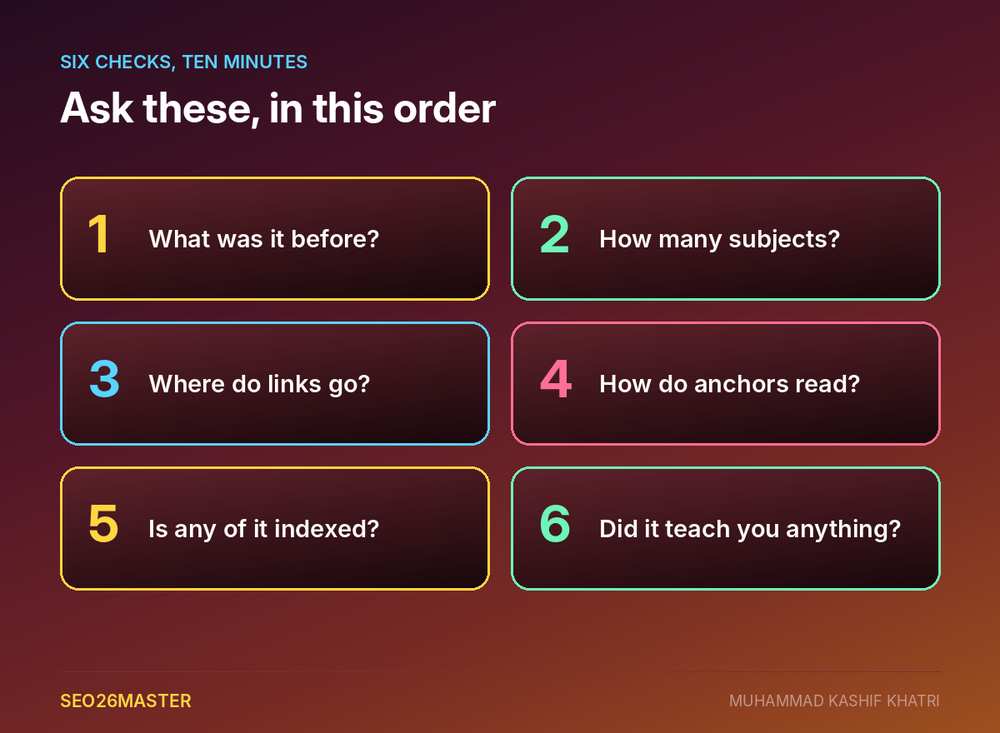
This article does that. Not with a feeling about the design, and not with a tool's score. With six checks you can run yourself in about ten minutes, each one tied to something Google has written down.
Before the checks, there is one fact that changes how you look at the whole problem.
The word Google never uses
Google publishes a page called spam policies for web search. It is public, anyone can read it, and it is the closest thing there is to the rulebook. Open it and read the link spam section line by line.
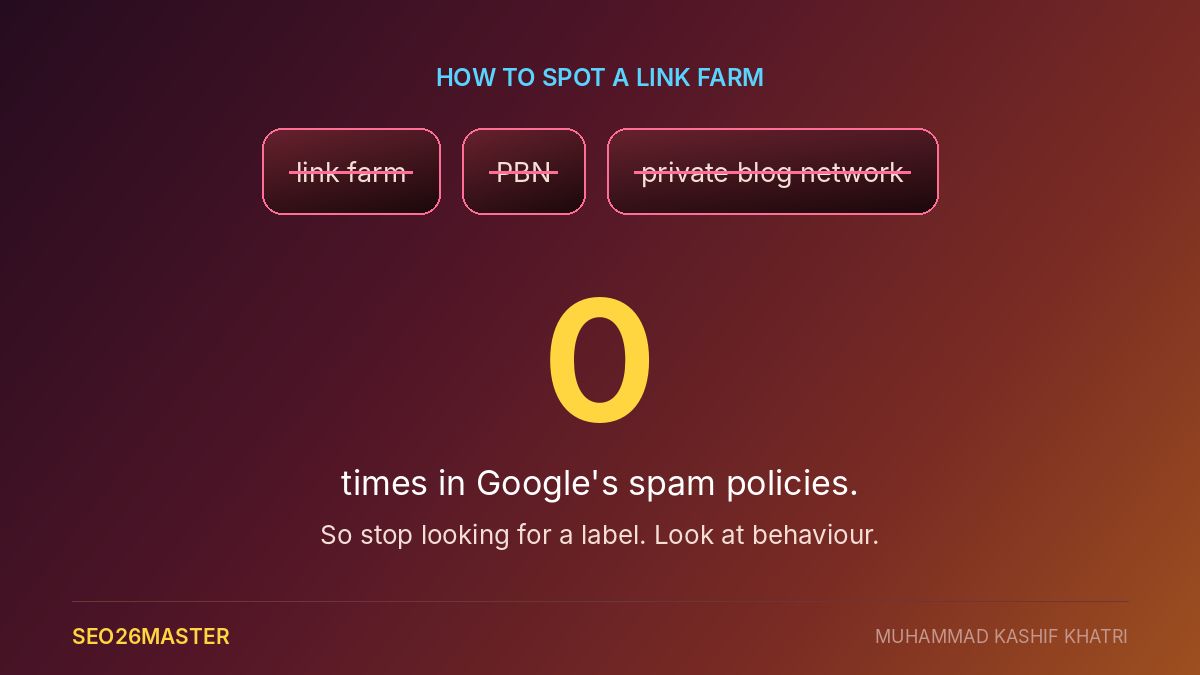
The phrase "link farm" is not there.
Neither is "link network". Neither is "private blog network", nor its short form "PBN".
Google's spam policies name eleven kinds of link spam, and not one of them is a label you can hang on a website. Every single one is a description of behaviour. Here are the ones that matter for this article, quoted exactly as Google writes them.
"Buying or selling links for ranking purposes."
"Using automated programs or services to create links to your site"
"Low-quality directory or bookmark site links"
"Widely distributed links in the footers or templates of various sites"
"Creating low-value content primarily for the purposes of manipulating linking and ranking signals"
Read that last one twice. It is the closest Google comes to defining the thing everybody calls a link farm, and it still does not name it. It describes what the site does.
This matters more than it sounds. Nearly every guide on this subject tries to teach you to recognise a category of website. Google does not grade websites by category. It looks at behaviour, and behaviour is something you can actually check from the outside.
So the real question is not "is this a link farm". The real question is "does this site do the things Google has written down".
That question has answers.
What a link farm actually is
A link farm is a website, or a group of websites, that exists mainly to carry links out to other people's sites. The payment is usually money, sometimes a link back.
Everything else about it is decoration. The articles exist so the links have somewhere to sit. The categories exist so the articles look organised. The About page exists so the site looks like a publication.
The oldest version was a page of nothing but links. That died years ago. The modern version looks like a real blog, publishes real sentences, and sells a link inside paragraph three.
That is the one you have to learn to see.
Why these sites exist at all
It helps to know where the whole business came from, because it explains why the sites keep changing shape.
Google was built on an idea published in 1998 by Larry Page and Sergey Brin while they were at Stanford. The idea was that a link from one page to another is a kind of vote, and that a page with many votes from important pages is probably important itself.
That idea worked. It also created a currency.
The moment links became worth money, somebody started manufacturing them. The first attempt was the crudest possible version, a page with five hundred links on it and nothing else. Google learned to ignore those quickly.
So the next version added paragraphs around the links. Google learned to spot those too. The version after that added a theme, categories, author names and a publishing schedule.
Each generation looks more like a real website than the last, because each generation was built by somebody who watched the previous one get caught.
This is the reason the old advice stopped working. Learning how to spot a link farm used to mean recognising an obviously bad website. Today it means checking behaviour, because the appearance has been fixed.
The six checks
Each of these is free. None of them needs a paid tool. Each one is tied to something Google has actually written.
Check 1: What was this domain before?
This is the strongest check in the article, and almost nobody runs it.
The Wayback Machine is a free archive that has been saving copies of websites for over twenty years. You can open any website as it looked on a date in the past.
Go to web.archive.org, paste the domain in, and look at what the site was three years ago. Then five years ago.
Say the site now publishes articles about SEO, crypto, casinos and weight loss pills. Say that five years ago it was a dental practice, or a school, or a small charity. You have not found a suspicious site. You have found a named Google violation. Here is Google's wording.
"Expired domain abuse is where an expired domain name is purchased and repurposed primarily to manipulate search rankings by hosting content that provides little to no value to users."
Google even gives examples:
"Affiliate content on a site previously used by a government agency"
"Commercial medical products being sold on a site previously used by a non-profit medical charity"
"Casino-related content on a former elementary school site"
That is the entire business model of most of the sites being sold to you. Somebody bought a domain that had already earned links over years of being something else, stripped it, and started renting out those old links to strangers.
The Wayback Machine shows you this in about twenty seconds. No score, no estimate, no subscription. You simply look at what the site used to be.
If the past does not match the present, stop there. Nothing else you check will make that acceptable.
Check 2: How many subjects does it publish?
Open the site's blog or category list and read the titles of the last thirty articles.
A real publication is about something. A trade magazine covers its trade. A personal blog covers whatever its author cares about, which is narrow in a different way. In both cases you can describe the subject in one sentence.
A link farm cannot be described in one sentence, because its subject is whoever paid last month. You will see an article about mortgages, then one about mobile games, then one about dental implants, then one about a crypto exchange, then one about garden furniture.
Google has a name for making pages at that volume without a reason.
"Scaled content abuse is when many pages are generated for the primary purpose of manipulating search rankings and not helping users."
Google lists examples, and one of them is worth reading carefully if you are judging a seller.
"Using generative AI tools or other similar tools to generate many pages without adding value for users"
Note what Google does not say. It does not say AI writing is the problem. It says generating many pages without adding value is the problem. A site can write by hand and still be doing this. A site can use AI and not be doing this. The test is the output, not the method.
Here is the practical version. Count how many of the last thirty articles are in your industry. If the answer is one or two, you are not buying a link from a publication in your field. You are buying a link from a rental shelf that happens to have your category printed on it this week.
Check 3: Where do the outgoing commercial links go?
Open five recent articles. In each one, find every link that points to a company rather than to a reference, a study or a news story. Write down where each one goes.
Then look at your list.
On a real publication, those links scatter. They point to sources, to studies, to tools the writer actually used, and occasionally to a company being discussed. They rarely repeat.
On a link farm, the list is a column of unrelated businesses, one per article, each in a different industry. Each one sits in a sentence that was clearly built around it.
Google describes this one directly. When Google announced its December 2022 link spam update, it said its spam system could now detect
"both sites buying links, and sites used for the purpose of passing outgoing links."
A site used for the purpose of passing outgoing links. That is a link farm, defined by Google, without the word.
If running this by hand sounds slow, that is because it is. I built a free guest post site checker that does the slow parts. It reads up to 60 of the site's recent articles, tells you how many are actually in your niche and when the last one ran, groups the commercial links going out of those articles by where they point, and shows you the anchor text exactly as written. No signup.
Check 4: Read the anchor text exactly as written
Anchor text is the visible words that a link is attached to. If a sentence says "we recommend this cheap car insurance in Texas" and those words are blue, that phrase is the anchor text.
Open the same five articles and read every anchor that points at a company out loud.
On a publication, anchors are the names of things. A company name. A product name. The title of a study. Sometimes just "according to this report".
On a link farm, anchors are search queries wearing a sentence. "Best cheap car insurance Texas." "Buy Instagram followers fast." "Affordable SEO services in Dubai." Nobody writes like that unless the phrase was supplied by the buyer.
Google names this in the same spam policy you read earlier. Two terms in it need translating first. An advertorial is a paid article dressed up to look like ordinary editorial writing. Ranking credit is the boost a link is supposed to pass along, the thing you were paying for in the first place.
"Advertorials or native advertising where payment is received for articles that include links that pass ranking credit, or links with optimized anchor text in articles, guest posts, or press releases distributed on other sites."
Optimized anchor text. Google puts the phrase in writing. The sentences around those anchors are usually the giveaway, because they bend awkwardly to fit the phrase in.
Check 5: Is anything on the site actually in Google?
This check takes thirty seconds and it ends a lot of conversations.
One word first. Google's index is the list of pages Google has copied and stored. If a page is in the index, Google can show it to somebody. If it is not, that page does not exist as far as Google is concerned, and no link on it can do anything for you.
So the question is whether the site you are being sold is actually in there. Google has a built in command for this, called the site operator. Go to Google and type this, with your seller's domain in place of the example:
site:example.comNow compare what you see to what the seller told you.
If the seller said the site has 2,000 articles and Google shows you 40 results, the rest are not in the index. A page that is not in Google's index cannot pass anything to you, no matter what you paid for it.
That count is an estimate, so do not treat it as exact. What you are looking for is the gap in size. Two thousand against forty is not rounding.
Then search for one specific article on the site by pasting an exact sentence from it in quotation marks. If Google returns nothing, that page is not indexed either.
This check is useful because it cannot be argued with. Metrics can be inflated. Traffic estimates can be wrong. Whether Google has the page is a yes or a no.
Check 6: Read one article properly
Pick the longest article on the site that is not about your industry, and read it to the end.
Ask yourself one question. Did it answer anything?
A real article makes a claim and supports it. It names a source, or a price, or a date, or a person. It tells you something its writer knew and you did not.
A link farm article circles. It restates the question in different words, lists general advice that would apply to anything, and finishes with a paragraph about how important it is to choose the right partner. There is no fact in it that could be checked, because checkable facts take work and the article was never meant to be read.
This is the plainest line in Google's whole list.
"Creating low-value content primarily for the purposes of manipulating linking and ranking signals"
If you finish an article and cannot name one thing you learned, you have your answer.
The checks that do not work
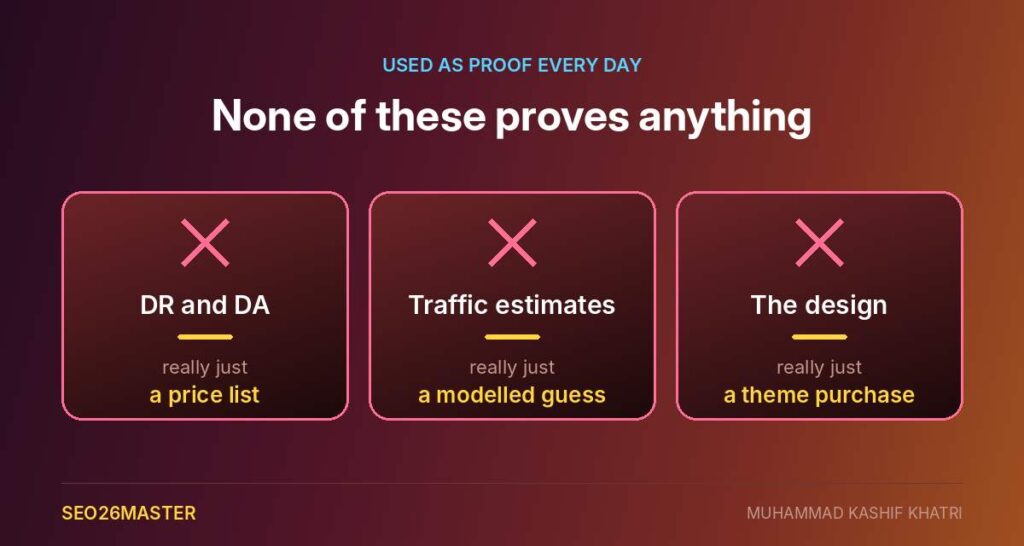
Three things get used as proof of quality every day. None of them proves what people think it proves.
Domain scores
DR stands for Domain Rating and comes from Ahrefs. DA stands for Domain Authority and comes from Moz. Both are scores out of 100, and both come from SEO companies, not from Google. Google has never published a score like this for any website.
They are built from the links pointing at a site. A site that has bought or inherited a lot of links scores well, which is exactly the situation you are trying to detect.
Worse, these scores are what the market prices on. In a pricing study covering 52,671 websites, published in 2026, sites with a domain rating of 1 to 30 averaged $332 per guest post, sites at 31 to 70 averaged $555, and sites above 71 averaged $2,025. Every ten points of domain rating added roughly 32% to the price.
So the number sets the price, and the number can be manufactured. That is not a quality signal. That is a price list.
If you want the longer version of this argument, I set out the five checks I actually run in what makes a backlink high quality.
Traffic estimates
Traffic estimates from SEO tools are calculated, not counted. Nobody outside a website can see its real visitor numbers, so these figures are software working out what the traffic probably is. They are useful for spotting a site with no traffic at all. They are not useful for telling a real publication from a well-fed farm, because a farm that ranks for a few hundred junk queries will show traffic too.
Use the site operator check instead. Indexing is a fact. Traffic estimates are a guess about a fact.
How the site looks
Every guide tells you to look for bad design, broken links and a missing About page.
Ten years ago that worked. It does not now. A clean theme costs almost nothing, an About page takes five minutes, and a plausible author bio with a photograph takes less. The sites you need to catch today are the ones that look completely normal, because the ones that look obvious have already stopped selling.
Design tells you how much the owner spent. It tells you nothing about what the site is for.
The hard case: sites that are half real
Most guides pretend every site is either a publication or a farm. In practice a large share of what gets sold sits in between, and these are the ones that cost people money.
Picture a regional news site that has been running for twelve years. It has real journalists, real local stories, and a real audience. Two years ago the advertising revenue fell and somebody in the office started accepting paid articles. Now it publishes four genuine news pieces a week and eleven paid placements about crypto exchanges and offshore clinics.
Is that a link farm? By any ordinary use of the word, no. It is a real publication. By Google's description of behaviour, part of it is doing exactly what the policy names.
Google has a term for this specific situation, and it is newer than most advice on the subject. In the sentence below, first-party content means the articles the site wrote for itself, and third-party content means the articles somebody else paid to put there.
"The site reputation policy applies where third-party content is published on a host site mainly because of that host's already-established ranking signals, which it has earned primarily from its first-party content."
Read that slowly. Google is describing content placed on a site because of the reputation the site earned doing something else. That is precisely what you are buying when you pay for a placement on a tired news site.
So how do you judge these?
Look at the ratio, not the label. Open the site's most recent twenty articles and sort them into two piles, the ones that look like the site's real subject and the ones that look paid. If the paid pile is bigger, the real subject is no longer what the site does. It is what the site used to do.
Then check where the paid articles live. A publication that is honest about this puts sponsored content in its own section, labels it, and does not let it sit in the news feed. A site that mixes them deliberately is not being careless. It is selling the confusion.
The honest summary is that these sites are a judgement call rather than a clear yes or no. What you can do is stop treating twelve years of history as proof that the last twelve months are fine.
What the seller tells you without meaning to
Before you check a single site, the sales process itself gives you most of the answer. These patterns are not proof on their own. Two or three together usually are.
They will not name the domain. The most common one. You are offered "DA 55, finance niche, real traffic" and the actual website only after payment or a deposit. There is one reason to hide the domain, which is that the domain does not survive being looked at.
The list is enormous. A spreadsheet with four hundred sites across every industry is not a publisher's catalogue. It is a reseller's inventory, and in most cases it is the same inventory everybody else is selling, which means your competitor can buy the same page.
Placement is instant. Real editors have a queue. If somebody can publish your article tomorrow on a site with twelve years of history, nobody is editing anything.
The price is tied to a score and nothing else. When every price on the list moves in a straight line with DR and nothing else varies, you are buying a number rather than an audience.
They guarantee the link is permanent. Nobody can guarantee this, because sites get sold, redesigned, cut back and abandoned. The survival figures later in this article show how often it fails. A guarantee against that is a sentence, not a protection.
They guarantee a ranking. The one promise that is never made honestly, by anybody, in any price bracket.
What actually happens if you buy from one
Most articles on this subject end with a vague warning about penalties. The honest answer is less dramatic and more annoying.
In December 2022 Google ran an update aimed specifically at link spam. It started on 14 December 2022 and finished on 12 January 2023, twenty nine days later. Google's own description of what it does is short.
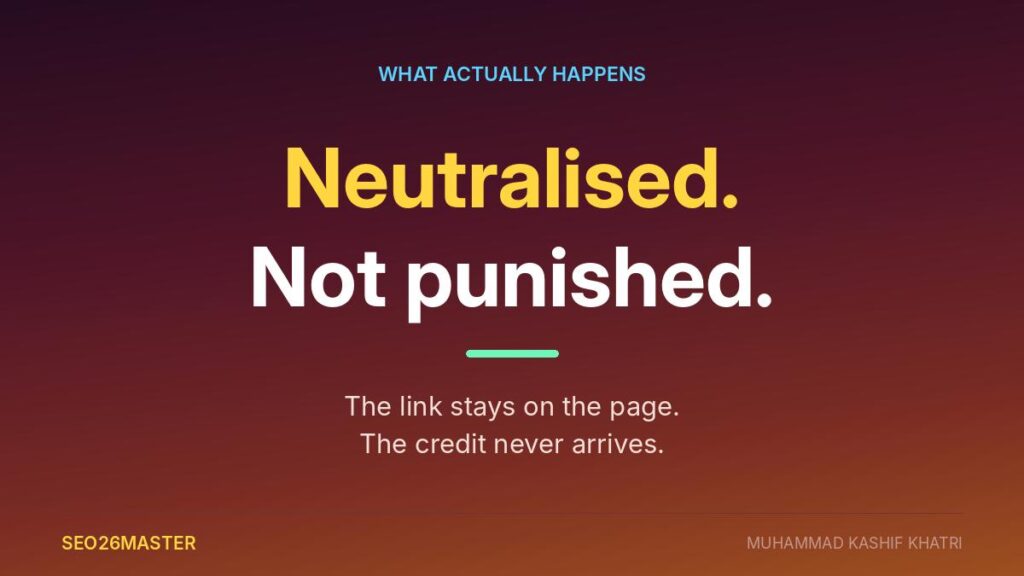
"Ranking may change as spammy links are neutralized and any credit passed by these unnatural links are lost."
Google's help documentation puts it even more plainly.
"when our systems nullify spammy links, the link credit that was previously generated is lost."
Neutralised. Not punished. The link keeps sitting there on the page, the invoice is still paid, and the thing you bought simply stops counting.
That is the normal outcome, and it is worth understanding because it explains why people keep buying. Nothing visibly bad happens. There is no email, no warning, no drop. There is just an absence of the result you were promised, which is very hard to tell apart from bad luck.
Manual penalties do still exist. A manual penalty is when a person at Google reviews your site and applies a punishment by hand, and you are told about it.
You find out in Google Search Console, which is the free Google tool that shows how your own site is doing in search. The page is called Manual actions. That same page is the only thing that settles whether you have any reason to touch the disavow tool, and almost nobody does.
There is a second cost that nobody mentions in the sales email. These links do not last. A study that tracked more than 865,000 links found at least 31% already gone, and on the weakest sites only about a third were still working at all. The cheapest links die the fastest. So the cheap option was never cheap. It was temporary.
What happened when a network got caught
This is not theory. It has happened, and the record is public.
BuildMyRank was a paid blog network that sold links across a large number of sites. On 19 March 2012, Google removed what the company itself described as an "overwhelming majority" of its network from search results entirely. Not demoted. Deleted from the index.
BuildMyRank shut the service down the same day and offered refunds.
The part worth remembering is what they wrote on their own blog afterwards. They had believed they would be left alone because they offered a "better quality service" that was "a bit different from other networks". Then came the admission, in four words, that every seller since has avoided saying.
"this was not the case."
Every network since has told its customers the same thing. Ours is different. Ours is curated. Ours has real traffic. Ours is safe.
It has been true for none of them so far.
If you already bought from one
Most people reading this have. There is a sensible order to work through, and it starts with doing nothing dramatic.
First, check whether anything actually happened. Open Search Console, go to Manual actions, and read what it says. If it says no issues detected, then no human at Google has looked at your site and decided anything about it. That is the only page that settles the question, it is free, and it takes thirty seconds.
Second, resist the urge to disavow. Disavowing means uploading a list of links to Google and asking it to ignore them. This is where people do real damage. Google's stated behaviour for these links is to neutralise them, which means the link already counts for nothing. Asking Google to ignore something that counts for nothing changes nothing, and the tool carries its own risk when it is used carelessly. I went through when it genuinely applies, and the two conditions Google requires, in the article on the disavow tool.
Third, write down which seller it was. Not for revenge. Because the same inventory gets resold under different brand names, and six months from now a different email will offer you the same sites with a new logo on the invoice. A list of domains you have already rejected is the most useful document in this entire process, and almost nobody keeps one.
Fourth, do not try to get the links removed. Writing to a hundred site owners asking for removal is weeks of work with a very low success rate, and it is not solving a problem that exists. If there is no manual action, there is nothing to clean up.
The money is gone. That is the actual loss, and it is survivable. The thing worth protecting from here is the next payment, not the last one.
The ten minute routine
Here is how to spot a link farm in the time it takes to make tea. The whole article, compressed into something you can run before you reply to an email.
- Paste the domain into web.archive.org. Look at it three and five years ago. If it used to be something unrelated, stop.
- Read the last thirty article titles. Count how many are in your industry.
- Open five recent articles. Write down where every commercial link goes.
- Read the anchor text on those links out loud. Do they sound like names or like search queries?
- Run site:thedomain.com in Google. Compare the count to what you were told.
- Read one full article. Name one thing you learned.
If checks 1, 2 and 3 all come back badly, you do not need checks 4 to 6. You already know.
Where this leaves the decision
Knowing how to spot a link farm does not tell you what to buy instead. It tells you what to stop paying for.
The uncomfortable part is that the answer changes with what you are buying. A link inserted into an old article and a new article written around your link are not the same product, and they do not carry the same risk. I went through that difference in detail in niche edits vs guest posts.
The rules themselves are worth reading once in full rather than in summary. I went through Google's link spam section line by line in what Google counts as a link scheme.
And if you have run these checks, found a publisher that passes all six, and want somebody to do the placement work, that is what I do. The guest post service is built on exactly these checks, because they are the ones I run before I will put anyone's name on a site.
Questions people ask
Is a link farm the same as a PBN?
In practice they overlap heavily, and Google's spam policies use neither term. A private blog network usually means a group of sites owned by one person, built to link to that person's own projects. A link farm usually means sites that sell links to anyone. The behaviours Google names, expired domain abuse and scaled content abuse and passing outgoing links, apply to both.
Can a link farm have real traffic?
Yes. A site publishing hundreds of articles a month will accidentally rank for something, and some farms buy traffic outright. Traffic does not make a site a publication. Ask what the site is for, not how many people landed on it.
Does one link from a bad site hurt me?
Usually it does nothing at all. Google's stated behaviour is to neutralise the link, which means it stops counting rather than counting against you. The real cost is the money, not the damage.
How long does it take to check a site properly?
The six checks above take about ten minutes by hand. The slow part is reading the outgoing links across several articles, which is the part worth automating.
What if the seller refuses to tell me the domain?
Then you cannot run any of these checks, which is the entire reason they refuse. A seller who will not name the site before payment is asking you to buy something you are not allowed to inspect. That is not a negotiating position. That is the product.
Sources
- Google Search Central, Spam policies for Google web search, link spam section, expired domain abuse and scaled content abuse definitions: https://developers.google.com/search/docs/essentials/spam-policies
- Google Search Central blog, December 2022 link spam update, 14 December 2022: https://developers.google.com/search/blog/2022/12/december-22-link-spam-update
- Search Engine Land, Google December 2022 link spam update done rolling out, 12 January 2023: https://searchengineland.com/google-december-2022-link-spam-update-done-rolling-out-390572
- Search Engine Land, Google Eliminates Another Link Network, BuildMyRank.com, 19 March 2012: https://searchengineland.com/google-eliminates-another-link-network-116513
- Adsy, Link Building Pricing study, 52,671 websites, 2026
- Linkody, Link Building Statistics, 865,000 monitored backlinks, 2026
Leave a Reply