
Somebody has quoted you $180 for a niche edit and $450 for a guest post. Both are on the same website. Both point to the same page of yours. One takes three days, the other takes three weeks.
So which one should you buy?
Almost every article comparing niche edits vs guest posts answers that question with opinions. I went and pulled the numbers instead. There is a price study covering 52,671 websites, a link survival study covering more than 865,000 monitored backlinks, and Google's own policy page, which I quoted word for word rather than paraphrasing.
The numbers point somewhere slightly uncomfortable for both sides of the argument.
I should say plainly that I sell guest post placements. You can see what I charge on my guest posts page. That means you should read my recommendation here with some suspicion, which is exactly why I have sourced every figure below so you can check it yourself instead of trusting me.
The short version
First, two words in plain language, because the rest of this article depends on them.
A backlink is a link on somebody else's website that points to yours. Anchor text is the visible words the link is wrapped around. If a page says "we use this accounting software every month" and the words "accounting software" are clickable, those two words are the anchor text.
Both a niche edit and a guest post are ways of buying a backlink. They differ only in how the link gets onto the page.
A niche edit is when somebody adds your link into an article that is already published on their website.
A guest post is when somebody publishes a brand new article, written by you or for you, with your link inside it.
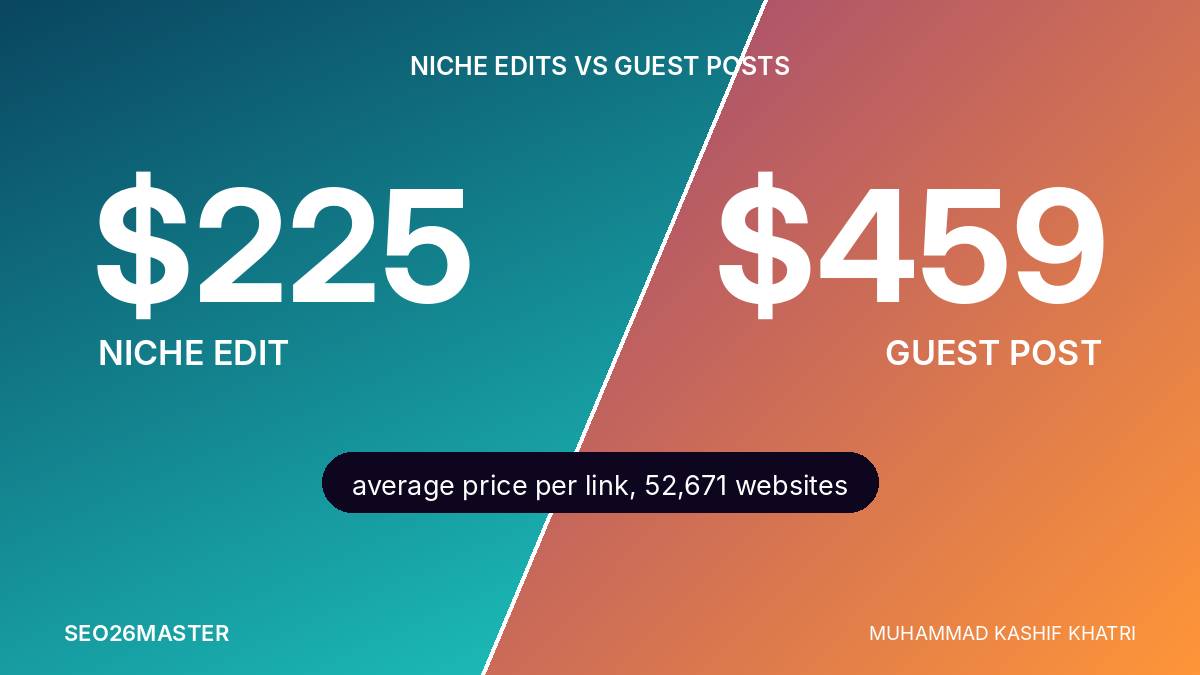
The price. Across 52,671 websites, the average paid guest post was $459 and the average link insertion was $225 in February 2026, according to Adsy's pricing study.
Google's position. Both are covered by the same section of the same policy. The policy names guest posts out loud. It never uses the words "niche edit" at all, but a clause in the same bullet catches them anyway.
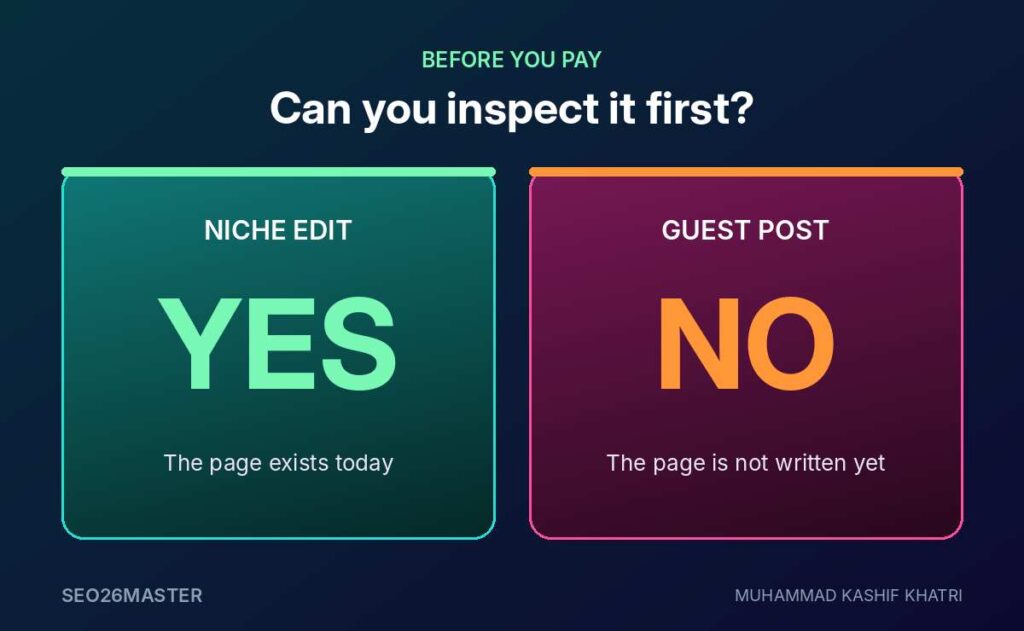
The real difference. A niche edit can be inspected before you pay, because the page already exists. A guest post cannot, because the page does not exist yet. You are buying a promise.
My answer. Buy the niche edit when the page it goes on already gets traffic and already has links of its own. Buy the guest post when the site is strong but every page you are offered is weak. Refuse both when the seller will not show you the URL in advance.
That is the whole article in six lines. The rest explains how I got there and gives you the checks to run.
What is a niche edit in plain words?
A niche edit is an edit to an article that already exists.
Imagine a marketing blog published a post called "12 ways to speed up your website" two years ago. It sits there, it gets a few hundred visits a month, and it has picked up some links of its own over time. A niche edit means the owner of that blog opens that old post, finds a sentence where your topic fits, and adds a link to your website inside it.
Nothing new gets published. No new article appears. One existing page quietly gains one more link.
You will see the same thing sold under other names. Link insertion is the most common. Curated link, contextual link and authority link all usually mean the same thing. Sellers invent new names because the old ones get a bad reputation, so do not assume a fancier word means a different product. Ask what the deliverable is. If the answer is "a link added to an existing post," it is a niche edit.
Why do people like niche edits?
Three reasons, and two of them are real.
They are quick. There is nothing to write and nothing to approve. Most sellers deliver in a few days.
They are cheaper. Half the price of a guest post on average, which I will show with data in a moment.
The page already has value. This is the real argument. An old page may already rank for something, already receive visits, and already have its own backlinks pointing at it. A link on a page like that sits in a much better neighbourhood than a link on a page nobody has ever visited.
That third reason is also where the whole thing falls apart, because most old pages have none of those qualities. I will come back to that.
What is a guest post in plain words?
A guest post is a brand new article published on somebody else's website, with your link inside it.
You pitch a topic, or the site gives you one. An article gets written, by you, by your writer, or by the publisher's writer. It gets published under a byline. Your link sits inside the body of that article, usually pointing to one of your pages.
The page is new. It has no history, no visits, and no links pointing at it on the day it goes live.
That last sentence is the part most buyers never think about, and it is the single most important thing in this comparison.
How much do niche edits and guest posts actually cost?
Here is where almost every other article on this topic fails. They give you ranges like "$50 to $400" with no source, no sample and no date, and the ranges contradict each other from one paragraph to the next. I checked.
So here is actual data.
Adsy analysed 52,671 websites, with a wider set of 155,858 sites used for the country and niche breakdowns. The data range is February 2026. These are the headline figures.
| What you are buying | Average price per link |
|---|---|
| Guest post | $459 |
| Link insertion, also called a niche edit | $225 |
The guest post average rose from $427 in 2025, which is an increase of 7.5% in one year.
So a niche edit costs roughly half of a guest post. That matches what sellers tell you, and it is the one claim in this whole debate that the data supports cleanly.
Keep that $459 guest post price in mind as a benchmark. It is the number to measure every quote you receive against, in either direction.
What makes the price move?
Authority is the main driver. Before the numbers, here are the two terms you will see on every price list, in plain words.
Domain Rating, or DR, is a score out of 100 that Ahrefs gives a website, based on how many other sites link to it. Domain Authority, or DA, is Moz's version of the same idea, also out of 100.
Neither number comes from Google. Google has never published a score like this. DR and DA are useful for comparing two sites in ten seconds, and they guarantee nothing at all. Sellers quote them because they sound official.
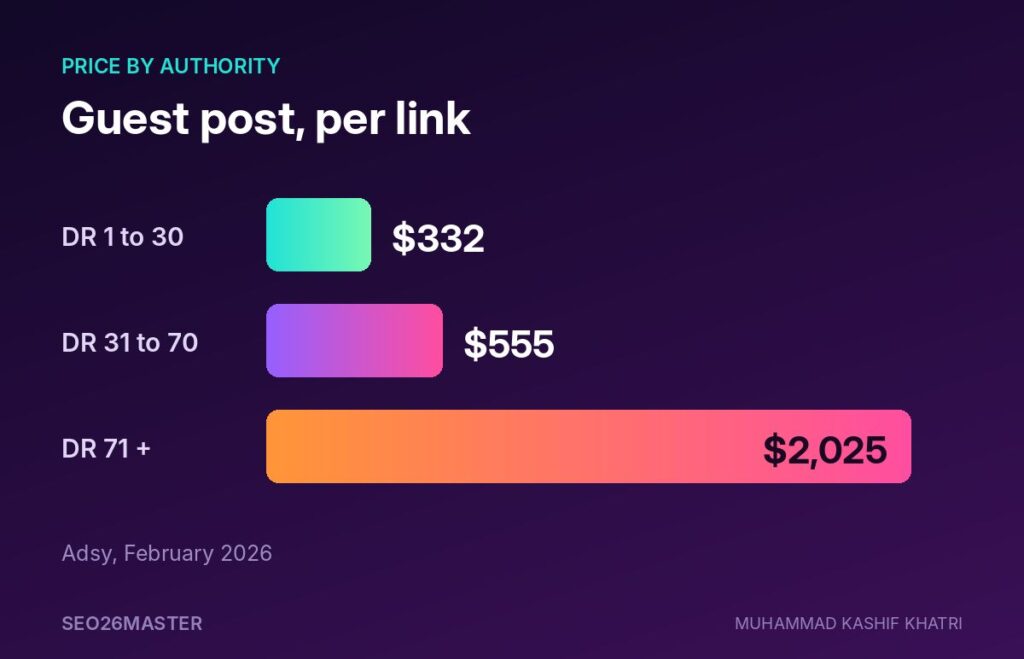
Now the prices, and the jump at the top is steep.
| Domain Rating band | Average guest post price |
|---|---|
| DR 1 to 30 | $332 |
| DR 31 to 70 | $555 |
| DR 71 and above | $2,025 |
The same study found that every extra 10 points of DR goes with about 32% higher prices. Traffic moves the price too, but far less. Sites with 10,000 monthly visitors charge around 21% more than sites with 1,000.
Why does the same link cost more in one country than another?
Because sellers price by market, not by value delivered.
| Country | Average guest post | Average link insertion |
|---|---|---|
| Pakistan | $217 | $144 |
| Bangladesh | $176 | Not listed |
| United States | $670 | Not listed |
| United Kingdom | $729 | Not listed |
| Switzerland | Not listed | $829 |
| Belgium | $1,236 | Not listed |
I am in Pakistan, so I will say the obvious thing out loud. A placement on a Pakistani site costs under a third of the same thing on a British site. If your customers are in Pakistan, that is a bargain. If your customers are in London, you have just bought a cheap link from the wrong country, and the saving is the least interesting thing about it.
Relevance is not only topical. It is also geographic. A home renovation company in Manchester gets very little from a link on a lifestyle blog in Jakarta, however cheap it was.
Why is the asking price almost never the price people pay?
This is the most useful number in the entire study, and I have not seen another article on this keyword mention it.
In the same dataset, the average asking price for a backlink was $929. The average price people actually paid was $207.
Read that again. Sellers ask for four and a half times what buyers typically pay.
That gap exists because the first number you are quoted is an opening position, not a price. Publishers who sell links have no fixed rate card. They have a number they try, and a number they accept when a buyer pushes back politely or walks away.
Three things that work, in my own experience of buying and selling these placements:
Ask for the URL first, price second. A seller who knows you will inspect the page before paying tends to quote the page's real worth rather than the site's best-case worth.
Buy more than one. Rates drop sharply for three or five placements compared with one.
Say no and mean it. Most sellers come back within a week with a lower number. If they do not, you have learned the first price was real, which is also useful.
If you take nothing else from this article, take this. The first quote you receive for either a niche edit or a guest post is usually negotiable by a large margin, and the data says the margin averages several hundred per cent.
Does Google treat niche edits and guest posts differently?
Short answer: no. Both land in the same section of the same policy. The wording is interesting though, and the difference people imagine does not exist.
What the policy actually says
Google's spam policies page has a section called Link spam. It opens with this definition.
"Link spam is the practice of creating links to or from a site primarily for the purpose of manipulating search rankings."
It then gives examples. The sixth one is the one that matters here, quoted in full.
"Advertorials or native advertising where payment is received for articles that include links that pass ranking credit, or links with optimized anchor text in articles, guest posts, or press releases distributed on other sites."
Now look carefully at that sentence, because two different things are described in it.
The first half is about payment. If money changed hands for an article containing a link that passes ranking credit, that is named.
"Passes ranking credit" means the link counts as a vote and helps the page it points to rank higher. A link with a nofollow or sponsored tag on it does not pass ranking credit, and I explain those tags later on.
The second half does not mention payment at all. It says "links with optimized anchor text in articles."
"Optimized anchor text" means the words around the link were chosen to help you rank, not to help the reader. A link on the words "best accounting software Lahore" is optimised. A link on the words "their website" is not.
Now notice the problem. An article is an article, whether it was published yesterday or three years ago. A niche edit is a link with chosen anchor text inside an article. It is caught by this clause, and money does not even have to change hands for it to be caught.
The words "niche edit" do not appear anywhere on Google's spam policies page. Neither does "link insertion." I searched the live page while writing this. Guest posts, meanwhile, are named out loud.
Some sellers use that absence as a selling point. It is not one. Google does not need to name your tactic for the catch-all clause to cover it.
The vocabulary problem here is not new either. I wrote about the same thing in my piece on the Google link scheme. That phrase has not existed in Google's documentation since 2022, yet every page ranking for it still uses it.
What Google staff have said out loud
The quotes here are worth having, because sellers quote them selectively in both directions.
On 20 January 2014, Matt Cutts, then head of Google's web spam team, published a post called "The decay and fall of guest blogging for SEO." The line everyone remembers is this.
"So stick a fork in it: guest blogging is done; it's just gotten too spammy."
That was twelve years ago. Guest posting plainly did not die. So read it as a warning Google wanted to send, not as something that came true.
More recently, in a webmaster hangout on 9 April 2020, John Mueller of Google was asked about linking to your own guest post. His reasoning is the part worth keeping.
"In general, with guest posts, you're the one placing the link essentially on another site."
"So I would recommend using nofollow for that."
Notice what the objection actually is. It is not the format. It is who chose the link. If you chose it and placed it, Google's view is that it should not pass ranking credit.
By that logic a niche edit is in a worse position, not a better one, because in a niche edit you chose the page, the sentence and the anchor text. There is even less editorial judgement involved than in a guest post.
The one line that makes either one safe
The same policy page carries this note, which most articles on this topic leave out entirely.
"Google does understand that buying and selling links is a normal part of the economy of the web for advertising and sponsorship purposes. It's not a violation of our policies to have such links as long as they are qualified with a
rel="nofollow"orrel="sponsored"attribute value to the<a>tag."
So paying for a placement is not against the rules. Paying for a placement that passes ranking credit is. The tag is the whole difference.
That leaves every buyer with an honest choice to make, and I would rather you make it with your eyes open than pretend the question does not exist. I set out the full reasoning in what makes a high quality backlink, including what Google's own engineers have said about how much links matter now.
Which one can you check before you pay?
Here is the difference that actually decides the money, and I have not found it stated clearly anywhere else on this keyword.
A niche edit has a URL that exists today. You can open it. You can see its traffic, its own backlinks, how many outbound links it already carries, and whether anyone has ever visited it.
A guest post has no URL yet. The page will be created after you pay. You can inspect the website, but you cannot inspect the page your link will live on, because nobody has written it.
That is a huge difference, and it works the opposite way to what most people assume. The cheaper product is the one you can check. The dearer product is the one you buy on trust.
So use that. Check the thing you are able to check.
Five checks to run on a niche edit URL
Ask for the exact URL before any money moves. If the seller refuses, you have your answer, and the answer is no.
1. Does the page get any traffic at all? In 2023 Ahrefs studied around 14 billion pages and found that "96.55% of all pages in our index get zero traffic from Google," with a further 1.94% getting between one and ten monthly visits. The page you are being inserted into is statistically very likely to be one of those. Check it in any tool that estimates page level traffic. If the estimate is zero, you are paying for a link on a page nobody reads.
2. Does the page have backlinks of its own? In other words, do other websites link to that page? The number of separate websites linking to it is called its referring domains, and every link tool shows it. This is the entire argument for niche edits. A link on a page that other sites link to inherits something. A link on a page nobody links to inherits nothing, and at that point you have simply bought a worse guest post for half the price.
3. How many outbound links does the page already carry? Open it and count. If an old post about website speed already links out to eleven unrelated companies, you are buying a slot on a noticeboard, and the next eleven buyers will dilute whatever you got.
4. Does the insertion make sense where it sits? Read the paragraph your link will go in. If your accounting software has been pushed into a sentence about garden furniture, a person would spot it in two seconds, and Google's automated systems are built to spot exactly that.
5. When was the page last updated, and will the edit show? Some publishers quietly update the modified date, which makes a two year old post look fresh. Others do not. Neither is fatal, but a page that has been edited eight times to add eight different companies' links has a pattern on it.
Four checks to run on a guest post site
You cannot inspect the page, so inspect the publisher instead.
1. Do their existing pages rank for anything? Not the homepage. Pick five recent articles and check whether any of them get visitors from Google. That is called organic traffic, meaning visits that come from somebody searching, not from an advert. A site with a high DR and no organic traffic on any article is selling you a number, not an audience.
2. Where will the article actually live? Ask for the URL and whether anything on the site will link to it. Many paid guest posts end up as orphan pages, meaning no other page on that website points to them. Google's own documentation says plainly that it uses links "to find new pages to crawl." A page that nothing links to is a page sitting on its own in the dark.
3. How many sponsored articles did they publish last month? Open their blog archive. If they are publishing four outside articles a day, you are buying into a link farm with a nice logo.
4. Will the link be followed, and are they honest about it? A followed link is one with no tag on it, so it is allowed to pass ranking value. A publisher who tells you plainly that they tag paid content is a publisher with a real business. A publisher who swears every link is natural while charging you a rate card is lying to one of you, and it may not be you.
If running these checks by hand sounds like work, that is because it is. I built a free guest post site checker to do the slow parts. It reads up to 60 of the site’s recent articles, tells you how many are actually in your niche and when the last one ran, groups the commercial links going out of those articles by where they point, and shows you the anchor text exactly as written. No signup.
How many of these links are still alive a year later?
This is the question that changes the maths completely, and nobody selling you links wants to discuss it.
Linkody monitored more than 865,000 backlinks continuously and published the results in June 2026. Here is what they found.
| Status of the link | Share |
|---|---|
| Still live and correct | 56% |
| Removed, page still up | 17% |
| Page returns an error | 14% |
| Crawl error, status unclear | 13% |
| Anchor text or link tag changed | Under 1% |
Adding the two categories that are definitely gone, removed links plus dead pages, gives a confirmed loss floor of 31%. The study notes that the real figure is probably higher, because only confirmed deaths are counted.
The speed matters too. Of the links that died, 21% were gone within three months and 52% were gone within a year. Average lifespan before death was about 20 months.
Now here is the part that should decide your purchase.
| Site strength | Share of links still live |
|---|---|
| Under DA 10 | 33% |
| DA 30 to 49 | Around 70% |
Two thirds of links on the weakest sites are dead. On mid strength sites, seven in ten survive.
Think about what that does to your cost per surviving link. A $90 placement on a DA 8 site has a one in three chance of being there next year, so your real cost is closer to $270. A $300 placement on a DA 40 site survives seven times in ten, so your real cost is about $430. The gap between cheap and mid priced placements is far smaller than the invoice suggests, and the cheap one bought you nothing in the meantime.
This applies to both formats. A deleted guest post and a removed niche edit are equally worthless.
Why does the host page matter more than the domain?
Because a link lives on a page, not on a website.
Everybody shops for links by domain metric. DR 50, DA 40, that sort of thing. Sellers price by domain metric too, which is why the DR bands in the price table are so neat. But your link does not sit on the domain. It sits on one URL, and that URL has its own traffic, its own links and its own neighbours.
Ahrefs' traffic study shows the scale of the problem. Of roughly 20 million pages that no other website links to, only 2,997 received more than 1,000 monthly visits from search. That is about one page in 6,671.
So a page with no links of its own is very unlikely to be a page with readers. And most pages have no links of their own.
This cuts both ways, which is what makes the comparison genuinely interesting.
The niche edit wins when the host page is one of the rare good ones. It has traffic, it has its own backlinks, and you can confirm both before paying. That is a better placement than any brand new article can offer on day one.
The guest post wins when every page the seller offers for insertion is a dead archive post from 2019 with nine outbound links already in it. In that case the new article at least starts clean, can be written to actually rank for something, and may earn its own links over time.
Neither tactic is better. The page decides, and you can only see the page in one of the two cases.
When is a niche edit the better buy?
Buy the niche edit when all six of these are true.
- The seller gives you the exact URL in advance, without being chased for it.
- The page shows some traffic from Google in a tool, even a small amount.
- At least a few other websites link to that page.
- The page carries fewer than about five outbound links to other companies.
- Your link fits the sentence without anything being bent to make it fit.
- The site is in your topic area and, ideally, in the country your customers live in.
In that situation you are getting a better placement for half the price, and you have checked it yourself. That is a good purchase.
Two more situations where it makes sense. If you need movement quickly, a niche edit is live in days rather than weeks. And if you are testing a new supplier, a single niche edit is a cheap way to find out whether they deliver what they described.
When is a guest post the better buy?
Buy the guest post when these are true.
- Every page offered to you for insertion is weak, old, or already crowded with outbound links.
- The publisher's recent articles really do get visitors from Google, so a new article there has a fair chance of doing the same.
- You want the article itself to work for you, not only the link. That means an article that answers a real question your buyers ask.
- You want the byline, because you are building a name and not only a pile of links.
- The publisher will link to the new article from somewhere on the site, so it is not left on its own.
There is one more reason, and it is the honest commercial one. A guest post is a published piece with your name on it. It can be quoted, shared, picked up by AI answer engines and shown to clients. A niche edit is a sentence inside somebody else's old post, and you cannot show it to anyone with any pride.
That matters more now than it did two years ago. Systems that write answers tend to pull from pages that are clearly about one subject, have a named author, and say something definite. A sentence slipped into somebody's old "top 10 tips" post is not that.
If you decide a guest post is the right buy, my guest post campaigns start at $349, and I publish exactly which sites each tier covers before you pay rather than after.
What should you refuse to pay for in either format?
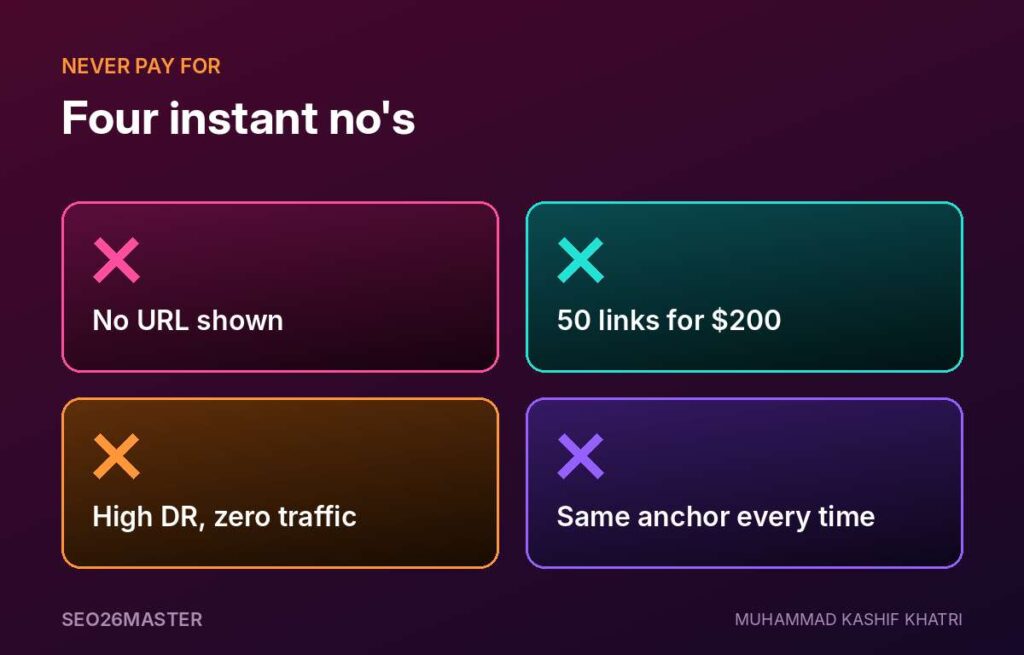
A placement with no URL shown in advance. For a niche edit, there is no excuse. The page exists. If they will not show it, the page is bad.
A site with a high DR and no traffic on any page. The score has been pumped up on purpose, usually by pointing a pile of cheap links at the site. I have seen percentages quoted for how common this is, and I could not verify any of them, so I will not repeat one. You do not need a statistic here. Open five of their articles and check whether any of them get visitors. That takes two minutes and settles it.
Anything sold as a bundle of fifty links. At a $225 average for insertions, fifty real placements cost over $11,000. If the price is $200 for the lot, they are not placements.
A page that has been edited repeatedly to add links. You can often see this in the page itself. Five unrelated companies linked in five paragraphs in a row is a pattern, and patterns are what automated systems are built to find.
The same anchor text on every link you buy. In the Linkody data, 56% of links used a keyword or phrase as the anchor, 18% used a brand name and 15% used the bare web address. A set of links where every single anchor is your main keyword looks nothing like that mix. Google's own policy names "optimized anchor text" directly, so this is the one detail worth being boring about. Vary it, and use your brand name often.
A link in a site wide footer or sidebar. Google's policy names "widely distributed links in the footers or templates of various sites." It is not a link inside the content, whatever the seller calls it.
Anything on an expired domain rebuilt for links. Google gives this its own separate section in the spam policies, titled Expired domain abuse. I covered why it keeps appearing on recommendation lists in backlinks without guest posting.
How do you decide in five minutes?
Run this in order. Stop at the first no.
1. Ask for the URL. For a niche edit, the exact page. For a guest post, the site plus five recent article URLs. No URL, no deal.
2. Check traffic at page level, not domain level. Does the page or do those articles get anything? If every single one is zero, walk away regardless of DR.
3. Check the site's own strength band. Under DA 10, expect two thirds of your links to die. Price that in or decline.
4. Count outbound links on the target page. More than about five commercial outbound links means you are buying a slot on a list.
5. Read the insertion point. Does your link belong in that sentence? Would a human editor have put it there?
6. Compare the price with the benchmark. $225 is the average insertion and $459 the average guest post. Asking prices average $929 while buyers typically pay $207. Negotiate from the benchmark, not from their first number.
7. Decide which asset you want. A link on an existing good page, or a new page with your name on it. Both are legitimate. They are not the same purchase.
Niche edits vs guest posts: the honest summary
The niche edits vs guest posts debate is usually framed as safe versus risky, or cheap versus expensive. Both framings are wrong.
On policy, they sit in the same bullet of the same Google policy. The clause about optimised anchor text in articles catches the niche edit, even though the words "niche edit" appear nowhere on the page.
On price, the niche edit is genuinely about half the cost, confirmed across 52,671 websites.
On survival, both die at the same rate, and that rate is governed by the strength of the site rather than the format.
On verification, the niche edit wins clearly, because the page exists and can be inspected. That single fact should change how most people buy.
So the real answer to niche edits vs guest posts is not a tactic. It is a rule. Buy the better page, and refuse to buy any page you have not seen.
Apply that and the label on the invoice stops mattering.
Frequently asked questions
Are niche edits safe?
They carry the same policy exposure as paid guest posts. Google's link spam section names "links with optimized anchor text in articles," which covers an inserted link whether or not money changed hands. The words "niche edit" never appear on the page, but that absence protects nobody. The practical risk depends far more on the quality of the host page and the pattern of your anchor text than on which of the two formats you chose.
How much should a niche edit cost?
The average link insertion price across 52,671 websites was $225 in February 2026, against $459 for a guest post. Mid strength sites cluster around the average, weak sites sit well below it, and sites above DR 70 charge several times more. Remember that average asking prices run to $929 while buyers typically pay $207, so the first quote is rarely the real one.
Is a niche edit faster than a guest post?
Yes, usually by weeks. There is nothing to write, pitch or approve, so most sellers deliver in a few days. A guest post typically takes two to six weeks because an article has to be written, reviewed and scheduled.
Do niche edits still work in 2026?
A niche edit on a page with real traffic and its own backlinks still passes real value, which is why the tactic has not gone away. A niche edit on a dead archive page passes almost nothing, and that describes most of what is being sold, because 96.55% of pages receive no Google traffic at all. The method works. Most of the pages on offer do not.
Which is better for AI search visibility?
A guest post, in most cases. Systems that write answers tend to draw on pages that say something definite, have a named author, and are about one subject. A new article you shaped can be that. A sentence slipped into somebody else's three year old tips post cannot.
Can I do niche edits for free?
Yes, and it is one of the better uses of your time. Find a page that links to a resource that no longer exists, or that mentions your company without linking, and email the owner. You are reporting a fault or asking for a correction rather than buying a slot. The hit rate is low but the links cost nothing and nobody can take an unpaid editorial link away from you on a whim.
Should the link be nofollow?
If you paid for it, then by Google's stated position, yes. A nofollow or sponsored tag is a small piece of code the publisher adds to the link. It tells Google the link was paid for or placed, so Google should not count it as a vote. A paid placement carrying one of those tags breaks no rule at all. The same tag also removes the ranking benefit you were paying for, which is the contradiction sitting at the centre of this entire market. Decide where you stand on that on purpose, rather than by accident. And understand what you are being sold. A publisher who promises you an untagged paid link is promising to break a rule on your behalf.
Does the niche edits vs guest posts choice matter more than the site I pick?
No, and this is the mistake almost everybody makes. The format decides your price and your waiting time. The page decides whether the link does anything at all. A niche edit on a strong page beats a guest post on a dead site, and a guest post on a genuinely read publication beats an insertion into an abandoned archive post. Pick the page first, then argue about the label.
How many of these links will I still have next year?
On sites in the DA 30 to 49 band, around 70%. On sites under DA 10, about 33%. Across all 865,000 monitored links, at least 31% were confirmed gone, and 21% of the dead ones vanished within the first three months. Expect to lose some in both formats, and budget for it.
Sources
- Google Search Central, Spam policies for Google web search
- Adsy, Link Building Pricing in 2026, 52,671 websites analysed
- Linkody, Link Building Statistics 2026, 865,000 monitored backlinks
- Ahrefs, 96.55% of Content Gets No Traffic From Google, Tim Soulo, 1 December 2023
- Matt Cutts, The decay and fall of guest blogging for SEO, 20 January 2014
- Search Engine Journal, Google Answers: Is It OK To Link To My Own Guest Post, 9 April 2020
Leave a Reply