
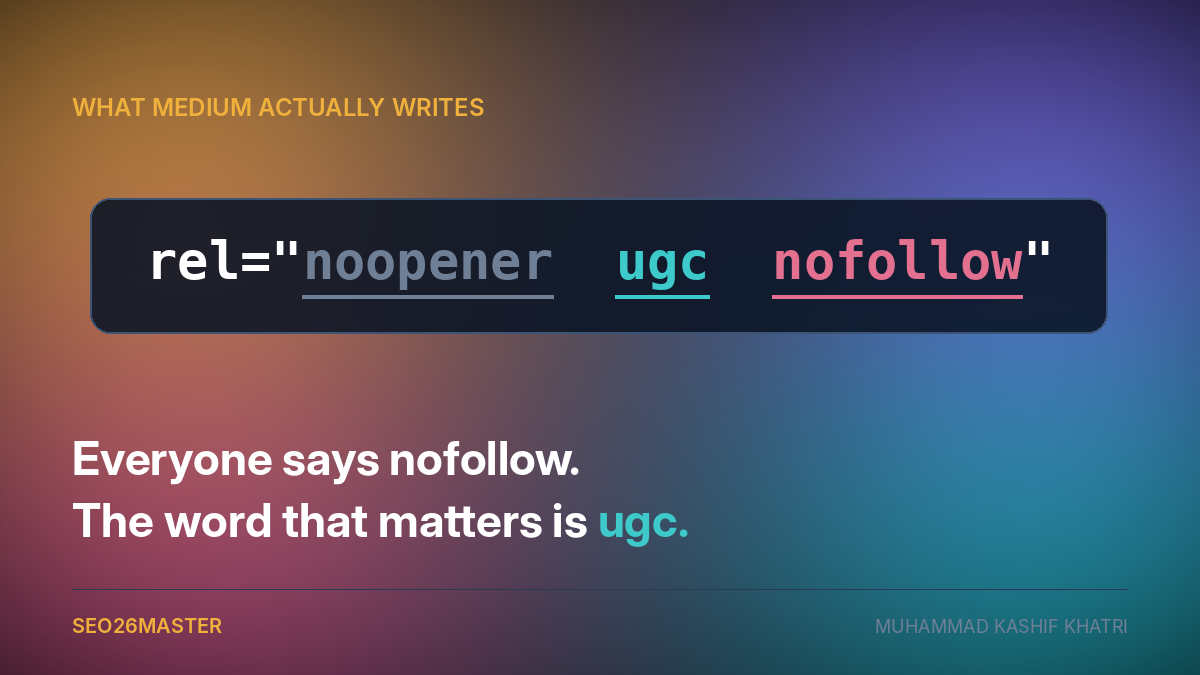
Every page answering this question says "nofollow" and stops there. None of them show you the tag. Here it is, copied from a live article, and the second word in it changes what you are buying.
You are about to pay for a placement on a Medium publication, or you have just published one and somebody has asked whether the link counts.
So you search for the answer and get the same sentence from every result. Medium links are nofollow. One of the pages saying it was written in 2015. Another was last updated in 2020. None of them show you the link.
The sentence is correct. It is also incomplete in a way that matters if money is involved.
Are Medium links nofollow?
Yes, and the tag Medium writes is more specific than that word.
Here is a real one. This is an outbound link inside one of my own published Medium articles, copied from the page source on 14 October 2026:
<a class="au um" href="https://seo26master.com/guest-post-site-checker/"
   rel="noopener ugc nofollow" target="_blank">seo26master.com/guest-post-site-checker</a>
If that line means nothing to you, here is what it is. Every link on a web page can carry a small tag called rel. Readers never see it. It is a note from the site to Google about what kind of link this is.
Medium's note has three words in it, not one. noopener is a browser security setting and has nothing to do with search. The two that matter to you are ugc and nofollow, and almost nobody writing about this mentions the first one.
There is no dofollow version of this. No setting to switch, no plan to upgrade to, and no publication that can turn it off for you.
That does not make a Medium placement worthless, it just moves the question somewhere else. What you end up weighing is whether the publication deserves your writing in the first place, and the five checks for that are in what makes a backlink high quality.
What does ugc actually mean?
It is Google's label for user generated content, and Google asks publishers to use it.
From Google's own documentation on qualifying outbound links: "We recommend marking user-generated content (UGC) links, such as comments and forum posts, with the ugc value."
The same page confirms that values can be combined. "You may specify multiple rel values as a space- or comma-separated list." The examples Google gives are rel="ugc nofollow" and rel="ugc,nofollow".
Read that example again. Google's own documentation uses the exact combination Medium applies to your link.
That changes how you should read it. Medium is not punishing you or singling your link out. It is doing exactly what Google asks any platform where anybody can publish. To Medium, your article and a forum comment are the same kind of thing, because both arrived from outside.
Does that mean the link does nothing?
Not quite nothing, and Google's exact wording here is worth reading rather than summarising.
The documentation says: "Links marked with these rel attributes will generally not be followed."
Generally. Not never. The same page adds that a linked page "may still be crawled" if Google finds it another way, such as through a sitemap or a link from a different site.
So the honest position is this. You should plan as if the link passes nothing, because that is the stated default and anything else is hope. But the page it points at still gets discovered, and the mention still exists in a place people read.
That distinction between being linked and being mentioned is the whole game in AI search too, and I wrote about the difference in being mentioned by AI is not the same as being recommended.
How do you check this yourself in thirty seconds?
Open the article, view the source, and search for your own domain.
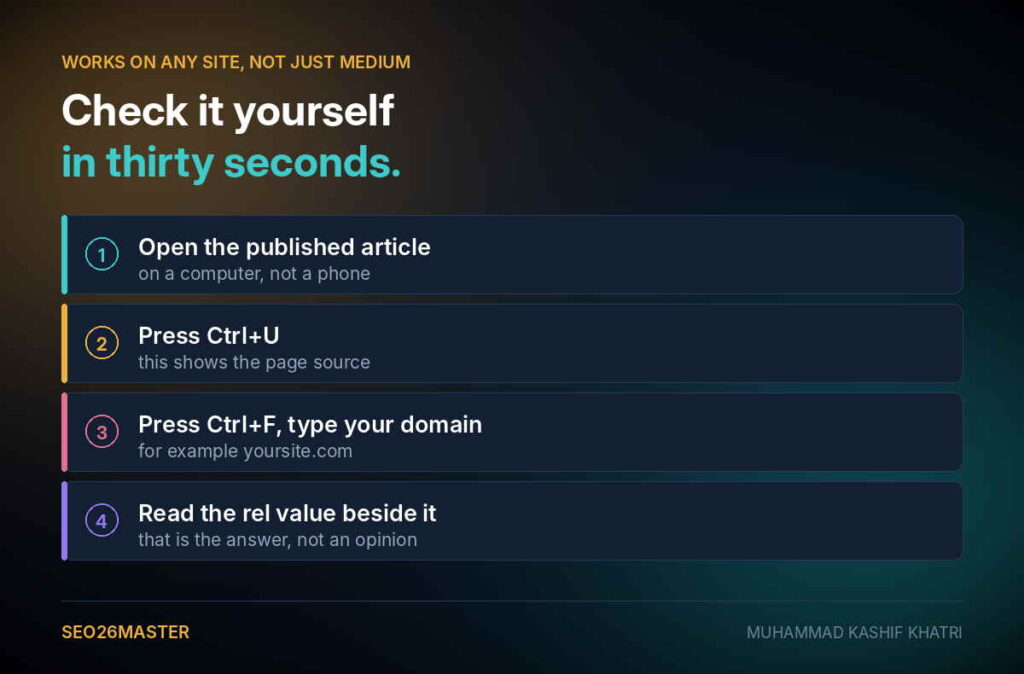
- Open the published Medium article in a browser on a computer.
- Right click anywhere on the page and choose View Page Source, or press Ctrl+U.
- Press Ctrl+F and type your own domain, for example
yoursite.com. - Look at the
<atag that contains it. Therelvalue is written right there.
That takes less time than reading any article about it, including this one. It also works on any site, not just Medium, which is the real reason to learn it. The guidelines page of a site tells you what it intends. The source of a published page tells you what it did.
I use the same check before and after every placement I buy, and it is the one that catches a link quietly changed after publication. The longer version of that check is in what Google's policy says about guest post anchor text.
So what are you actually buying with a Medium placement?
Four things, and the link is not one of them.
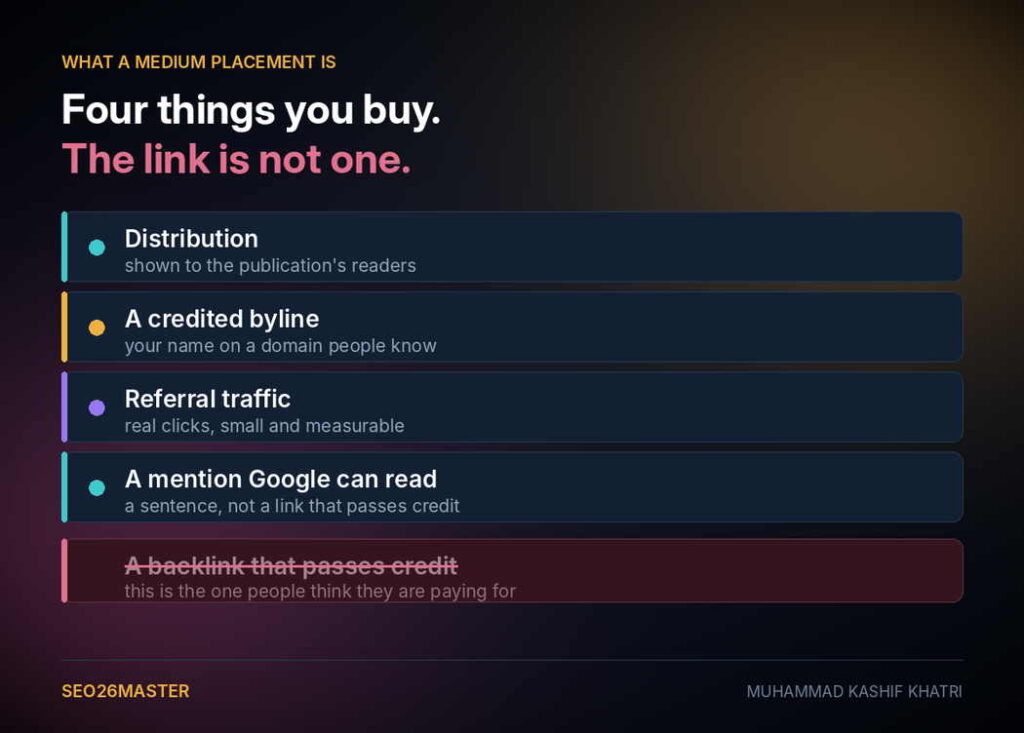
Distribution. A piece in a large publication is shown to that publication's readers. That is the product. It is the only one of the four you cannot replicate on your own site.
A credited byline. Your name next to your work on a domain people recognise. That matters for the kind of reader who checks who wrote something before deciding whether to believe it.
Referral traffic. Real people clicking through to a page you control. This is small in most cases and it is measurable, which makes it the easiest of the four to be honest about.
A mention somewhere Google can read it. Not a link that passes credit. A sentence with your name in it, on a page that gets read and quoted by other people.
If somebody is selling you a Medium placement on the strength of the backlink, they are either not checking or not telling. The placement can still be worth buying. The reason has to be one of the four above.
The same question comes up on ordinary paid placements, where the attribute is a choice rather than a platform rule. I went through what each option actually costs you in dofollow or nofollow: what you are actually buying.
What about the canonical trick?
It is real, it is supported, and it does something different from what most people think.
Medium lets you import a post from your own site. The imported copy carries a canonical tag pointing back at your original. A canonical tag is a line in the page code that tells Google which version of the same article is the real one.
So the import protects you from your own Medium copy outranking your own site. That is a real problem and this really does solve it.
What it does not do is turn the Medium link into a followed one. It is duplicate content protection, not link building. Useful, and useful for a different reason than the one it usually gets recommended for.
Does any of this change if the publication is large?
No. The attribute is applied by the platform, not by the publication.
This is worth saying because the sales pitch usually runs through publication size. A piece in a publication with 300,000 followers carries the same rel value as a piece on an account with none. Size changes how many people read it, which is a real thing worth paying for. It does not change what the link does.
I edit for ILLUMINATION and four other publications, so I see this from the side that approves the piece. What an editor can give you is placement, audience and a credit line. What an editor cannot give you is a different rel attribute, because that decision was made by the platform long before your draft arrived.
What should you ask before you pay for one?
Three questions, and the answers tell you more than any price list.
Which publication, by name, and can I see three recent pieces from it? Not "a large tech publication". The name. Then open the three pieces and look at the dates. A publication that has gone quiet is still a publication, and it still looks alive from the outside. That check is the same one I use for ordinary sites, and I wrote it up in how to vet guest post sites before you pay.
What happens if the editor says no? A real placement goes through an editor who can reject it. If the seller cannot imagine that happening, they are not placing your piece, they are posting it.
What am I getting besides the link? If the answer is only the link, you have your answer about the offer. The attribute on that link is the same one every other Medium article gets.
What this does not tell you
It does not tell you what Google does with a ugc nofollow link in practice, only what Google says it generally does. Nobody outside Google can close that gap. If somebody tells you they have measured it, ask what they actually measured.
It does not cover other platforms. Substack, LinkedIn and dev.to each make their own choice, and they change it without announcements. The check above is the answer for all of them, which is why the method matters more than the fact.
And the tag I have quoted is one link, on one article, checked on one day. Platforms change this kind of thing quietly and without announcing it. If you are reading this months after publication, spend the thirty seconds and look at the page in front of you rather than trusting the sentence in front of you. That advice applies to this article more than to most.
The short version
Medium links carry ugc nofollow, which is what Google asks platforms with open submissions to apply. As backlinks they are not dofollow and you should plan as though they pass nothing.
Buy the placement for the distribution, the byline and the audience. Those are real and they are what the better publications actually sell. If you want help deciding which publications are worth that and getting placed in them, that is what I do at editorial placements.
Muhammad Kashif Khatri runs SEO26MASTER, builds Site Dossier, and is an editor at ILLUMINATION and four other Medium publications. He sells editorial placements, which is a thing worth knowing while reading his opinion of what they are worth.
Leave a Reply