
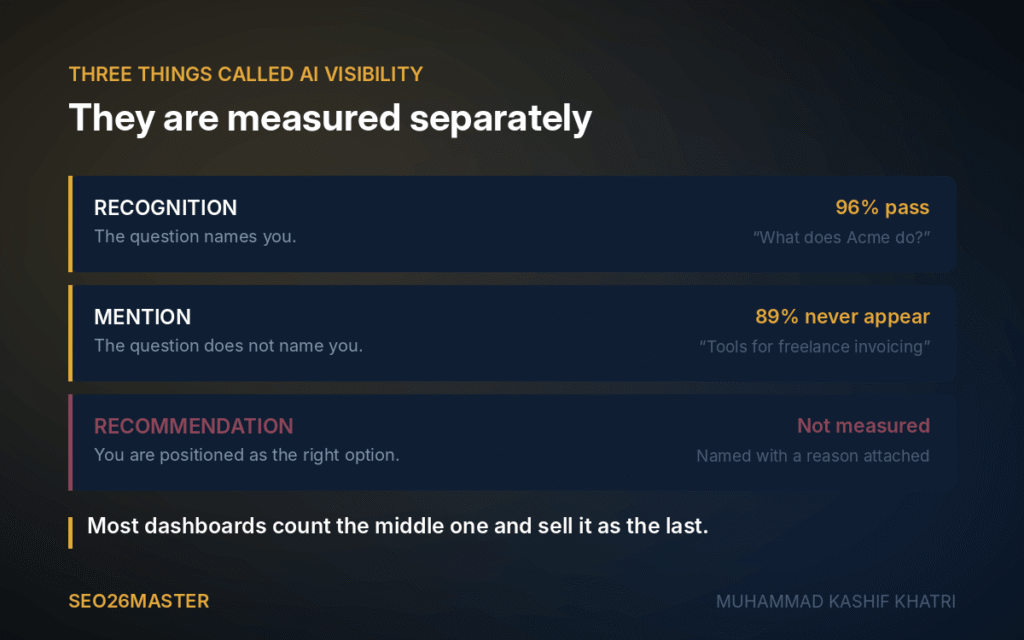
Three different things get called AI visibility. They are measured separately, and the difference matters.
- Recognition. The assistant describes you correctly when the question names you.
- A mention. Your name appears in an answer to a question that did not name you.
- A recommendation. Your name appears as a suitable option for someone deciding what to buy.
The published research measures the first two. The gap between them is enormous. One 2026 study found 96% of brands were described accurately when asked about directly. In the same cohort, 89% never appeared in category answers at all.
Almost nobody has measured the third properly. That includes the studies most often quoted for it.
Worth knowing before you pay anyone to improve it, including me. I sell AI search visibility work.
Where does the number everyone quotes come from?
Start here. This figure is now in every deck on the subject, and almost nobody says where it came from.
The 96% and 89% figures come from the Q2 2026 Quarterly Search Report by Victorious, an SEO agency. The report page puts them like this:
"96% of brands were accurately described when AI was asked directly."
"89% of those same brands never appeared in AI-generated category answers."
Four things about that source are worth stating plainly.
It is a vendor's own study. Victorious sells the services the findings imply you need.
It spread through a paid placement. Most people met it as a sponsored post on Search Engine Journal, published 29 July 2026 and written by Michael Transon, the company's founder and chief executive.
The dates do not line up. The report page is labelled Q2 2026. It carries a published date of 29 April 2026, before that quarter had finished. It was updated in late July.
The cohort sizes are missing from the report. The counters that should display them render as zero. The numbers appear only in the sponsored post. There, 175 brands entered the study, 140 produced evaluable recognition responses, and the citation analysis covers 150 brands. So 96% is of 140. And 89% is of 150. Neither is of 175.
I am still using the study. It is the most detailed public measurement of this that exists. But the provenance belongs next to the number, and you will not find it in the decks.
What are the three things people call AI visibility?
Recognition. You ask the assistant "what does Acme do" and it answers correctly. The model is drawing on what it already holds about you. Nearly every established brand passes.
Mention. You ask something with no brand name in it, like "tools for managing freelance invoices". Your name turns up in the answer. This is the 89% figure, and it is what most tracking tools actually measure.
Recommendation. The assistant does not just name you. It positions you as the right option for the person asking. Nobody publishes a clean measurement of this. Deciding whether an answer recommended a brand or merely listed one takes human judgement, and that does not scale.
Most AI visibility dashboards count mentions and present the result as recommendation. That is the gap to watch in any pitch, mine included.
Why does recognition not turn into a mention?
The two questions put different demands on the model. The difference is one of weighting, not a switch.
A direct question about your brand can be answered from the model's own parameters. It learned what you are. That is why recognition is close to universal.
A category question can be answered from parameters too, and often is. Turn web search off and ask for the best project management tool for a small agency. You still get a list. Those names come from training data.
What changes is what happens when the model goes and looks. It does that by default in Perplexity, in Google AI Overviews and in AI Mode. ChatGPT and Claude do it when they decide a query needs it.
At that point, almost everything the model reads about your category was written by someone else.
So your own content is not irrelevant. It is simply competing with every third-party page about your category, and in retrieval it loses.
Does your own site ever get the credit?
Rarely. This is the sharpest number in the report.
Across 49,391 citations analysed, 99.99% pointed to third-party sites. Only 4 of the 150 brands in the citation cohort received even one citation to their own domain.
Be careful what that measures. A citation is what the system chose to display as its source. It is not a list of everything the model read. Your own pages can be retrieved and can shape an answer without ever being credited.
But if the goal is to be the page a model points at, four out of a hundred and fifty is the answer. For that particular job, your own domain is close to a dead end.
This is also why a mention can matter more than the link that comes with it. On Medium the link passes nothing at all, which makes the sentence around it the only thing doing any work. The exact tag is in are Medium links nofollow.
Does being a bigger brand help?
Less than you would expect. The clearest illustration does not come from an SEO vendor.
On 29 June 2026, Harvard Business Review published a piece by three authors: John Gale, a consultant and adjunct professor at Georgetown's McDonough School of Business, Luca Cian of UVA's Darden School, and Luc Wathieu of Georgetown.
They asked ChatGPT, Claude and Gemini for running shoe recommendations. Brooks "appeared reliably". Nike "appeared far less consistently".
Nike is not the smaller brand. It is the less describable one for that question. Running shoe comparisons discuss Brooks in terms of pronation support, stack height and tested cushioning. They discuss Nike in terms of Nike.
I have to flag the sourcing here. The HBR article states no method. No number of queries. No number of brands. No list of categories, no scoring rule, and no link to an underlying paper. Its citations for Brooks and Nike go to a press release and an investor report.
So I am treating the shoe result as a reported observation by credible people, not as a measurement. I could not find a published study behind it.
HBR's page summary frames the conclusion as a shift "from symbolic positioning to evidentiary positioning". That wording sits in the summary rather than the authors' own text, so read it as the editor's compression.
Can anyone prove third-party mentions cause this?
No. This is where most writing on the subject quietly stops being careful.
The Victorious report found the strongest correlations with AI mention rates were referring domains at r = 0.49 and third-party web mentions at r = 0.45. It also reports that roughly 20,000 indexed third-party mentions corresponded to about a 50% chance of an AI mention.
The obvious reading is that third-party mentions cause AI mentions.
A second reading fits the same number exactly. Well-known brands are already in the training data. Well-known brands also attract more referring domains. In that version the mentions cause nothing. They are a symptom of the fame the model already learned.
A correlation of 0.49 cannot separate those two stories. The report also publishes no sample size and no significance test for the correlation analysis, so there is no way to judge how firm the figure is.
That does not make the advice wrong. It makes the honest claim narrower. Third-party coverage is the part you can change, and the evidence is consistent with it mattering. It is not proof that it will.
How do you tell which one you currently have?
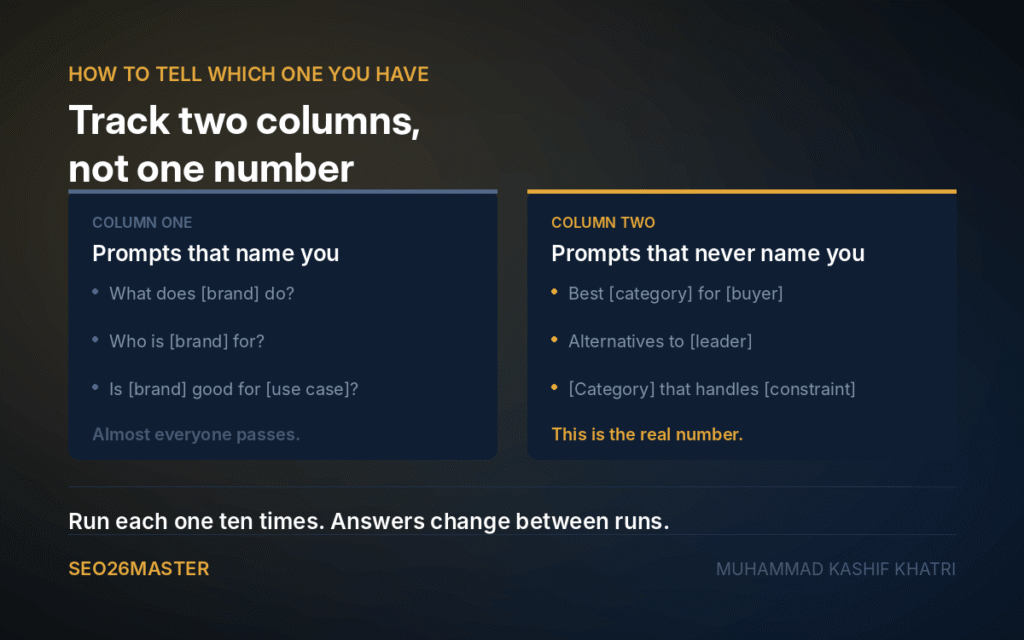
Split your tracking into two columns and run both every month. It takes an afternoon to set up. It is the only part of this article I would insist on.
Column one: prompts that name you.
- What does [your brand] do?
- Who is [your brand] for?
- Is [your brand] any good for [use case]?
Almost everyone scores well here. A low score points to a real problem with how you are described online. A high score tells you nothing about demand.
Column two: prompts that never name you.
- Best [category] for [specific buyer type]
- Alternatives to [the market leader in your category]
- [Category] that handles [specific constraint you solve]
- How do I choose a [category] when I need [specific requirement]
Run each one ten times, across the assistants your buyers actually use. Answers vary between runs, so a single test tells you nothing.
Then record two things. How often you appear at all. And how often you appear with a reason attached, rather than as one name in a list.
The second number is the one that matters. It is also the one no dashboard will give you.
If your gap looks like the study's gap, the work ahead is not brand building. It is getting described by other people, in specific terms, on sources that cover your category. Which sources, and whether they are worth paying for, is a separate question. I have written about that in how to vet guest post sites before you pay.
What this does not tell you
It does not tell you how long any of this takes. I have found no credible public data on how quickly a new third-party mention starts affecting AI answers, and I am not going to invent a figure.
It does not tell you that appearing in AI answers produces revenue. None of the research above connects mentions to clicks, enquiries or sales.
And it rests heavily on one vendor's study, with the provenance problems set out at the top.
What the evidence does support is narrow, and still useful:
- Recognition is nearly universal, so it is not a measure of anything.
- Mentions are rare, and are built largely from third-party sources.
- Recommendation is a third thing nobody is measuring properly yet, including the people selling it.
If you want the two-column tracking built and the source list worked out for your category, that is what the AI search visibility work is. If you would rather do it yourself, the two columns above are the whole method. The second one will probably be a worse number than you expect.
Muhammad Kashif Khatri runs SEO26MASTER and sells the AI search visibility work described above. He is also an editor at ILLUMINATION and four other Medium publications.
Sources
Leave a Reply