
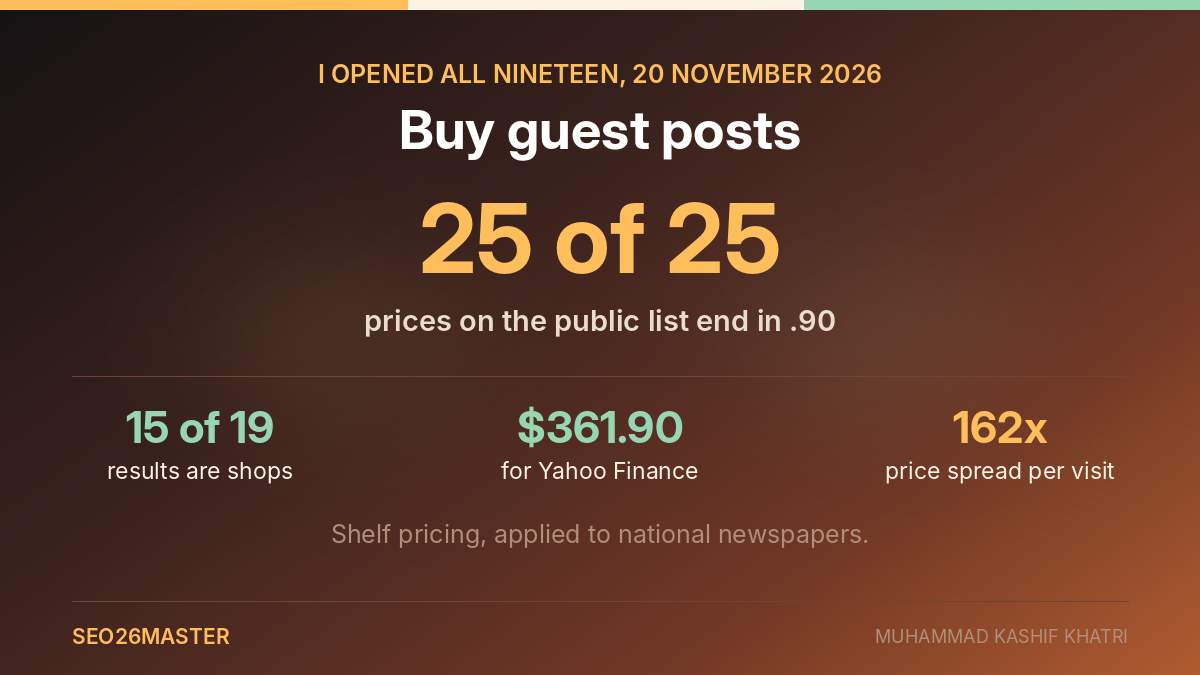
Search buy guest posts and fifteen of the nineteen results are shops. I opened all of them on 20 November 2026 and copied out every price I could find.
Two of those shops publish the names of the sites they sell. Yahoo Finance is on one of them for $361.90.
Every single price on that list ends in .90, like a supermarket shelf.
What is actually on page one and two
Nineteen results, each one opened.
| What ranked | How many |
|---|---|
| Link marketplaces and sellers | 15 |
| A freelance marketplace category | 1 |
| A list of guest posting sites | 1 |
| A buying guide | 1 |
| A university student portfolio | 1 |
No arguments, no warnings, no explanations. One result on the whole of page one and two is not written by somebody selling.
Two of the titles are worth reading as they appear in the results. Fiverr's category page is called "24 Best Dofollow Guest Post Services To Buy Online". Legiit's is "Buy Guest Posts, DA30 to DA90 Sites, Real Placements".
Both advertise followed links in the title tag. Google's spam policy lists buying or selling links for ranking purposes as its first example of link spam, specifically "exchanging money for links, or posts that contain links". Nobody on this results page is hiding from that. They are optimising for it.
The university portfolio on page one
Position eight is canvas.pieas.edu.pk, under the title "Write For Us: Buy High DA Guest Post Backlinks".
PIEAS is the Pakistan Institute of Engineering and Applied Sciences, on Lehtrar Road in Islamabad. It is a real university. The URL sits in its Canvas e-portfolio system, which is the folder where students keep their coursework portfolios.
I opened it. The portfolio is empty: "Nothing Entered Yet".
I have seen this exact thing once before. In my piece on the guest post outreach service market, a Spanish language Canvas install at campus.eucim.com was indexed under a guest posting title and was also empty when opened, in that case reading "Nada se ha ingresado aún".
Two Canvas systems, two countries, same pattern, both still listed by Google and both empty.
That is now the fifth domain I have recorded carrying this industry's marketing without being in the industry. The others, in link building reseller, were a cancer charity, an arts centre and a racing fabrication workshop.
The names on the price list
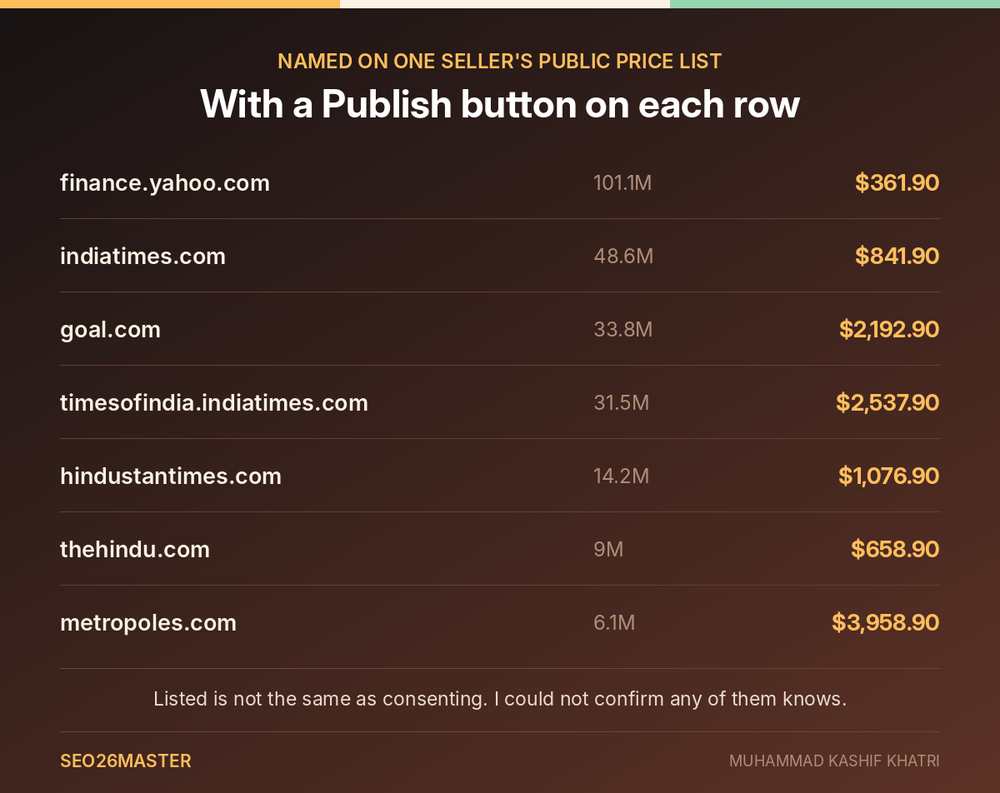
GuestPostLinks ranks twice for this search and publishes a public table of 25 sites with prices and a Publish button on each row.
These are not anonymous blogs.
| Site | DA | DR | Monthly traffic | Price |
|---|---|---|---|---|
| finance.yahoo.com | 93 | 94 | 101.1M | $361.90 |
| indiatimes.com | 94 | 92 | 48.6M | $841.90 |
| goal.com | 92 | 83 | 33.8M | $2,192.90 |
| timesofindia.indiatimes.com | 94 | 92 | 31.5M | $2,537.90 |
| hindustantimes.com | 92 | 89 | 14.2M | $1,076.90 |
| thehindu.com | 91 | 89 | 9M | $658.90 |
| livemint.com | 90 | 90 | 4.5M | $1,319.90 |
| metropoles.com | 92 | 94 | 6.1M | $3,958.90 |
The full list runs from $193.90 to $3,958.90 with a median of $841.90.
I want to be careful here, because this matters. The list says you can publish on these sites for these prices. It does not prove that any of these publications knows about it, has agreed to it, or would honour it. I have not tested a single order and I am not going to. What I can tell you is what the page says, and the page names them.
Every price ends in .90
All 25 of them. Not most. All.
$193.90. $219.90. $231.90. $272.90. $273.90. $346.90. $361.90. And on up to $3,958.90.
This is the oldest trick in retail, the one that makes $9.99 feel different from $10. It is applied here to the sale of editorial space on national newspapers.
It tells you how the seller thinks about the product. Not as a negotiation with a publisher, which is what the word guest post implies, but as a shelf price on an item. The guest post outreach service market has the same tell in different words, where the two biggest sellers both describe the product as a ghost post rather than a guest post.
The price does not follow the traffic
Here is the arithmetic nobody publishes, because it is awkward for a price list.
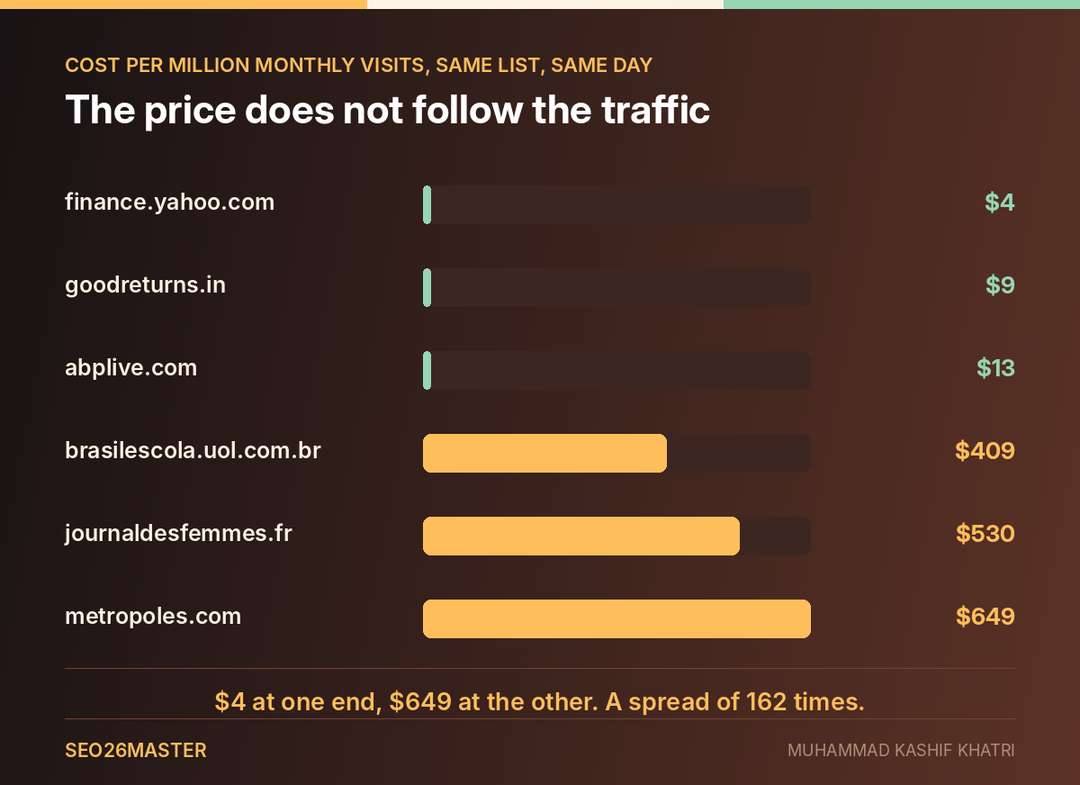
I divided each price by that site's stated monthly traffic, to get a cost per million visits.
| Site | Traffic | Price | Cost per million visits |
|---|---|---|---|
| finance.yahoo.com | 101.1M | $361.90 | $4 |
| goodreturns.in | 25.6M | $231.90 | $9 |
| abplive.com | 16.4M | $219.90 | $13 |
| brasilescola.uol.com.br | 6M | $2,452.90 | $409 |
| journaldesfemmes.fr | 7.3M | $3,865.90 | $530 |
| metropoles.com | 6.1M | $3,958.90 | $649 |
The cheapest row costs $4 per million monthly visits. The dearest costs $649. That is a spread of 162 times, inside one price list, on one page, on the same day.
If traffic set the price, that number would be close to flat. It is not close to flat.
Two sites, the same traffic, five times the price
The clearest example sits in the middle of the table.
| Site | DA | Traffic | Price |
|---|---|---|---|
| filmibeat.com | 77 | 4.2M | $193.90 |
| cricketworld.com | 57 | 4.2M | $993.90 |
Identical traffic. The site with the higher domain authority is the cheaper one, by five times.
There is a second pair just as awkward. india.com, DA 90, 6M monthly visits, $273.90. brasilescola.uol.com.br, DA 95, 6M monthly visits, $2,452.90. Same traffic, nine times the price.
So on this seller's own public page, neither DA nor traffic explains what you pay. Something else does, and the page does not say what. I have written about the gap between asking price and paid price in guest post pricing, but this is a different problem. This is one seller, one list, one day, and the internal logic does not hold.
The same publication, two sellers, two prices
EduGuestPost also ranks on page one, advertising "70,000+ Publisher Opportunities". It also lists finance.yahoo.com.
| GuestPostLinks | EduGuestPost | |
|---|---|---|
| Price for finance.yahoo.com | $361.90 | $506.83 |
| Stated DA | 93 | 93 |
| Stated monthly traffic | 101.1M | 3,610M |
The price is 40% apart. The traffic figure the two sellers display for the same domain is 36 times apart.
One of those numbers is wrong, and a buyer comparing the two listings has no way to know which. Checking the site yourself is the only answer, which is what how to vet guest post sites is for, and you can run any domain they name through my free guest post site checker before you pay anybody.
What you are actually buying is anonymous
Read the EduGuestPost listing closely and the named sites turn out not to be the product.
Seven of the ten rows on the first screen are labelled "Private publisher". The three named ones, including wikipedia.org and finance.yahoo.com, are tagged "Public example".
The full text under the wikipedia.org row reads, in their words: "Private inventory record: General, United States, DA 95, DR 0. Updated Aug 11, 2026; identity, current metrics, and editorial terms are confirmed after request."
So the famous name is an illustration of a tier. The thing you buy is a reference code, and you learn what it actually is after you ask.
That is a defensible way to run a marketplace. It is also the opposite of what the word example suggests to somebody skimming, and the price sits right next to the famous name.
One more detail from that same row. They display Wikipedia as DA 95 and DR 0. Wikipedia does not have a domain rating of zero. Their own metrics column is not reliable, on the row they chose to show the public.
Guaranteed dofollow, guaranteed nothing else
Two sentences on the EduGuestPost page, a few hundred words apart.
The first: "Confirmed guest post orders include a dofollow link and indexing guarantee under the review period and remedy written into the approved order."
The second: "Rankings, traffic, leads, sales, and authority-score increases are not guaranteed."
Put together, the offer is this. They guarantee the link is followed. They guarantee it gets indexed. They explicitly do not guarantee that any of that produces anything you would buy a link for.
That is honest. It is also the whole argument against the purchase, printed by the seller. The mechanics of why a followed paid link is the risky half of this are in dofollow vs nofollow guest post, and the version I have to be careful writing, because I sell placements, is is buying backlinks safe.
They also print a line I have not seen elsewhere: each price carries a percentage "below supplied list", between 4.33% and 7.85% on the rows I checked. That is a reseller quoting its own discount against a supplier's sheet, which tells you there is a supplier sheet. The chain behind that is in white label link building pricing.
The link shop is running shop software
One more thing I noticed in the results themselves rather than on the pages.
Both GuestPostLinks results arrived with a srsltid parameter stuck on the end of the URL. That is a Google generated tracking tag, the kind that gets appended to clicks on product listings rather than ordinary blue links.
Open the site and the page source carries WooCommerce markers. It is a shop, built on shop software, selling links as items.
I could not establish how those listings came to be treated that way, and I am not going to guess at it in public. I am recording what the URL carried and what the page runs on, because together they describe a market that has stopped pretending to be anything other than retail.
What happens to the page after you pay
The part the price lists leave out is what the article does once it exists.
A paid post on a site that publishes paid posts usually arrives with no internal links pointing at it, no place in the navigation, and no reason for anybody to find it. I went looking at what happens to those pages over time in guest post orphan pages, and the short version is that a page nobody links to internally is a page the host site is not treating as part of itself.
That matters more than the price. A $3,958.90 placement on a page with no internal links from its own domain is a worse buy than a $200 placement that sits inside a real section, and neither list above tells you which one you are getting.
Five things to ask before you buy any of this
1. Is this site named, or is it a reference code?
If the listing says private inventory, you are buying a tier, not a site. Ask for the domain in writing before you pay.
2. Whose traffic figure is that?
Two sellers on this one search gave the same domain 101.1M and 3,610M. Check it yourself.
3. Does the publication know?
A seller listing a national newspaper is not the same as the newspaper agreeing. Ask who the contact is.
4. Will my name be on it?
On most of this market the answer is no, and the seller will tell you so if you ask plainly.
5. What does the price actually track?
On the list above it tracks neither DA nor traffic. If the seller cannot tell you what sets it, you are negotiating blind.
If none of that appeals, the alternative is slower and free. Sites that accept guest posts is the method for finding publications yourself, and how to spot a link farm is how to tell when you have found a shop instead.
Where I sit in this
I sell guest post placements, so weigh all of this accordingly.
I am an editor at ILLUMINATION on Medium, which has 324,000 readers, and at four other publications. What I sell is a placement with the writer's name on it, on a publication where an editor reads the draft and can say no. That is a different product from anything on the price lists above, and it is slower, and sometimes the answer is no.
I am not neutral about this market. I am in it. The reason I keep counting things and publishing the counts is that it is the only argument I have that does not depend on you taking my word for anything. My terms are on guest post campaigns.
What I could not check
I did not buy anything. Every figure here is what a seller published on a public page on 20 November 2026, not what anybody actually paid or received.
I could not establish whether finance.yahoo.com, timesofindia.indiatimes.com, thehindu.com, wikipedia.org or any other publication named on those lists has agreed to appear there. Being listed is not consent, and I am not alleging that any of them took money.
I could not establish who created the PIEAS portfolio page, when, or when it was emptied. I can only report that Google lists it and that it is blank now.
The DA, DR and traffic figures are the sellers' own, and as the Yahoo Finance comparison shows, at least one of them is badly wrong.
On the tracking parameter, I can tell you what the URL carried and that the site runs WooCommerce. I could not establish whether the site submits a product feed to Google, how those listings are classified, or whether anybody at Google has looked at them. I am not claiming it was approved.
I ran this search once, from Pakistan, on one day. Results move by country and by hour.
Questions people ask
Is it safe to buy guest posts?
Buying followed links for ranking purposes is link spam under Google's own policy, whoever sells it. Paid placements are permitted when the link is qualified with nofollow or sponsored. Nothing on this results page made that distinction in its title.
How much does it cost to buy guest posts?
On the one seller publishing a full public list, 25 sites ran from $193.90 to $3,958.90 with a median of $841.90, checked 20 November 2026. A second seller priced the same named site 40% higher.
Why do all the prices end in .90?
Because they are shelf prices. All 25 on the list I checked ended in .90, which tells you the product is being merchandised rather than negotiated.
Do these prices follow domain authority or traffic?
Not on the list I checked. Two sites with identical 4.2M monthly traffic were priced $193.90 and $993.90, and the cheaper one had the higher DA.
Are the big publications really selling guest posts?
They are named on sellers' lists with prices next to them. That is all I can verify. I have no evidence any of those publishers knows or consents, and I am not claiming they do.
Will the article have my byline?
Usually not. Ask in those exact words before paying, because the answer sorts the whole market in one sentence.
What is a private publisher listing?
A listing that hides the domain behind a reference code and reveals it after you ask. One seller on this search labelled seven of ten visible rows that way, using famous sites as public examples beside them.
Leave a Reply