
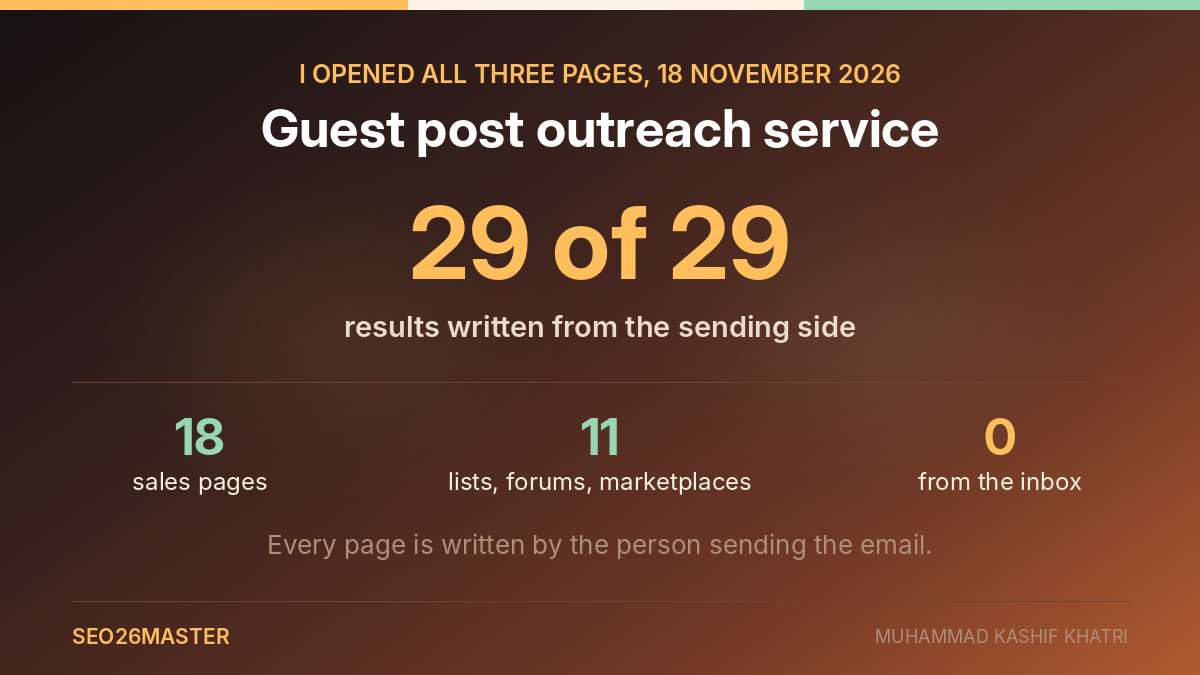
Search for a guest post outreach service and every page that comes back is written by the person sending the email. I opened all twenty nine results. Not one of them was written by somebody who receives those emails.
I receive them. I am an editor at ILLUMINATION on Medium, which has 324,000 readers, and at four other publications.
So this is the same market described from the other end of the inbox, which turns out to change the advice quite a lot.
What is actually on page one
I ran the search on 18 November 2026 and opened every result across three pages.
| What ranked | How many |
|---|---|
| Sales pages for the service | 18 |
| Freelance marketplace categories | 2 |
| "Best services" listicles | 2 |
| Blog posts explaining the process | 3 |
| Email template pages | 1 |
| A forum thread | 1 |
| A LinkedIn company page | 1 |
| An empty university e-portfolio | 1 |
Twenty nine results, and not one of them written from the receiving side. Even the forum thread, which dates from January 2021, is an agency asking other agencies which method to use.
The last row is worth a sentence. campus.eucim.com is a Spanish language Canvas install, the sort of system a college runs so students can keep a portfolio. Google lists one of those portfolios under the title "Guest Posting and Quality Blogger Outreach Services". I opened it and the portfolio is now empty: "Nada se ha ingresado aún". The parent domain eucim.com does not resolve at all.
That is the fourth time I have found this industry's marketing parked on a domain that has nothing to do with it. The others were a cancer charity subdomain, an arts centre, and the job board of a racing fabrication workshop, which I wrote up in link building reseller.
The thing the two biggest sellers say out loud
Here is the finding that should change what you buy, and it comes from the sellers themselves rather than from me.
The page ranking first for this search is guestpostingoutreach.com, titled "Manual Guest Post Outreach Services Company". Step two of its own process reads:
"our outreach guest posting comes directly from the blog owner with no guest profiles used"
FATJOE is the best known name on the results page. Directly under its headline, as a selling point:
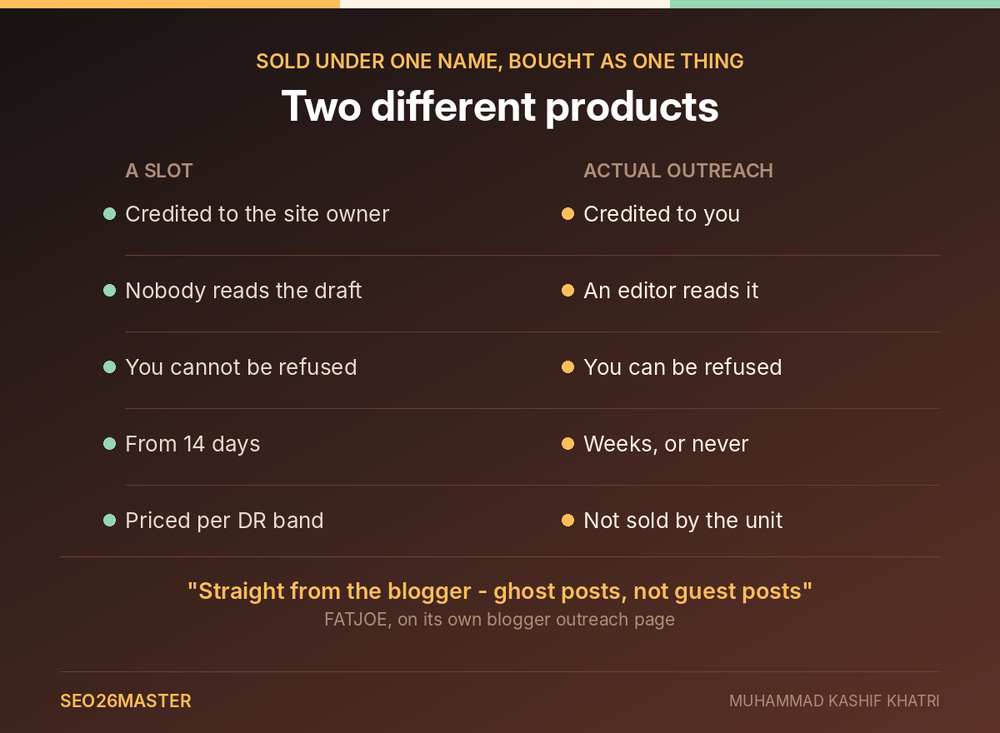
"Straight from the blogger - ghost posts, not guest posts"
Read those twice. Both are saying the article is published under the site owner's name. You are not a guest. There is no byline with your name on it. FATJOE is explicit about the word: ghost posts, not guest posts, on a page whose title tag says "Blogger Outreach (Guest Posting) Service".
Neither is hiding it. Both put it above the fold. It is simply that almost nobody reads a sales page closely enough to notice that the product has been renamed in its own description.
Two different products, one name
Once you see that, the whole results page sorts into two piles.
| Access to a slot | Actual outreach | |
|---|---|---|
| Who the article is credited to | The site owner | You |
| Who decides if it runs | Nobody reads it | An editor |
| Can you be refused | No | Yes, often |
| Timeline | From 14 days | Weeks, sometimes never |
| Priced by | DR band | Not usually sold by the unit |
| What you are buying | A placement | A chance |
Both are legitimate things to buy. They are not the same thing and they are not worth the same money.
The problem is that the second one's vocabulary has been borrowed to sell the first. "Manual outreach", "genuine outreach", "we reach out to bloggers" all describe a relationship with an editor. A ghost post placed on a site that publishes anything paid for has no editor in it anywhere.
If what you want is a byline on a publication people actually read, a product that explicitly removes your name cannot deliver it.
What the outreach numbers actually say
The most cited study in this field is still Backlinko's analysis of 12 million outreach emails, run with Pitchbox. It was published in 2019 and the page is still live.
| Finding | Figure |
|---|---|
| Outreach emails that get any reply | 8.5% |
| Effect of emailing the same contact again | 2x more responses |
| Effect of one extra follow-up | 65.8% more replies |
| Emailing several contacts at one organisation | 93% higher response rate |
| Personalised subject line | 30.5% higher response rate |
| Long subject lines against short ones | 24.6% higher |
It also found that emails about guest posting, link building and roundups all had an above average reply rate.
Sit with the first row. Ninety one and a half emails in every hundred are ignored. That is the baseline a service is working against when it promises you placements.
And the study is seven years old. Nothing about the years since has reduced the volume of this email.
Why the advice that works makes the inbox worse
This is the part I have not seen written anywhere, and it falls out of the data above rather than from any opinion of mine.
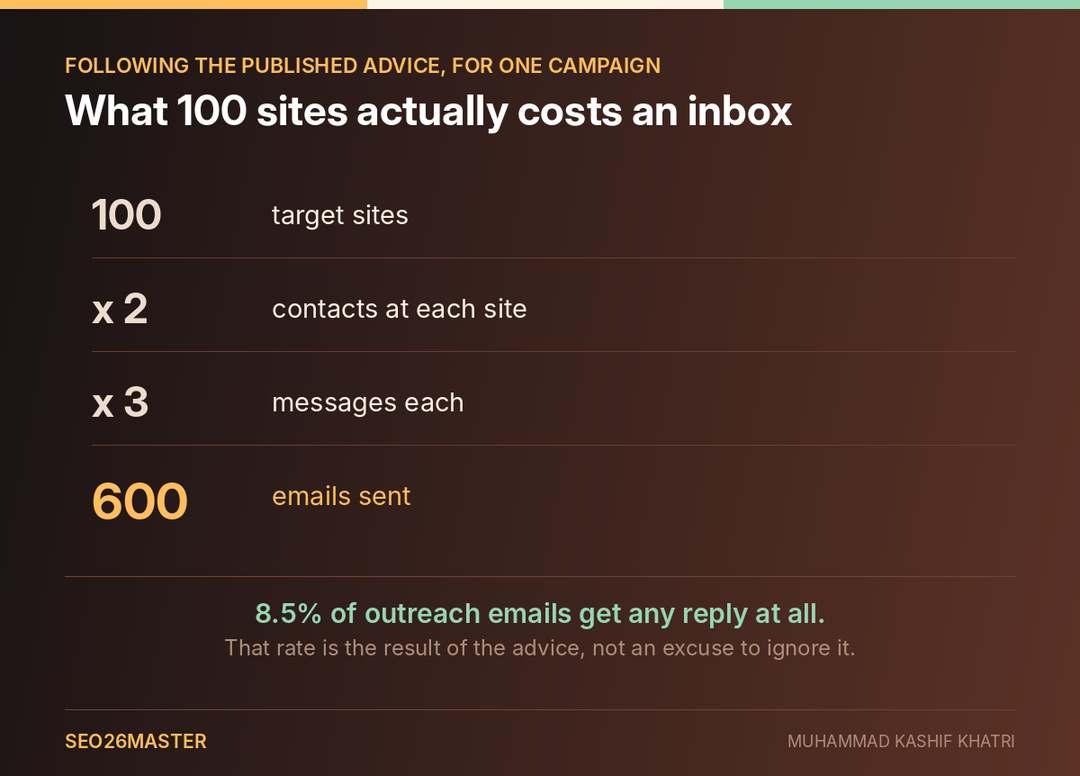
Hunter publishes guest post templates and states on that page that 66% of guest post replies come from follow-up emails rather than the first pitch. Backlinko found that three or more messages produces the best overall response rate, and that contacting several people at the same organisation lifts replies by 93%.
All of that is good advice. Follow it and you will get more replies than you would otherwise.
Now put it through an outreach service running a hundred sites. Three messages each, to two contacts at each site, is six hundred emails for one campaign. Multiply that by every agency following the same published advice.
The 8.5% reply rate is not a fact about human rudeness. It is the measured result of everybody taking the advice. Each sender optimising correctly makes the channel slightly worse for the next one, and the reply rate is the scoreboard.
I notice this from the receiving end. The follow-up is the part that decides how I read the sender, and it almost never helps.
What a guest post outreach service costs
FATJOE publishes a full rate card, which makes it useful whether or not you buy there. Checked on 18 November 2026, with a 20% discount running:
| Tier | Traffic band | List price | Discounted |
|---|---|---|---|
| DR10+ | 0 to 1,000 | $81 | $65 |
| DR20+ | 0 to 5,000 | $108 | $86 |
| DR30+ | 100 to 10,000 | $135 | $108 |
| DR40+ | 500 to 20,000 | $243 | $194 |
| DR50+ | 1,000 to 30,000 | $378 | $302 |
| DR60+ | 1,000 to 60,000 | $513 | $410 |
Included on the same page: from 14 days delivery, DR guaranteed, traffic guaranteed, writing included, one anchor and URL, do-follow, no duplicate domains, a lifetime link guarantee.
Two of those deserve a flag.
"Do-follow" is sold as a feature. A paid followed link is the first example Google's own spam policy gives of link spam. I have written the uncomfortable version of that, as somebody who sells placements, in is buying backlinks safe, and the mechanics of the attribute are in dofollow vs nofollow guest post.
"Lifetime link guarantee" is a guarantee with no number in it. In the most recent decay measurement I could find, the median lost backlink had been live for 128 days before it went. Ask for a replacement window with a length instead, and here is how to check whether a link is still live yourself.
Why the same DR band is priced three times apart
Hold that rate card against BuzzStream's October 2026 market data, which puts the average vendor guest post in the DR 30 to 39 band at $458.
FATJOE's DR30+ tier is $135.
Same band on paper, more than three times apart in price. The explanation is in the traffic column rather than the DR column. FATJOE's DR30+ sites carry 100 to 10,000 monthly visits. BuzzStream's average is pulled up by sites with far more than that, and in their data a vendor guest post on a site with over 100,000 monthly visits averages $3,210 against $229 at the bottom.
So the tier label tells you almost nothing. The traffic band tells you most of it. A rate card that gives you only a DR floor is giving you the cheaper half of the information, and guest post pricing has the longer version of why the asking price and the paid price keep diverging.
What happens when a pitch reaches me
A few things about the receiving end that change how you would write a pitch, if you were writing it yourself.
On the publications I edit on Medium there is no cold email at all. Submission goes through the platform. An outreach service emailing me is using a channel that is not the one the work arrives on, which tells me immediately that nobody checked. The five are listed on the publications I edit.
On an independent blog the email lands in the same inbox as invoices and client work. It is competing for attention with things that have deadlines.
What gets read is a subject line about the publication rather than about the sender. "Guest post opportunity" is about the sender. Anything naming a piece we actually ran is about us.
And the decision is two stages, not one. Saying yes to a pitch costs me nothing. Saying yes to a draft is a decision about what sits next to everything else we publish. Those are different answers and the second one is much harder to get. I wrote out the five reasons work comes back in why guest posts get rejected.
The part no outreach service covers
Follow that through and you find the gap in the product.
An outreach service sells you the first yes. On a site with an editor, the first yes is the cheap one. The draft still has to survive a read.
The services that guarantee publication have solved this by buying placements where nobody reads. That is the ghost post. It is why the guarantee is possible, and it is the whole trade: certainty in exchange for the thing that made a guest post worth having.
You can have a guarantee, or you can have an editor. There is no product that gives you both, and any page offering both is selling you the first while describing the second.
Five questions to ask before you buy
1. Will the article carry my byline, or the site owner's?
Ask it in exactly those words. The answer sorts the two products in one sentence, and both of the pages I quoted above already answer it in their own copy.
2. Does a human at the receiving site read the draft before it runs?
If no, you are buying a slot. Price it as a slot.
3. What is the traffic on these sites, not the DR?
DR is the half of the information that is cheap to guarantee. How to vet guest post sites is Google's own five checks, and you can run a domain through my free guest post site checker.
4. How many emails go out per placement, in my name or anybody's?
If the answer is six hundred for a hundred sites, you now know what the 8.5% is made of.
5. What is the replacement window, with a number?
Not "lifetime". A length, with terms.
When buying outreach makes sense, and when it does not
The honest version, from somebody who sells placements.
Buying makes sense when you need volume on a predictable schedule, when the pages you are linking to are commercial rather than reputational, and when nobody at your end is going to spend weeks being ignored. That is a real need and it is why this market exists.
Doing it yourself makes sense when the byline matters, when you want the relationship to still exist next year, and when one placement on a publication people read is worth more to you than ten slots. Sites that accept guest posts is the method for finding those without buying a list.
Most people reading this need some of each, which is fine as long as you are not paying the second price for the first product.
Where I sit in this
I should say plainly that I sell placements, so weigh all of the above accordingly.
The difference is the one this article is about. On the five publications I edit there is no site owner to pay for a slot and no ghosting of the byline, because the byline is the point. A piece runs with the writer's name on it or it does not run.
That also means I can say no, and do. If you want the version of this with a guarantee attached, buy the slot product from somebody on that results page. If you want the version with your name on it, the terms are on guest post campaigns, and agencies reselling it will want white label link building instead.
What I could not check
The Backlinko study was published in 2019. I verified the figures on the live page on 18 November 2026, but the data behind them is seven years old and the market has not stood still.
I could not establish who put a guest posting page on a Spanish university's e-portfolio system, or when it was removed. I can only report that Google still lists it and the page is now empty.
FATJOE's prices were captured during a 20% discount. List prices are what I have given alongside, but a rate card is a moment rather than a fact.
I have not bought from any company named here and cannot tell you whether they deliver. I read their published pages and quoted them accurately, which is a lower bar and the only one this method reaches.
My own observations about what reaches an editor are exactly that. They are one editor's experience across five publications, not a measured sample, and another editor would tell you something different.
Questions people ask
What is a guest post outreach service?
A company that contacts websites on your behalf to place an article containing a link to you. In practice the term now covers two different products: genuine pitching to editors, and buying a slot on a site that publishes paid articles under the owner's name.
Will the guest post have my name on it?
Often not. The page ranking first for this search states that its placements come "directly from the blog owner", and FATJOE describes its product as "ghost posts, not guest posts". Ask before you buy.
How much does guest post outreach cost?
FATJOE's published card runs from $81 at DR10+ to $513 at DR60+, checked 18 November 2026. BuzzStream's October 2026 market average for a vendor guest post in the DR 30 to 39 band is $458, because the average includes far higher traffic sites.
What response rate should I expect from outreach?
8.5% of outreach emails get any reply, in Backlinko's analysis of 12 million of them. Follow-ups roughly double that, which is also why the baseline is so low.
Is buying guest post outreach against Google's rules?
Buying followed links for ranking purposes is link spam under Google's own spam policy, whoever sends the email. Paid placements are permitted when qualified with nofollow or sponsored. Using an agency does not change which side of that line you are on.
Why does every page about this read like a sales page?
Because the people who sell it write the pages and the people who receive the emails do not. That is the gap this article exists to fill.
How long should guest post outreach take?
Fourteen days is the shortest credible delivery promise on the published rate cards I checked. A provider quoting forty eight hours is not waiting for anybody to read anything.
Leave a Reply