
Every white label pricing page tells you what you pay. None of them tells you what the site at the other end was paid.
The gap between those two numbers is the whole business, and it is published. It just sits in a table nobody divides.
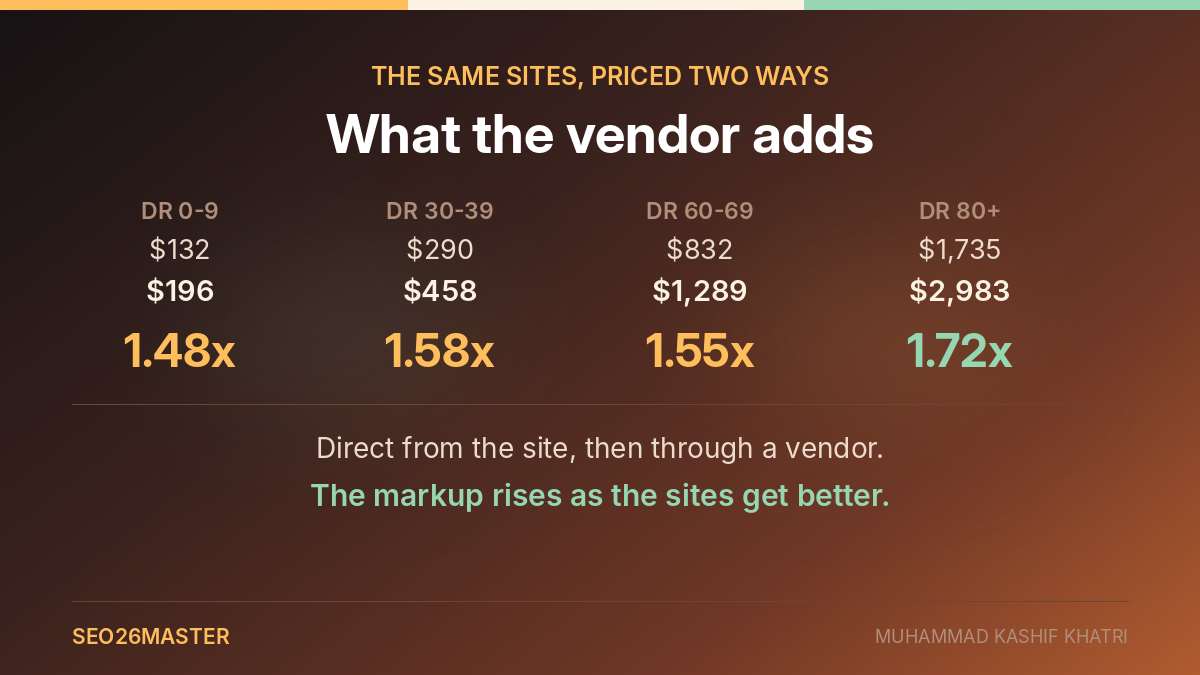
BuzzStream updated its link building price data on 20 October 2026. For the same sites, it lists two figures: what the site charges you directly, and what a vendor charges for the identical placement.
Here is what happens when you divide one by the other.
The markup, band by band
| DR band | Direct from the site | Through a vendor | Markup |
|---|---|---|---|
| DR 0 to 9 | $132 | $196 | 1.48x |
| DR 30 to 39 | $290 | $458 | 1.58x |
| DR 60 to 69 | $832 | $1,289 | 1.55x |
| DR 80+ | $1,735 | $2,983 | 1.72x |
Averaged across everything, a guest post costs $295 direct and $461 through a vendor. That is 1.56 times.
The markup is not a scandal and I want to be fair about that. A vendor finds the site, negotiates, commissions the writing, chases the editor and checks the link went live. That is real work and it has a price.
But if you are an agency deciding what to charge, this is the floor under your pricing and almost nobody states it.
It rises as the sites get better
Look at the right hand column again. The markup is 1.48 at the bottom and 1.72 at the top.
That is the opposite of what volume pricing usually does. Buy more of something, or buy something more expensive, and the percentage normally falls.
Here it climbs. At DR 80 and above, the vendor is adding $1,248 to a placement the site itself sells for $1,735.
The likely reason is simple. High authority sites are harder to reach, slower to answer and more likely to say no, so the work per placement goes up. But the effect on your margin is that the tier you are most tempted to resell is the tier where somebody else is taking the most.
What your client ends up paying
Now add the second layer, which is you.
If an agency resells at twice what it pays, which is a normal mark in this market, the arithmetic for a mid tier placement runs like this.
| Step | Price |
|---|---|
| The site is paid | $290 |
| The vendor charges the agency | $458 |
| The agency charges the client | $916 |
The client pays 3.2 times what the site received. At DR 80 and above, the same two layers take it to roughly 3.4 times: $1,735 becomes $5,966.
Nobody in that chain is doing anything improper. It is simply what two margins on one transaction look like, and clients rarely see it written down.
The finding that should change what you buy
This is the part of the data I did not expect.
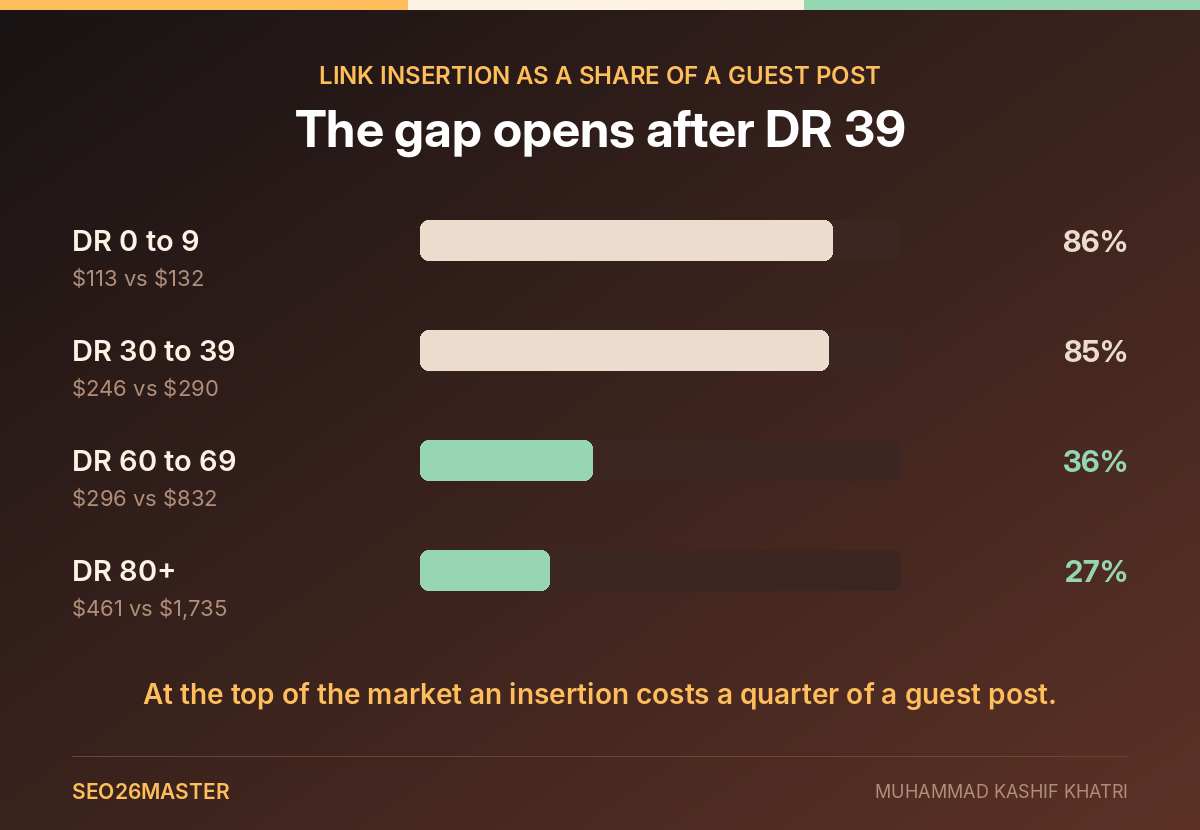
Compare a link insertion, which is adding a link to an article that already exists, against a guest post on the same site.
| DR band | Link insertion | Guest post, direct | Insertion as a share |
|---|---|---|---|
| DR 0 to 9 | $113 | $132 | 86% |
| DR 30 to 39 | $246 | $290 | 85% |
| DR 60 to 69 | $296 | $832 | 36% |
| DR 80+ | $461 | $1,735 | 27% |
At the bottom of the market the two cost almost the same. At DR 80 and above, an insertion costs a quarter of a guest post on the same site.
The gap is not small and it is not gradual. It opens up somewhere between DR 39 and DR 60 and then widens sharply.
If you are buying authority rather than a specific article, the high end of this market is priced in a way that rewards insertions heavily. I have written about where the two differ in practice in niche edits versus guest posts.
Traffic moves the price more than DR does
There is a second axis in the same data, and it moves prices further than domain rating.
| Monthly organic visits | Link insertion | Guest post, via vendor |
|---|---|---|
| 0 to 100 | $137 | $229 |
| 100,000+ | $510 | $3,210 |
A vendor guest post on a site with real readers costs fourteen times one on a site with almost none. The same jump on insertions is under four times.
That spread sits inside a single product. Two placements described identically on a rate card, both called a guest post, can differ by a factor of fourteen in what the site is actually worth.
It also explains a pricing trick worth knowing about. A provider selling on DR alone can buy in the cheap corner of this table and sell at the tier price, because DR and traffic come apart easily. A site can hold a high domain rating with almost no readers.
That is why the useful question is not which tier, but which site.
The DR 80 problem
There is a reason the top band is expensive, and it is not only authority.
In BuzzStream's database, 120 sites sit at DR 80 or above. That is 0.19% of the total.
So when a provider offers you DR 80+ placements, they are selling access to roughly one site in five hundred. The price is a scarcity price before it is a quality price.
And the number I keep thinking about
BuzzStream assessed 174 qualified sites against two criteria at once: real organic traffic, and a DA or DR threshold.
One site met both.
One, out of 174 that had already passed an initial filter.
I am not going to over-read a single figure, and BuzzStream does not explain how strictly those criteria were applied. But if you have ever wondered why a list of "high authority sites" shrinks to almost nothing once you check traffic as well as domain rating, that is the shape of it.
This is the argument for judging the site rather than the tier, which I have set out in what actually makes a backlink high quality.
What a month actually looks like
Abstract ratios are hard to act on, so here is ten placements a month at the mid tier, using the published figures.
| Line | Amount |
|---|---|
| You pay the vendor, 10 at $458 | $4,580 |
| You charge the client at 2x | $9,160 |
| Your gross margin | $4,580 |
| What the ten sites received between them | $2,900 |
Your margin and the entire publishing side of the transaction are almost the same number. That is the shape of this market and it is worth seeing once.
Two things follow from it.
If you can move even part of your supply closer to the source, the saving goes straight to your margin, because there is no quality change involved. You are removing a step, not cutting a corner.
And if a client ever asks what the sites were paid, you want to have decided your answer before they ask rather than during the call.
The average hides more than it tells you
One figure in the data does more damage to tidy pricing than any other.
The average link insertion costs $179. The range runs from $20 to $1,500.
That is a seventy five fold spread inside one product name. An average drawn across it is arithmetically correct and practically useless, because almost nothing actually costs $179.
The same problem sits under every tier on every rate card you will be shown. "DR40+" is a band, and inside the band are sites a buyer would pay $900 for and sites a buyer would refuse at $90.
This is why providers sell on tiers and why buyers should not buy on them. The tier is the thing the seller can standardise. The site is the thing you are actually getting.
BuzzStream's own rough summary is that a link bought from a vendor typically runs about $500. Hold that next to the $20 floor and you can see how much room there is for two placements at the same price to be worth entirely different amounts.
The third option nobody prices against
Guest posts and insertions are not the only way to buy links, and the comparison is rarely made honestly.
BuzzStream puts digital PR at $1,250 to $1,500 per unique linking domain, based on campaigns that typically net six or seven of them.
At first glance that looks expensive against $458 for a mid tier guest post. But those are not the same thing. A digital PR link is earned on a site that did not sell it, which puts it on the other side of Google's spam policy from a paid placement. I have written the uncomfortable detail of that line in is buying backlinks safe.
So the real comparison is: three mid tier paid placements, or one link from a site that chose to give it. Nobody can tell you which wins, and anyone who quotes you a ratio for it is guessing.
What you can say is that the price gap is smaller than the industry talks as though it is.
Reading a white label rate card properly
Four things to work out before you accept any price.
What is the direct price of these sites? You will not usually be told. But the table above gives you the shape: assume roughly 1.5 times has already gone on before you see the number.
Is the tier sold on DR, on traffic, or both? The traffic spread is enormous. A vendor guest post on a site with under 100 monthly organic visits averages $229. On a site with over 100,000 it averages $3,210. That is fourteen times, inside the same product.
Where does the price jump? The cliff between DR 39 and DR 60 is where guest post pricing roughly triples while insertion pricing barely moves. Knowing that tells you which product to buy in which band.
What happens when it comes down? Pricing is only half a deal. The median lost backlink lasted 128 days in the most recent decay measurement, so a replacement window shorter than four months covers very little. Here is how to check whether a link is still live.
What to do with this on Monday
Four things, in order, none of which takes long.
Ask your current supplier for two prices on one site. What they charge you, and what the site charges direct. Most will not answer. The ones who do are worth keeping.
Check one invoice against the table. Take a placement you bought last month, find its DR band, and see where your price sits against $196, $458, $1,289 or $2,983. If you are well above, you are paying for more than one layer.
Look at traffic, not just DR, on the next three sites you are offered. The difference between the cheap corner and the expensive corner of this market is fourteen times, and only one of the two numbers is on the rate card.
Get the replacement window in writing. Not a guarantee, a window, with a length. Four months is the floor worth accepting.
What I charge, and why it is different
I sell placements, so weigh this accordingly.
Everything above describes a chain: the site is paid, the vendor adds about 1.5 times, the agency adds its own margin, the client pays three times or more.
I am an editor at ILLUMINATION on Medium, which has 324,000 readers, and at four other publications. On those, the first link in the chain does not exist, because there is no site owner to pay for the slot.
That is the entire reason my prices sit where they do, and it is the one part of this that a competitor cannot match by discounting, because discounting does not remove a party from the chain.
The rates, the resale margin and what your client does and does not see are on my white label link building page. If you are weighing up the model itself rather than the price, start with link building reseller.
What I could not check
I did not collect this data and cannot verify it. BuzzStream states prices as of 20 October 2026 but does not say when the underlying data was gathered, which matters for a market that moves.
Their own sample sizes do not reconcile. The article gives 62,916 sites for link insertions and 257,267 for guest posts, while also describing the guest post set as "the same set as the link insertions (62,916 sites)". I have used the figures as published and flagged the inconsistency rather than picking one.
The markup ratios in this article are my arithmetic on their figures. The division is simple, but the conclusion is only as good as the inputs.
A database of sites that sell links is not the whole web. These prices describe the part of the market that advertises itself, which is the part you can buy from. That is not the same as what a link is worth.
The 2x agency resale figure is a common market mark, not a measured average. Your own number may be very different.
Questions people ask
What is white label link building pricing?
The wholesale rate an agency pays a supplier for placements it then sells under its own name. In BuzzStream's October 2026 data the average vendor price for a guest post was $461, against $295 charged by the same sites directly.
How much markup do link building vendors add?
Dividing the published direct and vendor figures gives 1.48 times at DR 0 to 9, rising to 1.72 times at DR 80 and above. The average across all bands is about 1.56 times.
What should an agency charge its clients?
Twice the wholesale price is a common mark, which puts the client at roughly 3.2 times what the publishing site received. There is no correct number, but you should know the chain before you set yours.
Are link insertions cheaper than guest posts?
At low authority, barely. At DR 80 and above a link insertion averages $461 against $1,735 for a guest post on the same site, which is about a quarter of the price.
Why are DR 80+ links so expensive?
Partly authority and partly scarcity. Only 120 sites in BuzzStream's database, 0.19% of it, sit at DR 80 or above.
Does a higher DR mean a better link?
Not on its own. Of 174 qualified sites assessed against both a traffic threshold and a DA or DR threshold, one met both.
How long should a replacement window be?
The median lost backlink in the most recent decay measurement lasted 128 days. A window shorter than four months covers very little of what actually happens.
Leave a Reply