
A backlink is simply a link on somebody else's website that points to yours. Search engines treat it a bit like a recommendation. That is why people buy them, chase them, and worry about them.
Every article about high quality backlinks gives you the same three words. Relevance. Authority. Editorial placement. Almost none of them tell you where those words came from. Almost none of them quote Google, which is the only company whose opinion actually decides the outcome.
This article does the opposite. Everything Google has published about links is quoted here, word for word, with the source named. Then you get five checks you can run on any link offer in about ten minutes, before you pay anybody.
One thing before you start, because it changes how you read the rest. Google has said in public, more than once, that links matter less than the SEO industry claims. The exact words are further down.
The short version
- A good link is one a real editor put inside a real article because it helped the reader.
- Domain Rating and Domain Authority are scores invented by tool companies. Google does not use either one.
- Paid links are allowed by Google, but only if the link is tagged as paid.
- Untrusted links are usually ignored, not punished. The money is wasted rather than the site damaged.
- Five relevant links beat fifty irrelevant ones, and Google has said so itself.
What is a high quality backlink?
A high quality backlink is a link that a real publication chose to put inside its own article because it helped the reader. The page carrying it gets real visitors, and the page it points to deserves the mention.
That is the whole definition. Everything else in this article is just a way of checking whether those things are true.
Four things decide the answer:
- Relevance. The page carrying the link covers a subject close to yours, close enough that a reader would want to click.
- Editorial placement. A human being chose to put the link in the body of the article. It was not bought from a price list, swapped, or dropped into a footer, a sidebar or a comment box.
- Real readers. The page gets visitors. The site has an audience, not just a pile of posts written for search engines.
- Honest tagging. The link can be read by Google, and it says what it is. A paid link marked
rel="sponsored"is fine. A paid link with no tag is what Google's own policy calls link spam.
Now look at what is missing from that list. Domain Rating is missing. Domain Authority is missing. Those are scores invented by tool companies, and Google has never used either one. They are useful for sorting a big list quickly. They are not a reason to buy anything.
What does Google actually say about links?
Google has written down its position in three places. Here it is, in Google's own words.
What links are for. From Google's documentation page about links:
"Google uses links as a signal when determining the relevancy of pages and to find new pages to crawl."
That one sentence does a lot of work, so read it slowly. Links do two jobs. They help Google discover pages it has not seen yet, and they help Google work out what a page is about. Notice what is not promised anywhere in Google's documentation. Nowhere does it say a link will raise your ranking.
Anchor text. Anchor text just means the words you can click on. From the same page:
"Good anchor text is descriptive, reasonably concise, and relevant to the page that it's on."
And a warning that most link sellers ignore:
"Write as naturally as possible, and resist the urge to cram every keyword."
Paid links. Google's spam policies page defines link spam like this:
"Link spam is the practice of creating links to or from a site primarily for the purpose of manipulating search rankings."
The same page then lists examples. Two of them describe the guest post market exactly as it works today:
"Buying or selling links for ranking purposes."
"Advertorials or native advertising where payment is received for articles that include links that pass ranking credit, or links with optimized anchor text in articles, guest posts, or press releases distributed on other sites."
And then comes the exception, which is the part nearly everybody skips:
"Note that buying and selling links is a normal part of the economy of the web for advertising and sponsorship purposes. It's not a violation of our policies to have such links as long as they are qualified with a
rel="nofollow"orrel="sponsored"attribute value to the<a>tag."
So paying for a placement is not banned. Paying for a placement and hiding the payment is. If you want the longer version of that argument, I wrote it out in dofollow vs nofollow for guest posts.
What happens to links Google does not trust. From Google's announcement of its December 2022 link spam update:
"Today, with our December 2022 link spam update, we're leveraging the power of SpamBrain to neutralize the impact of unnatural links on search results."
The same announcement told site owners what to expect. Rankings may move as these links are neutralized, and whatever credit they were passing is lost.
Read that again. The word Google chose is neutralize, not punish. For most websites, a bad link is not a penalty. It is a link that quietly counts for nothing. Which means the money spent on it also counts for nothing.
That policy lists eleven separate examples of link spam, and most of them have nothing to do with buying guest posts. I went through all eleven, quoted and explained one by one, in what Google counts as a link scheme.

Why does Google say links matter less than you think?
This is the part the link selling industry leaves out. That includes most of the people who would happily sell you links tomorrow.
In September 2023, at the Pubcon Pro conference in Austin, Google Search analyst Gary Illyes was asked whether links are a top three ranking factor. Search Engine Land reported his answer:
"I don't agree it's in the top three. It hasn't been for some time."
Seven months later, in April 2024, at a search conference in Bulgaria, he went further. Patrick Stox of Ahrefs reported the line:
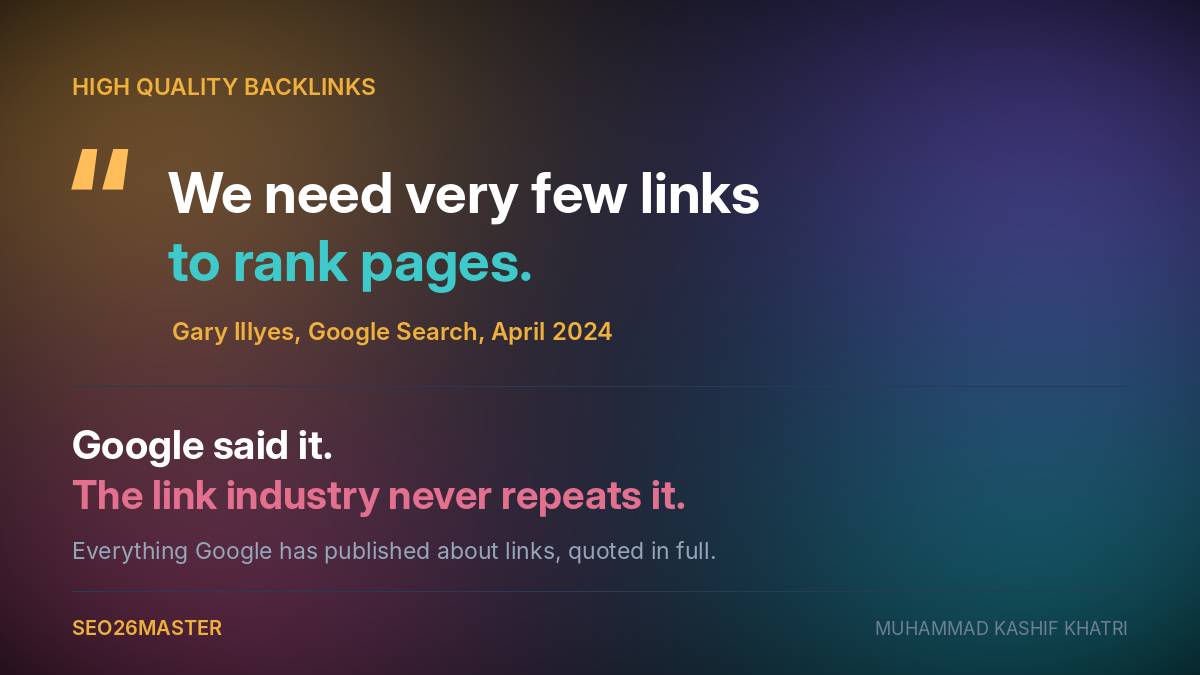
"We need very few links to rank pages... Over the years we've made links less important."
Illyes later posted that he should not have said it. That is worth noticing. People do not regret saying things that were untrue. They regret saying things that were true.
So how do you hold both ideas at once? Like this. Links still work, and Google's own documentation says so. But you need fewer of them than anyone is trying to sell you. And the difference between a good link and a weak one matters far more than the difference between five links and fifty. That is why the rest of this article is about judging one link properly instead of chasing a hundred.
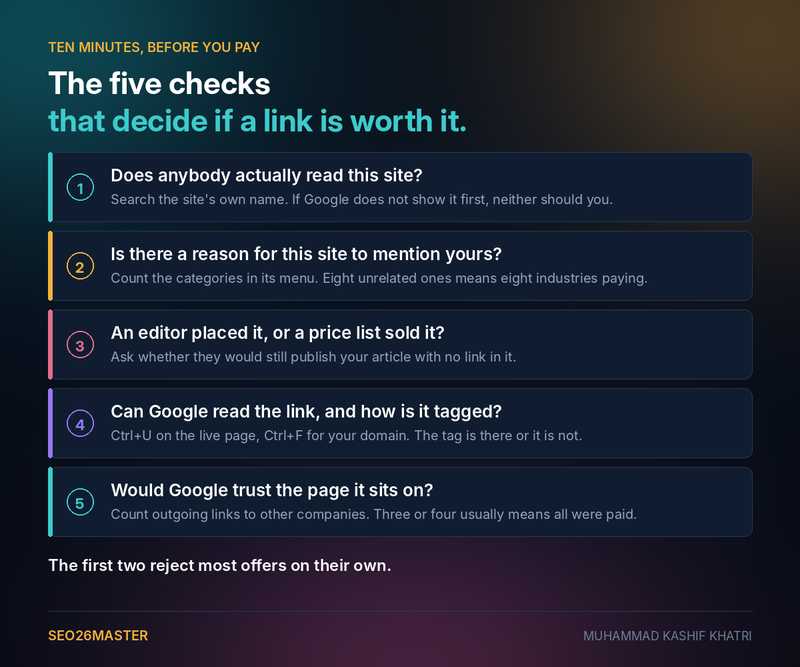
What are the five checks that decide whether a link is worth having?
Run these in order on any site that offers you a placement. The whole thing takes about ten minutes. The first two checks will knock out most offers on their own.
1. Does anybody actually read this site?
Open the site's ten most recent articles. Look at three things: the dates, the author names, and whether a single post has a comment, a share or a reply from a real person.
Then look at the traffic. Any backlink tool will show you an estimate of how many visitors a site gets from search. You are not looking for a big number. You are looking for a direction. Traffic that is steady or climbing is healthy. A site that had twelve thousand visitors six months ago and two thousand today is a site on the way down, and its link will give you a number in a dashboard instead of a visitor.
The thirty second version. Type site:example.com into Google to see roughly how many of its pages Google has stored. Then search the site's own name on its own. If Google does not show that site first for its own name, Google does not think much of it, and neither should you.
2. Is there a reason for this site to mention yours?
Relevance is not a feeling. There is a test. Read the paragraph your link would sit in, then ask one question. Would somebody reading this paragraph have any reason to click?
If a site covers travel, recipes, crypto and plumbing on the same home page, it is not relevant to anything. Ahrefs makes the same point in its own guidance on link quality. A page with no reason to mention your site will not help you.
The thirty second version. Open the site's menu and count the categories. On a small site, more than about eight unrelated categories usually means those categories exist to take money from eight different industries.
3. Was the link placed by an editor, or sold from a price list?
Ask the seller one question. Can I see your editorial guidelines, and who reviews the article before it goes live?
A real publication has an answer ready. It will tell you about word counts, about sources, about house style, and about the fact that a human being will edit your draft. A link seller answers with a turnaround time and a payment link.
This is the distinction Google's documentation keeps coming back to, and Ahrefs and Neil Patel's guides both land in the same place. In Ahrefs' words:
"The most valuable backlinks are those editorially placed somewhere within the content."
The thirty second version. Ask whether they would still publish your article if it had no link to you. The answer tells you exactly what you are buying.
4. Can Google read the link, and how will it be tagged?
A link Google cannot read does nothing at all. Google's documentation is specific about this:
"Generally, Google can only crawl your link if it's an
<a>HTML element with anhrefattribute."
In plain language, the link has to be a normal web link. A button, a redirect through another address, or a link built by a script may not count.
So before you pay, ask two questions. What will the link look like in the page code? And will it carry rel="nofollow" or rel="sponsored"? Google's instruction to publishers on this is one line:
"If you were paid in some way for the link, qualify these links with
sponsoredornofollow."
A seller who promises you an untagged link on a paid placement is promising to break Google's policy on your behalf. Notice who carries that risk afterwards. You do, not them.
Some large platforms make this decision for you, which is worth knowing before you spend a week writing for one. I checked what Medium does with its outgoing links in are Medium links nofollow, and the answer changes what that platform is actually good for.
The thirty second version. Once the article is live, open it, press Ctrl+U to see the page code, then press Ctrl+F and search for your own web address. The tag is either sitting there or it is not. My free guest post site checker does this check for you, along with a few of the others on this page.
5. Would Google trust the page your link sits on?
Finally, look at the article itself. Was it written for a reader, or assembled for a search engine? Does it name its sources? Does the author have a real history on that site?
This matters because a link can only pass along what its page has. A thin page that nobody else links to has almost nothing to give you, no matter how impressive the site's overall score looks. That is exactly why Ahrefs rates individual links using URL Rating, which measures the single page, rather than Domain Rating, which measures the whole website.
The thirty second version. Count how many outgoing links to other companies sit in the article where your link would go. Three or four of them in one short post usually means every single one was paid for.
How do you tell a high quality backlink from a low quality one?
| High quality backlink | Low quality backlink | |
|---|---|---|
| Why it exists | The link helps the reader finish a thought | The link exists because money changed hands |
| Where it sits | Inside the body of an article | Footer, sidebar, author bio, comment, widget |
| Who put it there | An editor who read the draft | Software, or a seller with a spreadsheet |
| The site's traffic | Steady or rising | Falling, or coming from one old viral post |
| The site's subject | One field, covered properly | Every field, covered thinly |
| The clickable words | Descriptive, varied, read naturally | The same sales phrase every time |
| How it is tagged | No tag if earned, sponsored if paid | No tag on a paid placement |
| What you get | Real clicks, plus the search signal | A number in a tool, and nothing else |
The clickable words row is where most paid campaigns give themselves away. I went through those patterns in guest post anchor text.
Where can I get high quality backlinks?
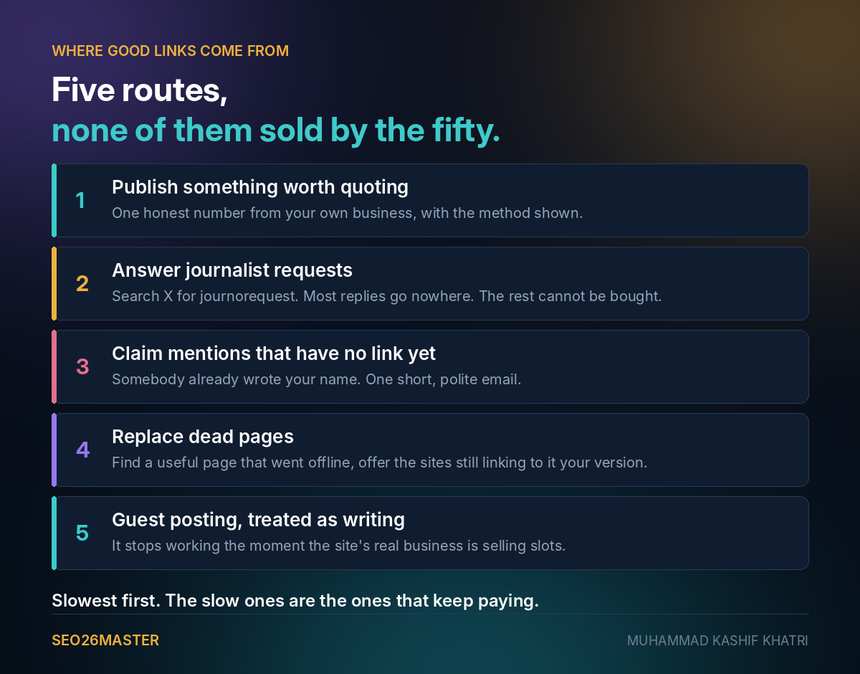
Here they are in rough order of what actually works for a small site with no budget and no reputation yet.
Publish something worth quoting. Real numbers from your own business beat opinion every time. You do not need a survey of ten thousand people. One honest figure from your own account, published with your method shown, gives writers something to cite. This is the slowest route, and the only one that keeps paying you back.
Answer journalist requests. Reporters publicly ask for sources every day. Search X for your subject along with the words journorequest or prrequest. Most of your replies will be ignored. The ones that land give you links that money cannot buy.
Claim mentions that have no link. Somebody has already written your brand name somewhere without linking to you. Find them by searching for your brand name in quotes while excluding your own site, then send one short, polite email. This works better than any other outreach, because the writer already decided you were worth mentioning.
Replace dead pages. Find a useful page in your field that has gone offline, find the sites still linking to it, and offer them your working version. The email writes itself, because you are fixing something broken on their site.
Guest posting, treated as writing rather than buying. This still works when you approach it as publishing. You pitch a specific article the publication's readers need, you write it properly, and the link is a by product rather than the point. It stops working the moment the site's real business is selling slots, which takes you back to check number three. I wrote out a longer process for judging those sites in how to vet guest post sites.
You will notice what is missing from that list. There is nothing here about packages of fifty backlinks. The next section explains why.
Each of those five routes has its own steps, its own search strings and its own honest success rate. I wrote them all out, along with three more and the five methods worth skipping, in how to get backlinks without guest posting.
Are free backlinks and backlink generators worth anything?
No, and Google's spam policies name them directly. One of the listed examples of link spam is:
"Using automated programs or services to create links to your site."
A backlink generator is exactly that kind of service. It produces profile links, comment links, directory entries and widget links across hundreds of sites in a few minutes. Google's list also names:
"Low-quality directory or bookmark site links."
"Forum comments with optimized links in the post or signature."
So here is the honest answer about free backlinks. Links from directories, profiles and comment sections are not dangerous in the way people fear, because of that word neutralize quoted earlier. They are simply counted as nothing. What you actually lose is the afternoon you spent making them, plus the false confidence of watching a number rise in a tool.
There is one kind of free link worth having, and it is not exciting. Your own genuine listings. Your Google Business Profile. Your industry association. Your local chamber of commerce. The supplier whose website lists its partners. The conference that lists its speakers. These are small, they are real, and they are the only free links that match something true about your business.
How much does a high quality backlink cost?
I have to be honest about the numbers here, because the published figures contradict each other.
A roundup of link building statistics by Create and Grow, which names the original source for each figure, reports all of these at the same time:
| Figure | What it claims to measure | Credited to |
|---|---|---|
| $361.44 | Average price of a paid backlink | Ahrefs |
| $77.80 | Typical cost of a paid guest post | Ahrefs |
| $508.95 | What SEO professionals consider acceptable for a high quality backlink | Editorial.Link, 2026 |
| $100 to $1,500+ | Range per link, depending on industry | Siege Media |
Those four numbers cannot all be describing the same thing. An average that swings from $77.80 to $508.95 depending on which study you open is not really an average. It is a sign that this market sells no standard product. So treat any single price quoted at you, including the ones in that table, as marketing rather than fact.
Since writing that, I found one dataset large enough to settle part of the argument. It covers 52,671 websites, and it separates the two things people actually buy, which the figures above do not. The 2026 averages come out at $459 for a guest post and $225 for a link insertion. I went through all of it in niche edits vs guest posts, including the gap between what sellers ask and what buyers really pay.
What actually moves the price:
- The site's real traffic. This is the only part of the price that matches something a reader would notice.
- Whether the site openly sells placements. Sites with a public price list are cheaper, and worth less, than sites you have to persuade.
- The industry. Finance, law, health and gambling cost several times more than a general business site of the same quality.
- Whether writing is included. A placement that comes with a properly researched article is a different purchase from slipping a link into an old post.
- The tag. If a seller charges extra specifically for leaving the paid tag off, they are charging you for the risk. The risk still stays with you.
I should say where I stand, because it affects how you read this section. I sell guest post campaigns. That makes me an interested party in any conversation about what links cost. It also means I have watched this market from the inside for years, and the five checks above are the ones I run before I will place anything for a client.
Are backlinks still relevant in 2026?
Yes, with two changes to how you think about them.
The first change is quantity. Go back to what Illyes said. Very few links are needed, and Google has made links less important over time. The old model, where an agency sold you a fixed number of links every month, was built for a version of Google that stopped existing years ago. Five placements on sites that genuinely matter in your field will do more than fifty on sites that accept anybody.
The second change is what a link is for now. AI answers in Google, ChatGPT, Gemini and Perplexity pick which sources to repeat. Getting named there depends on being mentioned and described across the places that write about your field. That is the same work as earning a good link, with one difference. For an AI answer, the mention counts even when there is no link in it at all.
So backlinks are not dead. What has changed is this. The thing a good link was always a side effect of, which is other people having a reason to talk about you, is now the main event. The link has become the receipt rather than the purchase.
Do bad backlinks hurt your site?
For most sites, no. Remember the wording Google chose in December 2022. Links it does not trust are neutralized, and the credit they were passing is lost. Nothing is taken away from you. The link simply stops counting.
That matters for two decisions.
Should you disavow? Disavowing means telling Google to ignore certain links pointing at your site. Almost certainly, you should not. Google's own staff have spent years explaining that this tool is for one narrow situation. It is for a site that has received a manual action for unnatural links, or a site that knows it bought links at scale and wants to come clean. A manual action means a human reviewer at Google has penalised your site, and Google tells you when that happens. Open Search Console, look under Security and Manual Actions, and check before you touch anything. An empty report means there is nothing to clean up.
Since writing that, two people have tested the tool properly and published what happened. One disavowed every link pointing at his own site, including links from Moz and Ahrefs, and nothing much changed. Another found a site running a file of 15,000 disavowed domains that had never mattered in either direction. I went through both, and what Google’s documentation actually requires, in the google disavow tool.
Should you worry about a competitor pointing junk links at you? Rarely, for the same reason. Ignored links are ignored.
The one situation that deserves real caution is buying links at scale with sales phrases as the clickable words. That is the exact pattern described in the spam policy quoted earlier in this article. That is what attracts a manual action, and a manual action is a completely different thing from a link being quietly ignored.
What this article cannot tell you
Three honest limits, because every other guide on this subject pretends it has none.
Nobody outside Google can measure what a link is worth. Ahrefs says so in its own documentation. URL Rating, Domain Rating, Domain Authority and every similar score is built from a company's own crawl of the web, not from Google's index. The checks in this article are better than those numbers, but they are still an educated guess.
The thresholds here are my judgement, not Google's rules. Eight categories, ten recent posts, three outgoing links. Those are the lines I use because they have worked for me, not because Google published them anywhere.
The prices are already out of date. The four figures in that table come from studies done at different times using different methods. Use them to understand how wide the range is. Never use them to decide what to pay.
What to do next
Take one link offer sitting in your inbox right now and run the five checks on it. If it fails the first two, you just saved the price of a placement in ten minutes, which is a better return than any article about backlinks is going to give you.
If you want the technical part done for you, my guest post site checker is free. It checks the tagging, the indexing and the basic site signals in one place, with no signup.
And if you would rather hand the whole thing to somebody who runs these checks before placing anything, that is what I do for clients in the UK, the US, Canada and Australia. The quickest way to start is to send me the page you want to rank and the search you want to rank for.
Frequently asked questions
Does a high quality backlink have to be dofollow?
No. There is no such thing as a rel="dofollow" tag. Dofollow simply means no tag was added. Under Google's policy a paid placement should carry rel="sponsored", and it can still send you the right readers and build recognition for your name.
How many high quality backlinks do I need to rank?
Google's Gary Illyes said in 2024 that very few links are needed to rank pages. The honest answer is that it depends on how competitive your search term is, and that five relevant placements usually beat fifty irrelevant ones.
Is Domain Rating a good way to judge backlink quality?
It is a way to sort a list quickly, not a way to decide. Domain Rating is Ahrefs' own score, built from Ahrefs' own crawl, and Google does not use it. A site with a high score, falling traffic and eight unrelated categories is still a low quality link.
Can I get high quality backlinks for free?
Some, yes. Mentions that have no link yet, journalist requests, genuine industry listings and your own original data all produce free links. Directory submissions, profile links and backlink generators do not, and Google's spam policy names automated link services directly.
How long does a backlink take to affect rankings?
Google has to find and read the linking page first, which can take days or weeks. After that any effect builds up slowly rather than arriving all at once. Treat anybody who promises results within a fixed number of days as a salesperson, not an SEO.
Sources quoted in this article
- Google Search Central, link best practices and crawlable links
- Google Search Central, spam policies for Google web search
- Google Search Central blog, December 2022 link spam update
- Search Engine Land, links are not a top three Google ranking factor
- Search Engine Journal, Google needs very few links
- Ahrefs help centre, what makes a high quality backlink
- Create and Grow, link building statistics
Leave a Reply