
You asked what a guest post costs. You were told it depends.
That answer is true and useless. So here is a better one, built from two separate studies covering more than three hundred thousand websites between them. Most guest post pricing articles quote a range somebody invented. These are measured numbers and you can check both sources at the bottom of this page.
A guest post, if the term is new to you, is an article you write that somebody else publishes on their site, usually carrying a link back to yours.
It has four prices, not one. They are all real, they are all different, and almost nobody separates them.
Here they are, before any explanation.
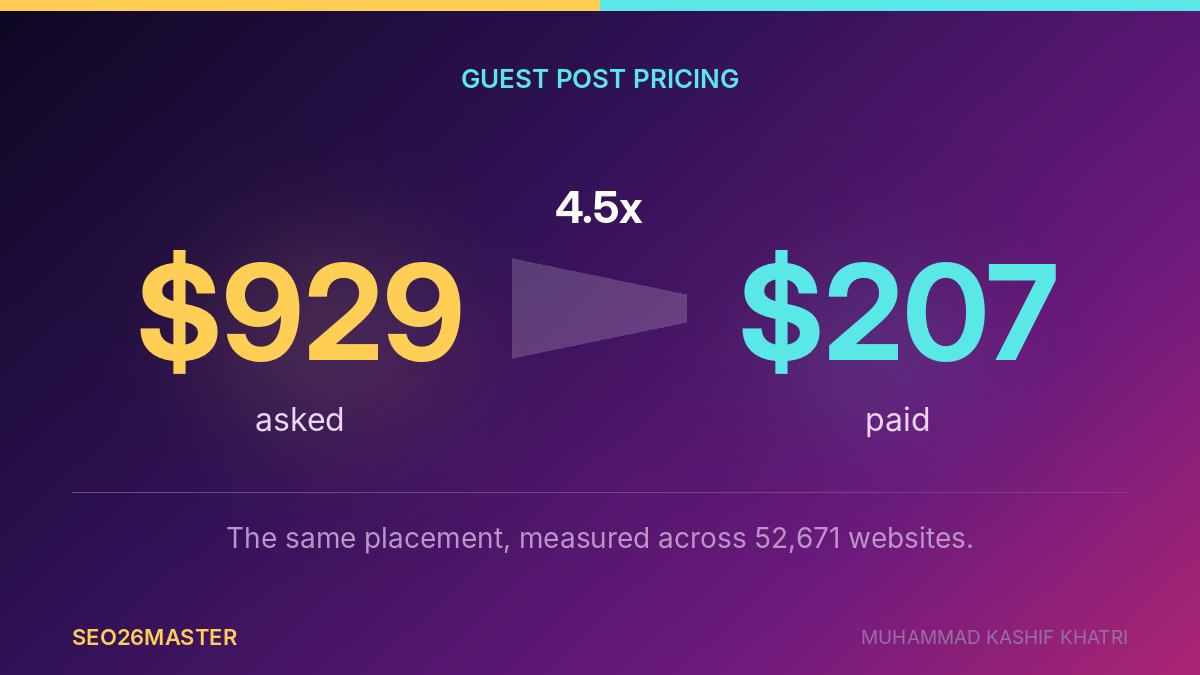
$929 is what sellers list it at. $461 is what a vendor charges you. A vendor here means anybody selling you the placement rather than publishing it, so a link building agency or a marketplace. $295 is what the site charges you directly, with no middleman. $207 is what buyers actually end up paying, once the haggling is done.
Same product. Four numbers. The rest of this article is about which one you should be paying, and why the gap between the first and the last is the most useful thing on this page.
Where these numbers come from
Two studies, run by two different companies, using two different methods.
Adsy published pricing research in 2026 covering 52,671 websites, with a wider set of 155,858 sites used for the country and niche breakdowns. The data is from February 2026 and comes from their own marketplace inventory, which means real listings and real transactions rather than survey answers.
BuzzStream published a study built from nearly 500,000 guest post sites, of which 257,267 had complete Ahrefs data and usable prices. It was published in August 2025 and last updated in June 2026. Their data comes from link vendor databases and a large link marketplace.
Different companies. Different sources. Different years.
Now look at what they found.
Adsy put the average guest post at $459.
BuzzStream put the typical vendor price at $461.
Two dollars apart.
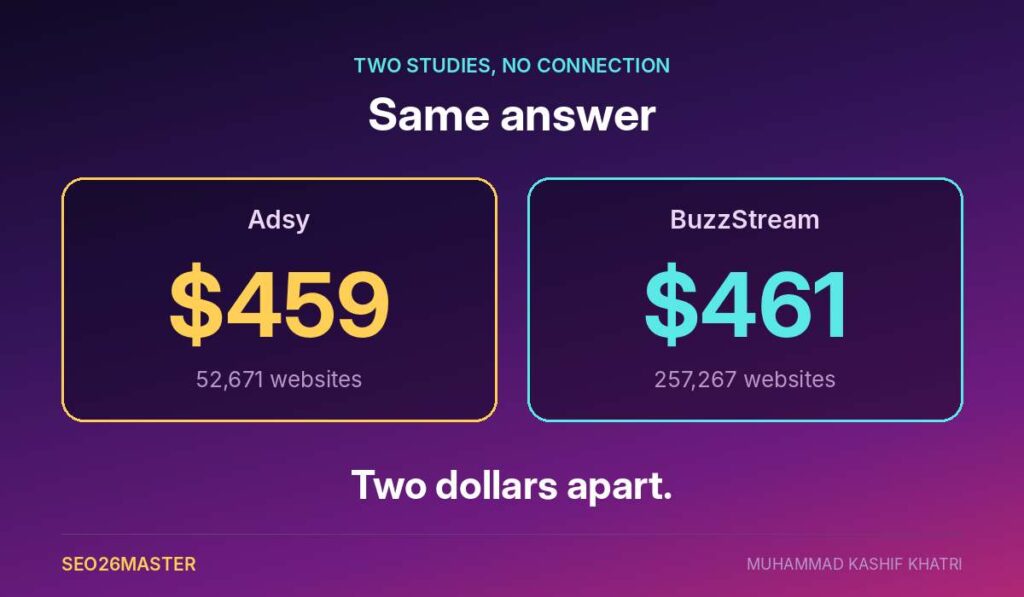
That is worth sitting with for a second. Two organisations with no reason to agree, measuring different pools of websites in different years, landed within half a percent of each other.
It means the number is real. When you are quoted $460 for a guest post, you are being quoted the market average, and both studies will back you up if you want to check.
It also means every price above and below that line needs explaining, which is the rest of this article.
The four prices, explained
$929: what sellers ask
This is the average asking price in the Adsy dataset. It is the number on the listing before anybody has negotiated anything.
Adsy's own conclusion is blunt.
"websites list backlinks at roughly 4x the typical transaction price."
So the first number you are given is not a price. It is an opening position, set high because the seller expects you not to argue.
$461 and $459: what a vendor charges
This is the market average, agreed by both studies. It is what you pay a link building company or a marketplace to handle the placement for you.
This number includes somebody else's work. Finding the site, pitching it, writing or commissioning the article, handling the publisher, chasing it when it stalls. Whether that work is worth the difference is a real question and the answer is sometimes yes.
$295: what the site charges directly
This is BuzzStream's figure for the price when you approach the publisher yourself rather than going through a vendor.
The gap between $461 and $295 is roughly 36%, and that gap is the reseller layer. BuzzStream are honest that some markup probably survives even in their direct figure, because many publishers also sell through marketplaces and keep their prices aligned.
So the real direct price is likely a little under $295, not over it.
$207: what buyers actually pay
This is the Adsy figure for the average price actually transacted, as opposed to listed.
It sits below the direct price, which looks odd until you understand what it contains. It includes every negotiated discount, every bulk deal, every cheap site in the pool, and every buyer who walked away from the first quote.
The distance from $929 to $207 is the single most useful fact about this market. It is a gap of about four and a half times, and it exists because most buyers accept the first number they are given.
What actually moves the price
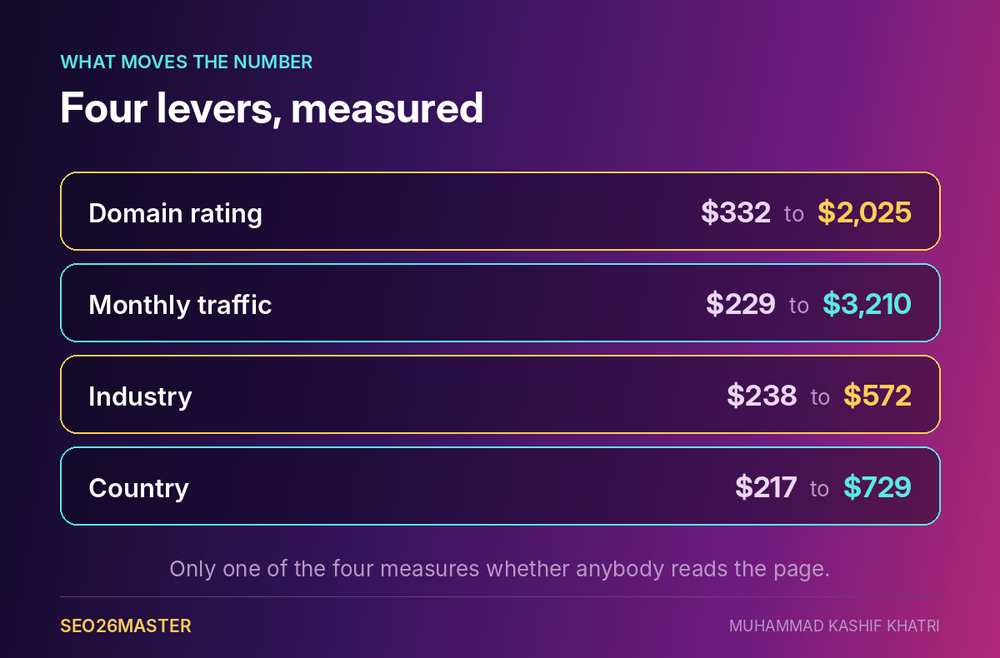
Four things, and they are not equally honest.
Domain rating
Domain Rating is Ahrefs' score out of 100 for how strong a site's backlink profile is. It is not a Google number and Google has never published anything like it.
Both studies show prices rising with it.
Adsy's bands:
| Domain rating | Average guest post |
|---|---|
| DR 1 to 30 | $332 |
| DR 31 to 70 | $555 |
| DR 71 and above | $2,025 |
Adsy put the relationship at roughly 32% more for every ten points of DR.
BuzzStream found the same shape, with around $200 at DR 0 to 9 and around $3,000 at DR 80 and above.
So the market prices on DR. That is a fact about sellers, not a fact about results.
Traffic
BuzzStream's traffic figures are steeper than their DR figures.
A site with under 100 visits a month averaged $229. A site with over 100,000 visits a month averaged $3,210.
That is a fourteen times spread, and it is the more honest of the two signals, because traffic is at least an attempt to measure whether anybody reads the page.
Industry
BuzzStream's averages by category are worth knowing before you accept that your niche is expensive.
| Category | Average |
|---|---|
| Sports | $572 |
| News and media | $567 |
| Health and wellness | $352 |
| Ecommerce | $341 |
| Adult and gambling | $238 |
Most people assume gambling is the expensive one. In this dataset it is the cheapest, because the supply of sites willing to take it is enormous.
Country
This is the one that surprises people, and it needs care.
Adsy's country figures, measured against their $459 average:
| Country | Average guest post |
|---|---|
| Pakistan | $217 |
| Global average | $459 |
| United States | $670 |
| United Kingdom | $729 |
A placement on a British site costs more than three times a placement on a Pakistani one.
I am based in Pakistan, so let me be precise about what this number is and is not.
It describes where the publication is, not where the seller is. A British agency can sell you a Pakistani placement at a British price, and somebody in Karachi can place you on a British site at the British cost plus their fee. The country figure follows the website, never the invoice.
So the useful question is not where your supplier lives. It is which country's websites you are actually being placed on, and whether those sites have readers in your market. If you sell to customers in Manchester, a cheap placement on a site nobody in Manchester reads is not a saving.
Which way prices are moving
Guest post pricing is not flat, and it is not rising evenly either.
Adsy compared their 2026 figures against their 2025 figures. The overall average went from $427 to $459, a rise of 7.5% in a year.
That is modest. The interesting part is where the rise happened.
| Domain rating | Price growth, 2025 to 2026 |
|---|---|
| DR 61 to 70 | 23% |
| DR 71 to 80 | 21% |
| DR 81 to 90 | 46% |
The top of the market is inflating more than twice as fast as the band below it, while the overall average barely moved.
Two things follow from that.
The first is that the average is being held down by the enormous supply of low DR sites, not by restraint at the top. If you are shopping above DR 70, last year's budget buys noticeably less than it did.
The second is more useful. A 46% rise in a single year, in a band where there is no new supply being created, is a sellers' market rather than a quality improvement. Those sites did not get better in twelve months. The queue for them got longer.
Where domain rating stops working
Here is something in BuzzStream's own data that undercuts the thing the whole market prices on.
In their study of link insertions, covering 421,259 sites, the average price by DR band runs like this.
| Domain rating | Average insertion |
|---|---|
| DR 0 to 9 | $113 |
| DR 10 to 19 | $144 |
| DR 20 to 29 | $188 |
| DR 30 to 39 | $246 |
| DR 40 to 49 | $197 |
| DR 50 to 59 | $212 |
| DR 60 to 69 | $296 |
| DR 70 to 79 | $411 |
| DR 80 and above | $461 |
Read the fourth and fifth rows again. Sites at DR 40 to 49 are cheaper than sites at DR 30 to 39.
BuzzStream flag this themselves rather than smoothing it over, which is to their credit.
It matters because it shows the DR premium is not a rule. It is a pricing habit, and habits have gaps. A site at DR 45 priced like a site at DR 35 is a genuine bargain, and it stays one whether or not the seller realises it.
What link insertion cost looks like, for comparison
A link insertion, also sold as a niche edit, means your link is added into an article that already exists. No new article is written, which is why the link insertion cost sits well below a guest post.
Both studies measured it.
Adsy put the average at $225, which they describe as about 56% cheaper than a guest post.
BuzzStream put it at $179 across 421,259 sites, of which 62,916 offered insertions.
The two figures are further apart than the guest post numbers were, but they agree on the shape. An insertion costs roughly half what a guest post costs, sometimes less.
Which of the two is worth paying for is a longer argument and it does not come down to price. I went through it in niche edits vs guest posts.
Where the money actually goes
At $460, a fair share of what you are paying for is not the link. The spend breaks into five parts, and only the first one is what most buyers think they are buying.
The publisher's fee. The money the site actually receives. On many sites this is less than half the total.
The writing. An article a real publication will accept takes hours, not minutes. On a technical subject it takes longer, and if the writer has to use the product before writing about it, longer again. This is the part that disappears first when a price is cut.
The finding. Identifying a site that fits, takes contributions, and is worth being on. The searches that do this are free and I wrote them up in sites that accept guest posts, but running them properly still takes an evening.
The checking. Whether the site is a publication or a rented shelf. This decides whether the money was wasted, and it is the part most often skipped, because it produces nothing the buyer can see. The six checks are in how to spot a link farm.
The chasing and the failures. Editors go quiet. Articles sit in queues for six weeks. Pieces get rejected after being written, and somebody absorbs that cost.
Now apply all five to a $20 placement.
At that price there is no writing worth the name and no checking at all. The publisher's fee has to be close to nothing, which tells you what sort of site would accept it. The money was not saved. The work was simply not done, and what you have is a link on a page nobody reads, on a site that exists to carry links.
When a price sits far below market, ask which of the five was removed. It is almost always the checking.
If you want the longer version of what separates a link worth paying for from one that is not, it is in what makes a backlink high quality.
How to negotiate, written by somebody you would be negotiating with
I sell this. Publishing what follows is against my own short term interest. I am doing it because the first number in this article makes the whole trade look dishonest, and I would rather be on the other side of that.
Never accept the first quote. You now have the figure. Across 52,671 websites, listed prices averaged four and a half times transacted prices. The seller is not insulted by a counter offer, they are waiting for one.
Counter with a reason, not a number. "Can you do better" invites a token ten percent. "Your site publishes twice a month and four of the last ten posts are sponsored, so I would be paying publication rates for a sponsored slot" changes what is being discussed.
Ask what the price includes before you ask what it costs. The publisher's fee, the writing, the finding, the checking and the chasing are five separate jobs. A $200 price covering two of them is more expensive than a $500 price covering all five, because you will pay for the missing three somewhere.
Ask who owns the relationship with the publisher. If your seller is buying from another seller, there is a second markup in your quote and nobody will mention it. BuzzStream measured that layer at roughly 36%.
Ask what happens if the link is removed in six months. The answer is almost always nothing. Getting that said out loud before payment changes how seriously the rest of the conversation is taken.
Be willing to walk away on one placement. This is the only leverage that reliably works, and it only works if it is true. If you need this specific site, you have already lost the negotiation and you should expect to pay closer to $929 than to $207.
Do the checking first. Every item above depends on knowing something about the site that the seller assumed you would not look up. The checks cost nothing and they are the entire source of your position.
What I charge, and why it is on the page
Most people in this trade will not publish their prices. The reason is in the first number in this article. If your asking price is four times your real price, publishing it ends the negotiation you were relying on.
Mine are published, on the pricing page, and they start at $150 per article for editorial placements and guest posts.
That is below every figure in this article, including the $207 that buyers actually pay on average and the $295 direct price.
I am not claiming that makes me better. It makes me cheaper, and by the rule I gave you four sections ago, a price that low is exactly the kind you should interrogate rather than celebrate.
So interrogate it. Here is what it does and does not include, plainly.
It is per piece of work. No packages, no retainers, no minimum term. The price moves with the publication, the research involved, and whether I have to use a product before writing about it, so $150 is a floor and not a flat rate.
All five jobs are in it. The publisher's fee, the writing, the finding, the checking and the chasing. What is not in it is a sales team, an office, or a second seller taking a cut. Those are most of what sits between $295 and $461 in the figures above.
There are also three things I do not charge for, and they are part of why the floor can sit where it does.
I do not charge for telling you a placement is not worth doing. That conversation is the most valuable thing in the process and billing for it would give me a reason to say yes.
I do not charge for telling you your budget is better spent elsewhere, including when the answer is that you should not be buying links at all this year.
I do not charge for adding a writer to any of the five publications I edit, one of which is ILLUMINATION on Medium with 324,000 readers.
If you want the full detail, it is on the pricing page. If you want to talk about a specific site, the guest post service page explains how that works.
What not to pay for
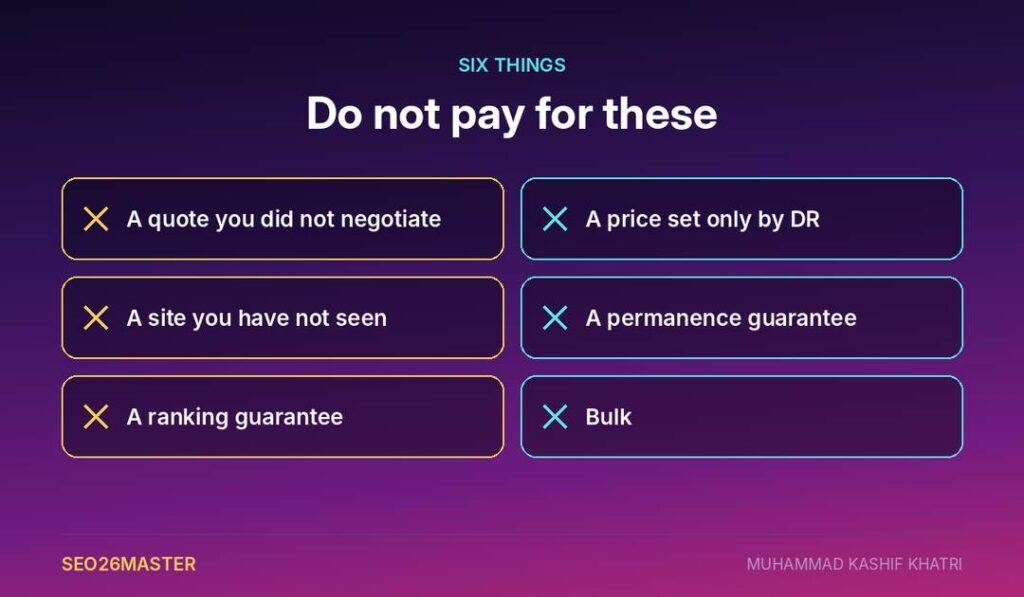
Six things, based on the numbers above.
A quote you did not negotiate. The market average asking price is four and a half times the market average paid price. If you accepted the first number, you were the buyer that statistic was built from.
A price set only by DR. You now know that BuzzStream's own data has a band where higher DR costs less. A seller whose entire price list moves in a straight line with DR is pricing a number, not a placement.
A site you have not seen. Any seller who will not name the domain before payment is asking you to buy something you are not allowed to inspect.
A permanence guarantee. Nobody can guarantee a link stays. Sites get sold, pruned and abandoned, and a study of more than 865,000 monitored links found at least 31% already gone.
A ranking guarantee. The one promise nobody makes honestly, at any price.
Bulk. The cheapest end of this market is cheap because the checking has been removed. Fifty placements at $20 is not a discount on $1,000 of work, it is a different product with the same name.
The rules, because price is not the only question
No guest post pricing article is complete without this part, and most of them skip it entirely.
Google's spam policies open the link spam section with a definition.
"Link spam is the practice of creating links to or from a site primarily for the purpose of manipulating search rankings."
Then they list examples. The first one is short.
"Buying or selling links for ranking purposes."
Note that it says buying or selling. The policy applies to the publisher taking your money as much as to you paying it.
The example that names this exact transaction comes further down the list. One term in it needs translating first. Ranking credit is the boost a link is supposed to pass to the page it points at, which is the thing being bought.
"Advertorials or native advertising where payment is received for articles that include links that pass ranking credit, or links with optimized anchor text in articles, guest posts, or press releases distributed on other sites."
The words "guest posts" are in Google's own sentence.
The same documentation also says this, which almost nobody quotes.
"Google does understand that buying and selling links is a normal part of the economy of the web for advertising and sponsorship purposes. It's not a violation of our policies to have such links as long as they are qualified with a
rel="nofollow"orrel="sponsored"attribute value to the<a>tag."
So paying for a placement is allowed. Paying for one that passes ranking credit is not. Those tags are two short words a publisher adds in the page code, invisible to readers, that tell Google not to pass credit through the link.
Anybody selling you a guaranteed followed link for money is selling you the violation, not the workaround. The full policy, line by line, is in what Google counts as a link scheme.
A fair way to decide what to pay
- Take the quote you were given.
- Divide it by four and a half. That is roughly where the market actually transacts.
- Ask whether the site would still be worth it at the lower number. If not, the site is the problem, not the price.
- Run the checks before you negotiate, because knowing the site is weak is the only leverage that works.
- Ask what the price includes. If writing, checking and chasing are not in it, you are paying a placement fee for a link, which is a different and worse purchase.
- Decide what the link is tagged as before money moves, not after.
Questions people ask
How much does a guest post cost in 2026?
The average guest post price is around $460. Two independent studies put it at $459 and $461. Adsy measured 52,671 websites from February 2026 inventory. BuzzStream measured 257,267 sites with complete data, published August 2025 and updated June 2026.
Why is guest post pricing so inconsistent?
Because four different prices exist for the same product and sellers quote whichever one suits them. Listed prices average $929, vendor prices average around $460, direct prices average $295 and transacted prices average $207. All four are real numbers from real data, which is why two honest sellers can quote you figures that are four times apart.
Is a more expensive guest post better?
Not reliably. Price tracks domain rating and traffic, and only traffic is an attempt to measure readership. BuzzStream's own insertion data has a band where higher DR sites cost less, which tells you the pricing is a habit rather than a measurement.
Why are guest posts cheaper in some countries?
Because supply is larger and costs are lower there. Adsy put Pakistan at $217, the United States at $670 and the United Kingdom at $729. That figure describes where the website is, not where your supplier is.
Should I buy in bulk to get the price down?
Bulk discounts in this market usually come from removing the checking rather than from economies of scale. The cheapest placements also die fastest, which makes the saving temporary.
Is paying for guest posts against Google's rules?
Paying for a placement is not. Paying for one whose link passes ranking credit is. The difference is a tag in the page code, and it is settled before publication rather than after.
What do you charge?
From $150 per article, published on the pricing page, priced per piece of work with no packages or retainers. That sits below the $207 average that buyers actually pay, which is a reason to ask what is included rather than a reason to relax.
Sources
- Adsy, Link Building Pricing in 2026, 52,671 websites analysed, February 2026 data: https://adsy.com/blog/how-much-should-you-pay-for-guest-post
- BuzzStream, The Cost of Guest Posts, based on nearly 500,000 sites with 257,267 usable records, published August 2025 and updated June 2026: https://buzzstream.com/blog/guest-post-costs/
- BuzzStream, The Cost of Link Insertions, 421,259 sites, 2026 data: https://www.buzzstream.com/blog/link-insertion-costs/
- Google Search Central, Spam policies for Google web search, link spam section: https://developers.google.com/search/docs/essentials/spam-policies
- Linkody, Link Building Statistics, 865,000 monitored links, 2026
Leave a Reply