
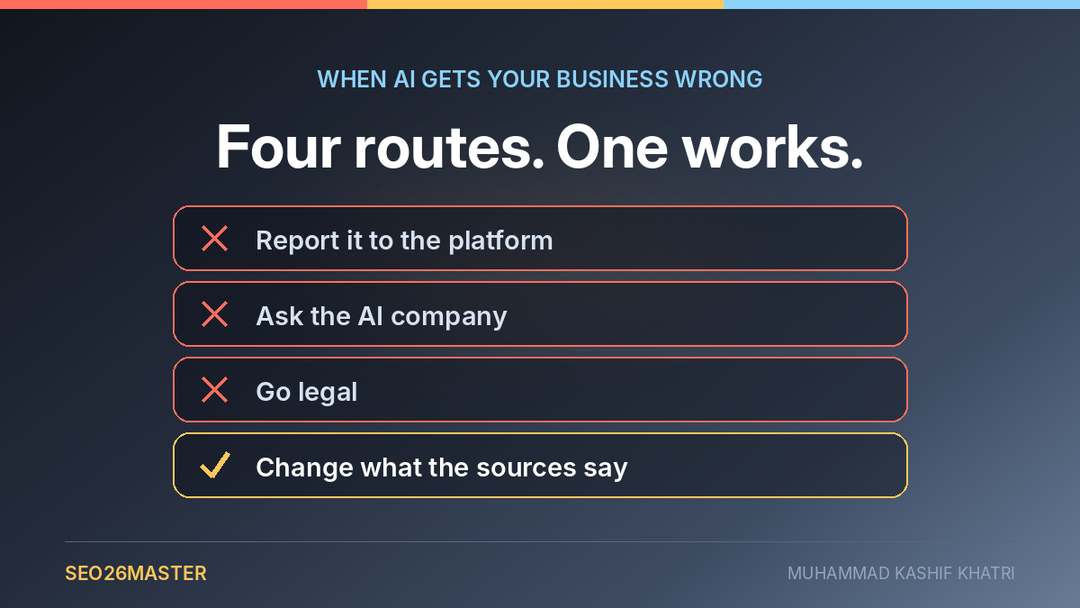
Search this problem and you get the same four pieces of advice everywhere.
Click the thumbs down and report it. Email whoever published the wrong page. Contact the AI company. If it is serious, get a lawyer involved.
Three of those four have been tested in public, with published results. The results are not what the advice suggests.
Google has said in writing that it does not fix AI answers one at a time.
OpenAI has told a European regulator that it cannot correct a false fact about a person. It can only block that person's name altogether.
And the one company that ran the email-the-publisher route properly and published its numbers got a correction about a quarter of the time.
People search for this in the first person. AI wrong information about my business, typed in a hurry, usually by somebody who has just seen it and wants it gone today. This page goes through all four routes, what each one really does, and the one approach with a documented before and after.
How often does this actually happen
More often than most business owners realise. The only serious published count comes from a company that pointed the test at itself.
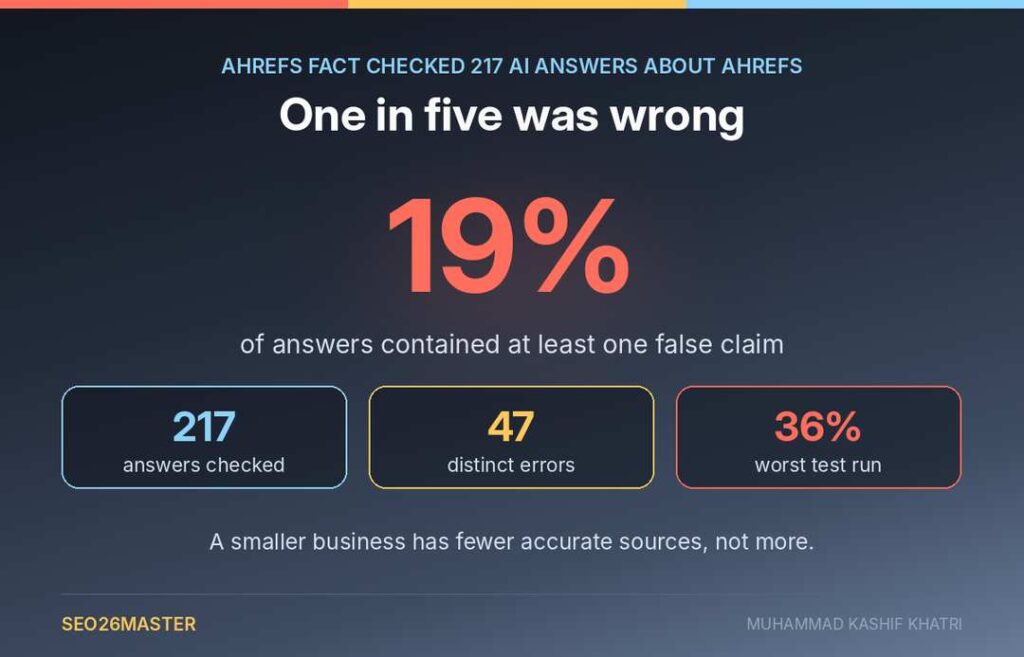
Ahrefs fact-checked 217 AI-generated answers about Ahrefs. Of those, 41 answers contained at least one false claim. That is 19%, or in their words "roughly 1 in 5".
They found 47 distinct errors in total, and they add that "in some of our tests, the error rate was as high as 36%."
Sit with that for a second. This is a well known company, with thousands of pages about it, a large brand presence and plenty of accurate sources for a model to draw on. One answer in five about them still contained something false.
If you run a smaller business, with fewer pages written about you and fewer independent sources, there is no reason to expect a better rate. There is every reason to expect a worse one.
What it looked like when it happened to me
I publish a free tool for checking guest post sites. Google's AI Overview described it by mixing it up with a different, similarly named tool, and presented the result confidently.
That is the pattern worth noticing. The AI did not invent something from nothing. It collapsed two real things with similar names into one, and then described the merged version as a fact.
That matters for the fix, because the question is not "where did it get this nonsense". The question is "which real thing did it confuse mine with, and where". Those are very different problems to chase.
The four kinds of error, and why the difference matters
Before you can do anything useful you have to know which kind you are looking at. They look identical in the answer and they need completely different responses.
| Kind | What it looks like | Where the fix is |
|---|---|---|
| Quote | The wrong fact appears word for word on a page the AI cites | That page |
| Outdated | It was true once. An old price, a feature you removed | Usually your own site, or an old article about you |
| Merge | Two real things with similar names collapsed into one | Nowhere. The fix is making your name unambiguous |
| Invented | No source anywhere contains it | Nothing to correct. Only prevention helps |
Most advice treats all four as the same problem and sends you to the same feedback button. They are not the same problem. A quote has a page you can point at. A merge does not, and writing to anybody about it is wasted effort.
The quickest way to tell them apart is to open the sources the answer cites and search each page for the wrong claim. If you find it, you have a quote. If you do not, you almost certainly have a merge or an invention, and the route changes completely.
Route one: the feedback button
This is the advice on almost every page about this problem. Find the thumbs down under the AI Overview, click it, choose Report a problem, describe what is wrong.
Here is what Google has actually said about what happens next.
Elizabeth Reid, Google's Vice President of Search, wrote a post on 30 May 2024 about AI Overview errors. In it she explained how Google handles them:
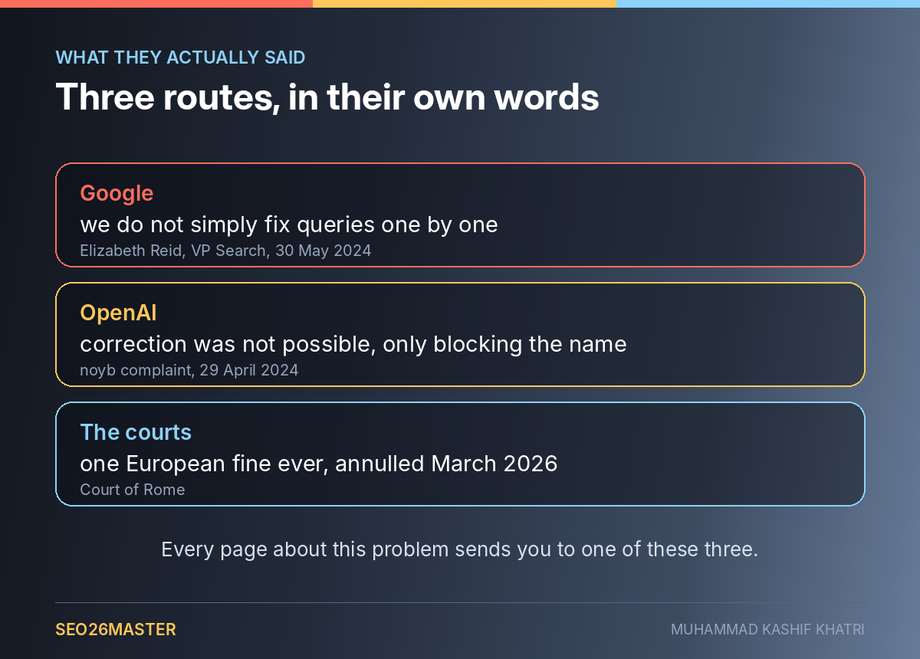
we don't simply "fix" queries one by one, but we work on updates that can help broad sets of queries
Read that again, because it is the opposite of what the feedback button implies. Google is telling you that it does not go in and repair the specific answer you reported. It looks for patterns across many queries and ships changes that affect broad groups of them.
Google does act directly in one case, which it also states. It removes AI Overviews that break its content policies. Her wording is that Google has "established processes to remove responses that don't comply with our policies."
So the honest summary of route one is this. If the answer about your business breaks a Google policy, there is a removal process. If it is simply wrong, your report becomes one data point in a pattern, and nobody will write back to tell you what happened to it.
That is not a reason to skip it. It takes fifteen seconds and it costs nothing. It is a reason not to sit waiting for a result.
Route two: ask whoever published the wrong page
This is the route that actually touches the cause. It is also the only one anybody has tested at scale and published the numbers for.
Ahrefs traced their errors back to the pages the AI was citing, found the authors, and asked for corrections. Their results, in their own words:
We contacted 26 authors about inaccurate information in their articles.
14 replied (53.8%), and 6 made corrections we could verify on their pages (23%).
For 12 of the 26 contacts, we received no reply.
| What happened | How many | Share |
|---|---|---|
| Authors contacted | 26 | 100% |
| Replied | 14 | 53.8% |
| Verified correction made | 6 | 23% |
| Never replied at all | 12 | 46% |
So roughly one request in four produced a fix. Nearly half of the people contacted never answered at all.
And remember who was doing the asking. This is Ahrefs, a company most people in this industry have heard of, writing to authors who very likely use their software. If their hit rate is 23%, an unknown business writing cold should plan for less.
That is still the best number on this page. Route two works more often than the other three put together. It just works less often than the advice implies, and that changes how you should spend your time on it.
Route three: ask the AI company to correct it
This is where the advice falls apart completely, and the evidence comes from the AI companies themselves.
On 29 April 2024 the privacy group noyb filed a complaint against OpenAI with the Austrian data protection authority. The complainant was a public figure. ChatGPT kept giving the wrong date of birth for him. Rather than saying it did not know, it produced a confident wrong answer.
He asked OpenAI to correct it. OpenAI said that was not possible.
What OpenAI said it could do instead was block his name. Not correct the date, not replace the wrong answer with the right one, but filter the name so the system would stop returning information about him at all. Correct or invisible, with nothing in between.
Asked about accuracy more generally, OpenAI's position was that "factual accuracy in large language models remains an area of active research."
A second noyb complaint followed in March 2025, this time in Norway, from a man whom ChatGPT described as having murdered his own children. Not a wrong date. An accusation of murder.
I am not raising these to be dramatic. They are the clearest public record we have of what the model makers say they can actually do about one specific false fact. The answer is much less than the advice assumes.
If OpenAI told a regulator it could not correct a public figure's date of birth, your support ticket about a product description is not getting edited either.
Route four: the legal route
This one sounds strongest and has produced the least.
Europe's data protection law gives people a right to have inaccurate personal data corrected. That is Article 16 of the GDPR, and it is the basis of both noyb complaints. On paper it is exactly the right tool.
Here is what has come of it.
Italy's privacy regulator, the Garante, fined OpenAI 15 million euros in late 2024. In March 2025 a court suspended the decision. On 18 March 2026 the Court of Rome annulled it.
Writing the next day, Theodore Christakis described what that leaves behind. The Garante fine was "the only final GDPR enforcement action ever adopted in Europe concerning the period of the launch of generative AI", and it is now gone. In his words, "since then, not a single other European DPA has published a final enforcement decision." DPA there means data protection authority, the national privacy regulator in each country.
So the legal route in Europe currently stands at one final decision ever, overturned, and nothing else finished.
There is a real caveat, and it cuts the other way. Pressure from regulators has changed how these companies behave even without a fine landing. When Italy briefly banned ChatGPT in 2023, OpenAI added a privacy notice, an opt-out mechanism and age verification. Christakis makes that point directly: regulator action "can reshape how AI companies operate in Europe" without any penalty being paid.
That is worth knowing. It is also not a fix for your business this quarter.
There are also two practical limits, and both matter more than the law itself.
The first is what it covers. Article 16 applies to personal data, meaning information about a person. A wrong description of your product is usually not personal data. If the error names you, you have a lever. If it describes your software, mostly you do not.
The second is where it applies. This is European law. The United Kingdom kept the same right after leaving the European Union, so it applies there too. If your business is in the United States, Canada or Australia, there is no equivalent right you can point at, and this route is simply not available to you. Most pages that recommend it do not mention that.
The four routes, side by side
| Route | What the evidence shows | Worth your time |
|---|---|---|
| Platform feedback button | Google says it works on patterns across many queries rather than fixing them one by one. Removal exists only for policy breaches. | Yes, it costs fifteen seconds. No, as a plan. |
| Ask the publisher of the wrong page | 26 contacted, 14 replied, 6 verified corrections. 23%. | Yes. The best of the four, and still fails three times in four. |
| Ask the AI company | OpenAI told a regulator it could not correct a date of birth, only block the name entirely. | No. |
| Legal, under Article 16 | One final European decision ever, annulled March 2026. Covers personal data, not product descriptions. Europe and the UK only. | Only if the error names you, is damaging, and you are in a country where the right exists. |
Nothing in that table is an argument for doing nothing. It is an argument for spending your effort where the evidence says something moves.
What actually works
Everything above is a route to someone else's decision. Google decides, the author decides, OpenAI decides, a court decides. That is why the success rates are what they are.
There is one route where the decision is yours, and it is the only one with a clean documented before and after.
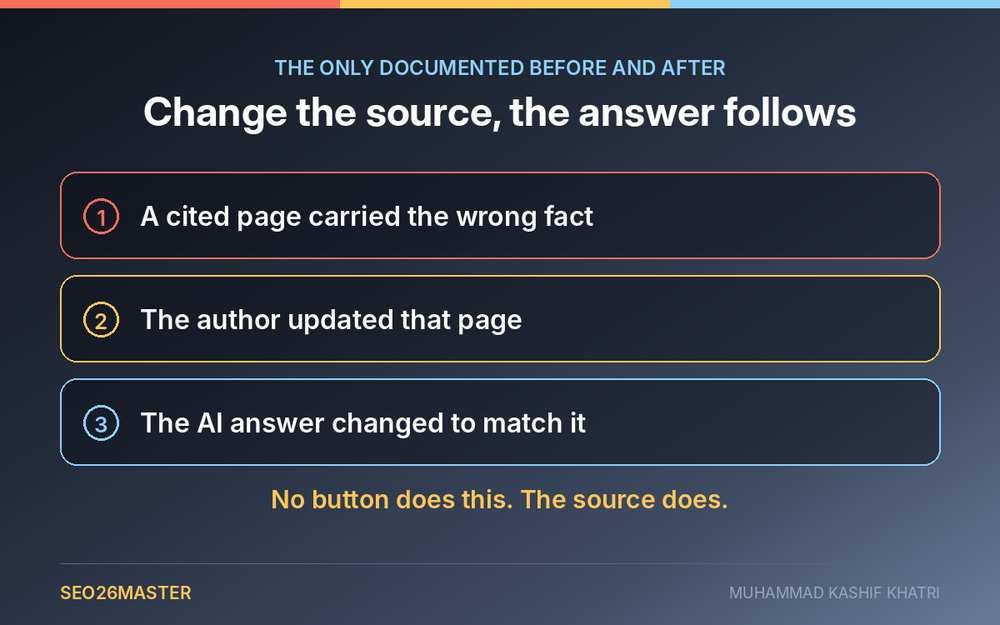
In the Ahrefs work, one author updated their page after being contacted. Claude's answer about Ahrefs then changed to match the corrected page.
That is the whole mechanism, and it tells you something the four routes do not. The AI is not storing a grudge against your business. It is reading pages. Change what the pages say, and the answer follows.
You cannot change other people's pages. You can change three things.
Your own pages. Check whether the wrong fact appears anywhere on your own site. If it does, the AI did not invent anything. It quoted you. Outdated prices, features you removed, an old description in a blog post from 2023. Fix those before you write to anybody else. It is an awkward email to send when you are still publishing the mistake yourself.
How findable the correct fact is. The model picks up what is easy to find and repeated. One correct sentence on one page loses to the same wrong sentence on nine. The answer is not to say it louder on your homepage. It is to get it stated in more places that are not yours.
That is the same work as earning any other mention, and the same rules about which places are worth being in apply. A correct sentence on a site nobody reads and nobody trusts does very little, for the same reasons set out in high quality backlinks. Finding the places worth approaching is covered in how to find sites that accept guest posts.
How unambiguous your name is. My own error was a name collision with a different tool. No amount of correcting fixes that. The fix is that every time your name appears, the sentence beside it says what you actually are. Do that often enough and the two things stop looking interchangeable.
How to find the page the error came from
Before you can do any of that, you need to know where the wrong fact lives. This takes about ten minutes.
Write down the exact wrong sentence. Copy it from the AI answer, word for word. Next to it write the correct version, with a link that proves it. Ahrefs call this list a source of truth, which just means one place where the right answers are written down. It is the step people skip.
Open the sources listed under the answer. AI Overviews, ChatGPT and Perplexity all show you which pages they used. Open each one and press Ctrl+F to search that page for the wrong claim.
If none of the cited pages contains it, the error is a merge, not a quote. That is what happened to me. The model combined two sources. In that case you are not looking for a page to correct, you are looking for the thing your name is being confused with.
Run the same question several times. These answers vary between runs, so one check tells you very little. If you get the error in four runs out of five, it is a real pattern. If you get it once, you may be chasing a one off.
Record the date every time. The answers move. Without dates you have no way of knowing whether anything you did made a difference.
Check more than one place
An error on one platform is not the same problem as an error everywhere, and the fix is different.
Run the same question on Google, ChatGPT, Claude, Perplexity and Copilot. Note which ones carry the error and which do not.
If only one platform has it, the cause is something that platform reads. The sources listed under that one answer will usually point straight at it, and correcting a single page can be enough.
If every platform has it, the wrong fact is sitting in something they all read. That is almost always a widely copied page or a directory entry with a lot of links pointing at it. Slower to fix, but at least it is findable.
This is also where the whole thing stops being one job and becomes a standing one. New pages get written about you. Old pages get copied. Any of them can become a source. Checking once tells you about today and nothing else.
What to do with the three quarters that do not get fixed
If 23% is the best published hit rate, most of what you find will never get corrected. Planning for that is more useful than pretending otherwise.
| Situation | What is realistic |
|---|---|
| The wrong fact is on your own site | You fix it today. This is the only one fully in your control. |
| The wrong fact is on one page you can identify, with a reachable author | Ask. Roughly one in four says yes. |
| The author never replies | Nearly half do not. Move on rather than chasing. |
| No cited page contains the error | It is a merge. Work on making your name unambiguous instead. |
| The error names you personally, and you are in Europe or the UK | Article 16 gives you a right to ask. Expect it to be slow, and expect to need a lawyer. |
| The error breaks a platform policy | Report it. This is the one case where removal processes exist. |
The thing to protect is your time. An hour spent getting the correct fact stated in five new places usually beats an hour spent chasing the fifth author who has not replied to anybody.
Stopping the next one
Most of this is unglamorous and most of it is just good practice.
Keep one page on your site that states the plain facts about what you sell, what it costs and what it does not do. Keep it current. That page is what gets quoted.
Say the same thing in the same words in the places that are not yours: your directory listings, your profiles, your author bios. Inconsistency is where merges start.
Check your own old posts for facts that have changed. An outdated price in a three year old article is a live source, not an archive.
And check what is being said about you often enough to catch things early. An error that has run for a year has been copied onto other pages by then. Every copy is another correction to chase. The same thing is true of links, where checking early is most of the battle, which I went through in how to check if a backlink is live.
One more thing worth watching. Sometimes the wrong fact sits on a page that exists mainly to republish other people's content. Correcting it there is usually pointless, because that kind of page will just recopy the next version. The signals for spotting those sites are in how to spot a link farm.
If you would rather this was done for you than done by you, it is part of what AI search visibility work covers, alongside the wider SEO audit. The pricing is on the page.
Questions people ask
How do I fix AI wrong information about my business?
Start by finding which page the wrong fact came from, because that is almost always what the model is reading. If it appears on your own site, fix it there first. Then ask whoever published the other page to correct it. The published success rate for that request is about 23%. Reporting it to the platform takes seconds and is worth doing, but expect nothing from it. Google has said in writing that it works on patterns across many queries rather than fixing them one at a time.
Can I get Google to remove a specific AI Overview?
Only if it breaks Google's content policies. Google says it has established processes to remove responses that do not comply with its policies. For answers that are simply inaccurate, Google's stated approach is to work on updates that help broad sets of queries, not to repair individual ones.
Can OpenAI correct what ChatGPT says about me?
On the evidence of the noyb complaint, not in the way you would want. A public figure asked OpenAI to correct his date of birth. OpenAI said correction was not possible. What it offered instead was to block his name, which would stop ChatGPT returning any information about him at all. On accuracy generally, OpenAI's own position was that it "remains an area of active research".
How often do AI answers get business facts wrong?
The best published figure comes from Ahrefs fact-checking 217 AI answers about themselves. 19%, around one in five, contained at least one false claim, and in some of their tests the rate reached 36%. A smaller business with fewer independent sources should not expect to do better.
Does asking the website owner to correct it actually work?
Sometimes. Ahrefs contacted 26 authors, 14 replied and 6 made corrections they could verify, which is 23%. Twelve never replied at all. It is the most effective of the available routes and it still fails three times out of four.
Is there a legal way to force a correction?
In Europe and the United Kingdom, Article 16 of the GDPR gives a right to have inaccurate personal data corrected, and two complaints have been filed against OpenAI on that basis. The enforcement record is thin. Italy's 15 million euro fine against OpenAI was annulled by the Court of Rome in March 2026, and no other European authority has published a final decision. Two further limits. It covers personal data, so it rarely helps with a wrong product description. And it does not exist in the United States, Canada or Australia.
Why does AI keep confusing my brand with another company?
Usually a name collision. The model is not inventing anything, it is merging two real things that are described in similar words. Correcting individual answers will not help with this. What helps is making sure that wherever your name appears, the sentence beside it says clearly what you are, so the two stop looking like the same thing.
How long does it take for a correction to show up in AI answers?
There is no published timeline, and anyone who gives you one is guessing. What is documented is that it happens through the source. In the Ahrefs work, after a cited page was corrected, Claude's answer changed to match it. So the sequence is source first, answer second, and the gap between them is not something you control.
Sources
- Ahrefs, How to Spot and Fix Mistakes in AI Answers, Mateusz Makosiewicz
- Google, AI Overviews: About last week, Elizabeth Reid, Vice President of Search, 30 May 2024
- noyb, ChatGPT provides false information about people, and OpenAI can't correct it, 29 April 2024
- Cross-Border Data Forum, Generative AI and GDPR Enforcement in Europe, Theodore Christakis, 19 March 2026
Leave a Reply