
Somebody has sent you a report. It says your site has 847 toxic backlinks and a risk score of 68. The report ends with a recommendation to disavow them, and a price for doing it.
Before you pay anybody for that, read what Google actually says. It takes two minutes and it is not what the report told you.
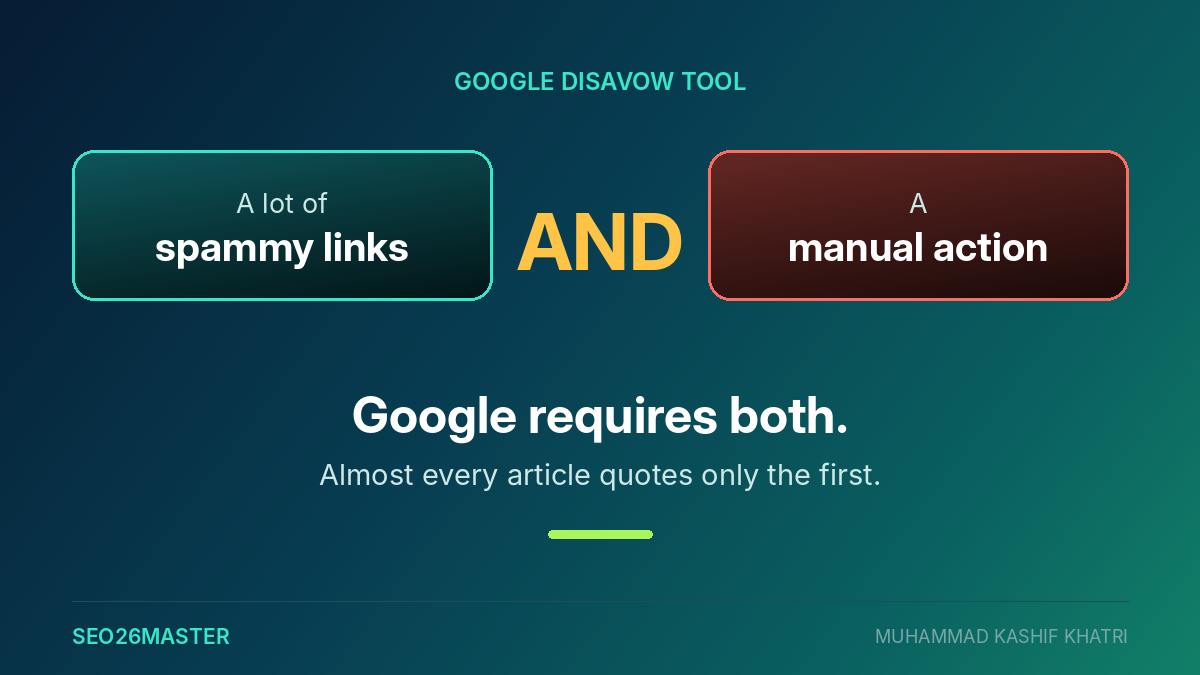
Google's own documentation sets two conditions for using the disavow tool. Not one. Two, joined by the word AND. Almost every article ranking for this topic quotes the first condition and quietly drops the second, which changes the answer completely.
There are also two real experiments on record, run by people who published their data. Neither appears on any of the pages currently ranking for this subject. One of them disavowed every single link pointing at his own site, including links from Moz and Ahrefs, to see what would happen.
This article covers what Google says word for word, what those experiments found, the one check that settles the question in thirty seconds, and the honest case for the other side.
I should say where I stand. I sell guest post placements, so I have a commercial interest in people not being frightened of links. That is exactly why every figure below is quoted from its source and linked, so you can check it rather than trust me.
The short version
First, three terms in plain language, because everything below turns on them.
A backlink is a link on somebody else's website that points to yours.
Search Console is Google's free dashboard for site owners. It shows how Google sees your site, and it is where the disavow tool and the one important check both live. If you have never opened it, that is the thing to fix before anything else in this article.
A manual action is a penalty applied by a human being at Google, not by software. Somebody at Google looked at your site, decided it had broken a rule, and pressed a button. When that happens Google tells you, in writing, in Search Console. It is not a secret and it is not something you have to guess at.
Hold on to that last one. Most of this article comes down to whether you have one.
What it is. The Google disavow tool lets you give Google a text file listing links you want it to ignore when assessing your site.
What Google says. You should use it only if you have a lot of spammy links AND those links have caused a manual action, or probably will. Both conditions, not either one.
Google's own words on who needs it. "In most cases, Google can assess which links to trust without additional guidance, so most sites will not need to use this tool."
Where it is heading. In May 2024, John Mueller of Google said of the tool, "At some point, I'm sure we'll remove it."
The one check that matters. Open Search Console, go to Security and Manual Actions, and click Manual actions. If it says no issues detected, you almost certainly do not need this tool.
What to do about the toxic link report. Nothing. No Google tool produces a toxicity score. Those numbers come from the company selling you the cleanup.
That is the whole article. The rest is the evidence.
What is the Google disavow tool, in plain words?
The disavow tool is a way of telling Google to ignore specific backlinks.
You write a plain text file. Each line names a page or a whole website whose links you want discounted. You upload it in Search Console. Google reads it as a request to stop counting those links when it works out what your site deserves.
It arrived in October 2012, six months after something called Penguin.
Penguin was a Google system built to catch sites that had bought links or built them artificially. When it first ran in April 2012 it hit hard, and thousands of site owners woke up to find their rankings gone. Many of them had hired an agency years earlier, had no idea what that agency had done, and had no way to undo it. The links were on other people's websites and those people were not answering emails.
The disavow tool was the escape hatch Google built for exactly those people.
That is the thing to hold on to. The tool was built for a specific emergency, in a specific year, for sites that had done something. It was never meant as routine housekeeping, and Google has said so directly.
What changed in 2016 that nobody mentions?
This is the part missing from almost every article on this subject, and it explains why the honest answer today is different from the honest answer ten years ago.
On 23 September 2016, Google announced Penguin 4.0 on its Webmaster Central blog. Three sentences from that announcement matter here.
"Penguin is now real-time."
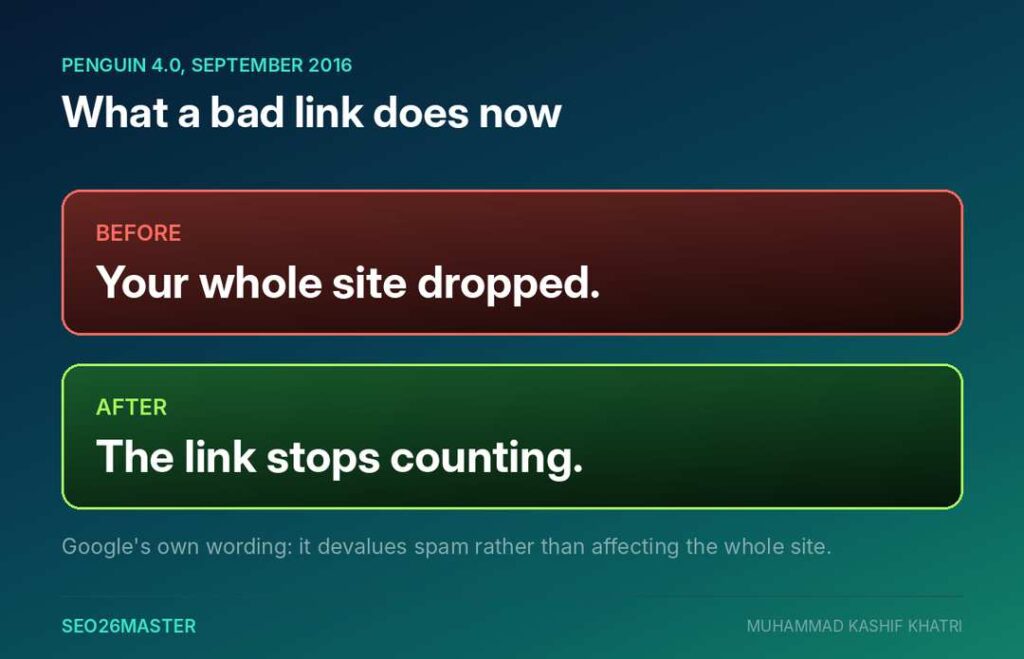
"Penguin now devalues spam by adjusting ranking based on spam signals, rather than affecting ranking of the whole site."
"Penguin is now more granular."
Granular means it acts on smaller pieces rather than the whole thing at once. Read the middle quote again, because it describes a change in what actually happens to you.
Before September 2016, Penguin demoted the entire site. One bad patch of links and your whole domain lost its rankings, and it stayed down until the next Penguin refresh, which could be a year away. That is a genuine emergency, and the disavow tool was the only exit.
After September 2016, Penguin devalues the links instead. The bad link stops counting. It does not drag the site down with it. And since the system runs in real time, there is no waiting a year for a refresh.
So the thing the disavow tool was built to rescue you from mostly stopped happening in 2016. Google now does automatically, link by link, what the tool was invented to let you request by hand.
That is why the advice changed, and it is why an article written in 2017 telling you to audit your links every quarter is not just outdated, it is describing a version of Google that no longer exists.
What does Google actually say about when to use it?
Here is Google's own documentation, quoted exactly. Read the structure of it, not just the words.
"This is an advanced feature and should only be used with caution."
"If used incorrectly, this feature can potentially harm your site's performance in Google Search results."
Then the conditions.
"You should disavow backlinks only if:
- You have a considerable number of spammy, artificial, or low-quality links pointing to your site, AND
- The links have caused a manual action, or likely will cause a manual action, on your site."
Look at that word in the middle. AND. Not OR.
This is where nearly every article on this subject goes wrong, and where every toxic link report goes wrong on purpose. They quote condition one, show you a list of ugly links, and treat that as the trigger. Google says condition one on its own is not the trigger. You need both.
And Google states the conclusion itself, in the same document.
"In most cases, Google can assess which links to trust without additional guidance, so most sites will not need to use this tool."
Most sites will not need to use this tool. That is Google's sentence, not mine.
Is Google going to remove the disavow tool?
On 4 May 2024, John Mueller of Google was asked about the disavow tool on X. His reply was one sentence.
"At some point, I'm sure we'll remove it."
He posted it publicly, as a Google employee, about a Google tool. Search Engine Land reported it two days later.
He has not softened the position since. At a Search Central event in New York, reported by Search Engine Journal in April 2025, Mueller put it this way.
"the disavow tool is not something that you need to do on a regular basis. It's not a part of normal site maintenance."
Think about what both statements mean together. Google is openly discussing deleting the tool, and telling people it is not part of running a website. That is not how a company talks about something its users need.
The tool still exists and still works, so this is not a reason to ignore it when you genuinely qualify. It is a reason to stop treating it as a standard part of an audit.
What happens if you disavow every link to your site?
Somebody tested this properly, and the result is the most interesting thing in this entire subject.
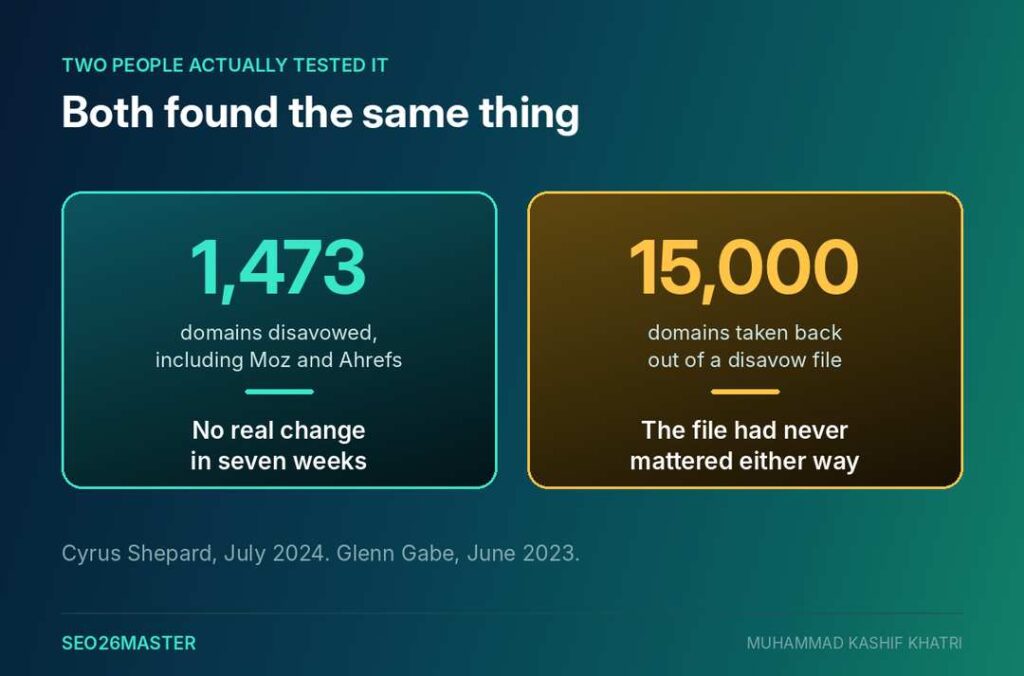
Cyrus Shepard of Zyppy published the experiment on 10 July 2024. He took his own site, zyppy.com, and disavowed everything.
Not the bad links. Everything. The file contained over 10,000 links from 1,473 separate domains. That included links from Moz, Ahrefs, Semrush and Backlinko, which are about as good as links get in this industry. He had no manual action and no history of buying links.
If the disavow tool worked the way most people assume, throwing away every good link should have been catastrophic.
Here is what happened over seven weeks.
Traffic went up slightly at first. About four weeks in, it dipped a little. Then a new post went live and it rose again. Across the whole period there was no meaningful harm.
One thing did move. The link count in Search Console fell from around 2,700 to roughly 100 within a few weeks. That turned out to be a reporting bug on Google's side, which was later fixed, and the number went back to normal.
Shepard offers three explanations and says he cannot prove which is right. Google may simply not have trusted a file that threw away obviously good links. The effect may take months rather than weeks. Or he may not have disavowed enough, because other link tools list far more links than Google and Ahrefs between them showed him.
He did not reach a firm conclusion, and I will not invent one for him. But the headline fact stands on its own. A site threw away every link it had, including its best ones, and seven weeks later nothing much had happened.
What happens if you remove a big disavow file?
The opposite experiment also exists, and it comes from one of the more careful analysts in this field.
Glenn Gabe of G-Squared Interactive published a case study on 15 June 2023. A site had come to him in late 2022 after moving to a new domain name and losing almost everything in the process. Traffic had fallen roughly 70 to 80% and had not come back. The owner had laid off most of their staff.
While investigating, Gabe found the site was running a disavow file containing over 15,000 domains.
The owner had never built artificial links. They had disavowed out of fear, because random spammy links kept showing up in their reports and somebody had told them that was dangerous.
Gabe also found something telling. Some of the disavowed pages were not in Google's index at all, meaning Google had never added them to its records. A link on a page Google has not recorded cannot affect anything. Those entries had never done a thing in either direction.
In late March 2023 the owner removed the file entirely.
On 19 April 2023, during Google's reviews update, the site surged. It gained 5, 10 and 20 or more positions on key terms. More than 31,000 keywords moved into the top 10, some of which had not been in the top 100 before. Gabe reports the site up 140% on that update.
Now the important part, and I am going to quote his caution rather than skip past it, because this is where most articles would cheat.
Gabe explicitly does not claim that removing the file caused the recovery. His point is narrower and more useful. The file had never mattered at all. Fifteen thousand disavowed domains made no difference in either direction.
His conclusion is the strongest sentence anybody has written on this topic. He estimates that 99.99% of sites never need the disavow tool, and that it belongs only to sites that built unnatural links, took part in link schemes, or have a manual action or could realistically get one.
He also says plainly that nobody should disavow based on a third party toxicity score.
Is there a case for disavowing without a manual action?
Yes, and I am going to give it a fair hearing, because an article that only presents one side is an advert.
The clearest version of the argument was written by Michael Bates, Head of Media Growth at Jaywing, on 15 April 2019.
His reasoning goes like this. Google says it can ignore bad links, but ignoring something still means looking at it first, so Google is clearly aware of them. Unwanted links keep appearing in Search Console's reports, which suggests Google is still keeping a record of them. And Google might quietly hold a site back without ever issuing a manual action, in which case waiting for a manual action means waiting for a warning that never arrives.
He supports it with one client. An online shop taken over from another agency, no known penalty, a careful disavow file uploaded on 20 February 2019, and a graph showing visibility rising afterwards.
Here is my honest reading of that evidence, and you should apply the same test to anything I tell you.
It is one site, and there was no second site left untouched to compare it against. Without that comparison you cannot tell whether the disavow did it or whether the site would have risen anyway. The same client was getting other work done at the same time and was being prepared to move to a new domain, so several things changed at once. The article shows a graph but gives no actual numbers. And the central claim, that Google quietly holds sites back without ever issuing a manual action, is a guess that the author himself admits nobody outside Google can see.
So it is an experienced person's theory rather than a test. It may still turn out to be right. But put it beside Shepard's experiment and Gabe's case study and it is the weakest of the three, and it is seven years old.
How do you know if you actually have a manual action?
This is the check that decides everything, and it takes about thirty seconds.
1. Open Google Search Console and select your site.
2. In the left menu, find Security and Manual Actions.
3. Click Manual actions.
4. Read what it says.
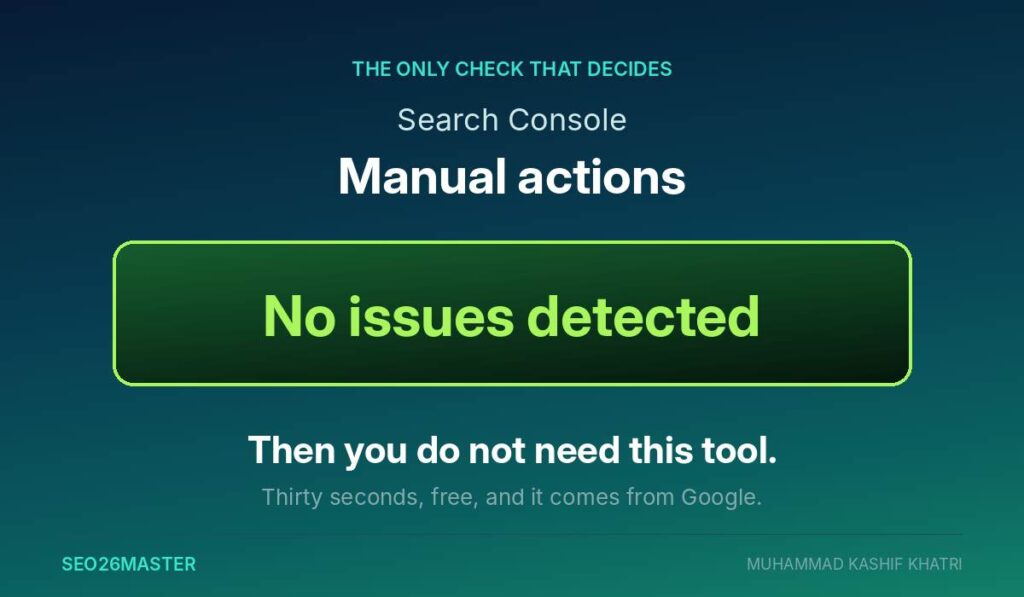
If it says "No issues detected", a human reviewer at Google has not taken action against your site. Google's second condition is not met. By Google's own documentation, you should not be using the disavow tool.
If it names an issue, read it carefully. The one relevant here is usually called Unnatural links to your site. If you see that, you are in the small group the tool was built for, and the rest of this article's caution does not apply to you.
That screen is the whole test. It is free, it is authoritative, and it comes from Google rather than from a company selling cleanup services. Check it before you believe any report about your links.
What if the screen does show a manual action?
Then the advice in this article flips, and here is the order of work.
Read exactly what it says. The message names the issue and sometimes gives examples. An unnatural links manual action can apply to your whole site or to a section of it, and the message tells you which.
Work out which links caused it. This is the honest part. If you or an agency bought placements, ran a network, or traded links at volume, those are the links. You usually know. If you genuinely do not, download your links from Search Console and look for the patterns Google names in its policies, which I went through one by one in the Google link scheme.
Try removal before disavowing. Google prefers links taken down rather than ignored. In practice most site owners will not reply, but a record of having asked helps your case.
Build the disavow file. Domain level for the sites you know are bad. Keep comments in it explaining what each group is, because a human at Google may read it.
Submit a reconsideration request. This is a separate step from uploading the file. A reconsideration request is a message you send Google asking them to look at your site again and lift the penalty. You write it in Search Console, in the same place the manual action appeared. Explain what happened, what you removed, what you disavowed, and what you changed so it will not happen again. A real person at Google reads it, so write it for a person.
Expect weeks, not days. Google has to recrawl the linking pages before the file takes effect, and a human has to read the request.
This is the one situation where the tool is exactly right, and where none of the caution above applies to you.
What about toxic link scores from SEO tools?
No Google tool produces a toxicity score. No Google documentation uses the word toxic. There is no Google metric called link risk, spam score or trust score.
Every one of those numbers is invented by the company showing it to you.
That does not make the tools dishonest. They are trying to measure something real using the patterns they can see, and a site covered in junk forum links genuinely does look different from one that is not. The problem is what gets built on top of the number.
A score creates a feeling of danger. The feeling creates demand for a cleanup. The cleanup is a service with a price. And at the end of it you have handed Google a file telling it to ignore links, with no evidence that any of them were hurting you.
Gabe's client had 15,000 domains disavowed on exactly this basis, and it achieved nothing in either direction.
If you want to know whether a link is worth having, judging it by hand is a better use of your time than reading a score. I set out the checks I actually run in what makes a backlink high quality, and the five things that genuinely matter are all things you can see for yourself.
What does a disavow file look like, if you do need one?
If you have checked Search Console and you do have an unnatural links manual action, then here are Google's rules, quoted exactly.
"Specify one URL or domain to disavow per line."
"To disavow a domain (or subdomain) prefix it with
domain:, for example:domain:example.com"
"You cannot disavow an entire subpath, such as
example.com/en/"
"The file must be a text file encoded in UTF-8 or 7-bit ASCII"
"The file name must end in .txt"
"Maximum URL length is 2,048 characters"
"Maximum file size is 100,000 lines (including blank lines and comment lines) and 2MB."
"You can include comments if you like by starting a line with a # mark. Any lines that begin with # will be ignored by Google."
So a real file looks like this.
# Links from the 2019 agency campaign
domain:spammydirectory.example
domain:anotherbadsite.example
http://badsite.example/page-with-our-link/
On timing, Google says this.
"It can take a few weeks for Google to incorporate your list into our index as we recrawl the web and reprocess the pages that we see."
A few weeks, because Google has to revisit each linking page before the instruction has any effect. Nothing happens the day you upload it.
Two practical points that Google does not spell out. Disavowing at domain level is usually right, because a site that gave you one bad link will give you more. And before you add anything to a file, download the existing one, because a previous agency may have disavowed links you would want to keep.
What are the risks of disavowing when you should not?
Google states the risk itself in the first lines of the documentation. Used incorrectly, the feature "can potentially harm your site's performance in Google Search results."
The mechanism is simple. A disavow file is a list of links you are throwing away. If you throw away a link that was helping you, you lose whatever it was giving you, and you will probably never know that is what happened.
That is not a theoretical danger. Automated cleanup lists are built from scores, and scores flag unfamiliar domains, foreign language sites, small blogs and anything with low traffic. Some of those are genuinely worthless. Some are a real editor linking to you because they found your work useful, which is the most valuable kind of link there is.
There is a second cost, and it is larger than people expect. The time and money spent auditing links you were never penalised for is time and money not spent on the thing that would have moved your rankings. Gabe's client spent months anxious about 15,000 domains that had never mattered.
If you are deciding where to put your effort, the question of which links are actually worth having is a better one to answer. I went through the pricing and the trade-offs in niche edits vs guest posts, and what Google's policy actually names as a violation in the Google link scheme.
So should you use the Google disavow tool?
Run this in order and stop at the first answer that applies.
Do you have a manual action in Search Console, specifically unnatural links to your site? If yes, use the tool. This is what it exists for. Clean the file carefully, submit a reconsideration request, and expect it to take weeks.
Did you or a previous agency buy links in bulk, run a network of websites built only to link to yours, or trade links with other owners at volume? If yes, you are in the group that could realistically receive a manual action, which is Google's second condition. A disavow file is reasonable here, limited to the links you know you built.
Is your answer to both of those no? Then do not use it. Google says most sites will not need it. Gabe estimates 99.99% never will. Shepard threw away every link he had and nothing happened. And the person telling you otherwise is usually the person charging for the cleanup.
The honest summary of the Google disavow tool is that it is a fire extinguisher. It is worth knowing where it is. It is not worth spraying the room every month because a report told you there might be a fire.
Frequently asked questions
Does the Google disavow tool still work in 2026?
Yes, it is still live in Search Console and Google still processes submitted files. Whether it does anything for your site is a different question, and for most sites the answer is no, because they never had the problem it solves. John Mueller said in May 2024 that Google will remove it at some point, so treat it as a tool with a limited future rather than a permanent part of SEO.
Should I disavow links if I have no manual action?
Google's documentation says no. It sets two conditions joined by AND, and the second is a manual action or the likely prospect of one. The only reasonable exception is if you know you built unnatural links yourself, because then a manual action is a real possibility even though it has not arrived yet.
How long does a disavow file take to work?
Google says it can take a few weeks, because it has to recrawl each linking page before the instruction takes effect. There is no way to speed that up, and nothing visible happens on the day you upload.
Can I undo a disavow file?
Yes. Upload a new file without those lines, or remove the file entirely. Google will then start counting those links again on its next recrawl, which again takes weeks. Glenn Gabe's 2023 case study documents a site doing exactly this with a file of over 15,000 domains.
Are toxic backlinks real?
Links from spam networks and manipulative link schemes are real, and Google names them in its spam policies. A numerical toxicity score is not real in the sense people assume. It is a third party estimate, no Google tool produces one, and no Google documentation uses the word toxic. Judge a link by whether the page has readers, has links of its own, and had a reason to mention you.
Does negative SEO work, and should I disavow attack links?
Google's consistent public position is that it ignores most low quality links automatically, which is why the documentation says most sites will not need the tool. If you are seeing a flood of obvious attack links, check Manual actions first. If that screen is clean, you have no evidence of harm, and disavowing on suspicion carries its own risk of discarding something good.
Should I disavow links from a site in a different language or country?
No, not on that basis alone. A link from a Spanish site to an English site is unusual, not dangerous. Automated lists flag these constantly because they look odd to a score, and this is one of the most common ways people end up throwing away links that were doing nothing wrong.
What is the difference between disavowing and nofollow?
They are controlled by different people. A nofollow or sponsored tag is added by the site that owns the page, in the page's own code, and it tells Google not to pass ranking credit. A disavow file is submitted by you, about links on other people's sites, and it asks Google to ignore them when assessing you. You control the second, never the first.
Sources
- Google Search Console Help, Disavow links to your site
- Search Engine Land, Google disavow link tool will go away at some point, 6 May 2024
- Search Engine Journal, Google says disavow tool not part of normal site maintenance, Roger Montti, 8 April 2025
- Zyppy, I Disavowed Every Link To My Website, Cyrus Shepard, 10 July 2024
- G-Squared Interactive, Google disavow file case study, Glenn Gabe, 15 June 2023
- Jaywing, Google probably doesn't ignore spammy links, Michael Bates, 15 April 2019
Leave a Reply