
A backlink is a link on somebody else's website pointing at yours. Guest posting means writing an article for another site, with a link to yours inside it, and it is the method almost every guide recommends first.
I sell guest post placements. So read the next sentence knowing I have every reason to say the opposite.
If you are starting out, guest posting is usually the wrong first move. It costs money you may not have. It puts you inside the part of Google's policy that gets watched most closely. And it is the one method where somebody else sets the price.
This article is about everything else. Eight methods that need no publisher, no budget and no payment. Each one comes with the exact steps, a search you can copy and paste, an honest success rate, and how long it really takes.
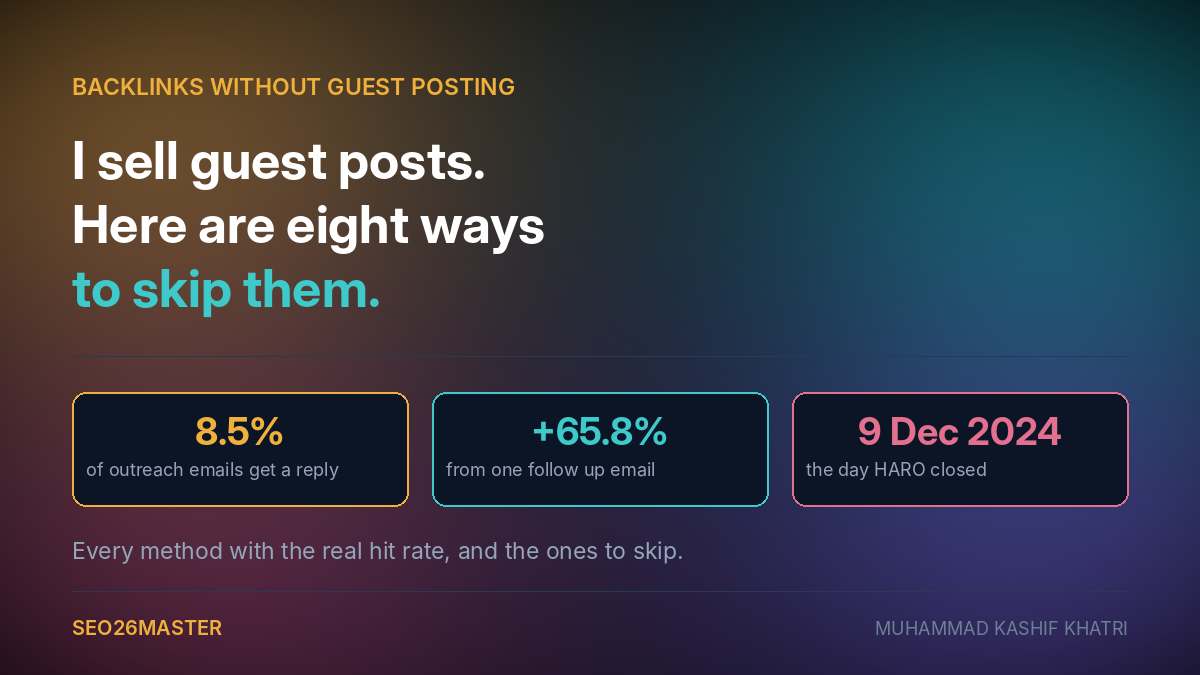
One number first, because it shapes everything that follows. Backlinko and Pitchbox studied 12 million outreach emails in 2019. Outreach simply means emailing somebody to ask for a link or a mention. Only 8.5% of those emails got any reply at all. Nine out of ten were ignored.
The short version
- The method that works best is claiming mentions of your brand that already exist without a link.
- HARO no longer exists. It became Connectively, and Cision closed it on 9 December 2024. Most guides still tell you to use it.
- Buying expired domains appears on half the lists you will read. Google's spam policies name it as a violation all of its own.
- One follow up email raises your reply rate by 65.8%. That is the cheapest improvement available to you.
- Links from Quora and Reddit carry a tag that stops them passing any ranking value. They can still send you readers.
Why look for backlinks without guest posting?
Three honest reasons, and none of them is that guest posting fails.
Cost. Published prices for a single placement run from about $78 to over $500, depending on which study you open. If you have no budget, that whole route is shut. These methods are not.
A larger dataset puts firmer numbers on that. Across 52,671 websites, the 2026 average was $459 for a guest post and $225 for a link insertion. If you do have a budget and want to know which of those two is worth paying for, that question has its own article: niche edits vs guest posts.
Policy. Google's spam policies name paid guest posts and advertorials directly. Paid placements are allowed when the link carries rel="sponsored" or rel="nofollow" in the page code, which is a small tag telling Google the link was paid for. Most sellers quietly leave it off. I went through every line of that policy in what Google counts as a link scheme, including the parts that have nothing to do with buying links.
Control. When you pay for a placement, somebody else decides the price, the date it goes live, and whether your link survives their next redesign. Every method below leaves those decisions with you.
What should you know before you start?
Four things, so your expectations match what is coming.
This is a numbers game, and the numbers are hard. That 8.5% reply rate came from 12 million emails. So if you send ten emails and hear nothing back, that is an ordinary week, not a sign your email is broken.
Follow ups are the cheapest improvement you have. The same study found that sending one follow up email produced 65.8% more replies. Personalised subject lines did 30.5% better. Personalised message bodies did 32.7% better. Those are patterns in the data rather than proof, and they all point the same way: fewer emails, written properly, sent twice.
Most of these methods are slow. None of them will produce fifty links next month. Several produce two or three links a quarter that then keep working for years.
Judging the site still matters. A link that costs you nothing can still be worth nothing. The checks that decide whether a link is worth having are in what makes a backlink high quality, and they apply to free links just as much as paid ones.
Which methods actually work without guest posting?
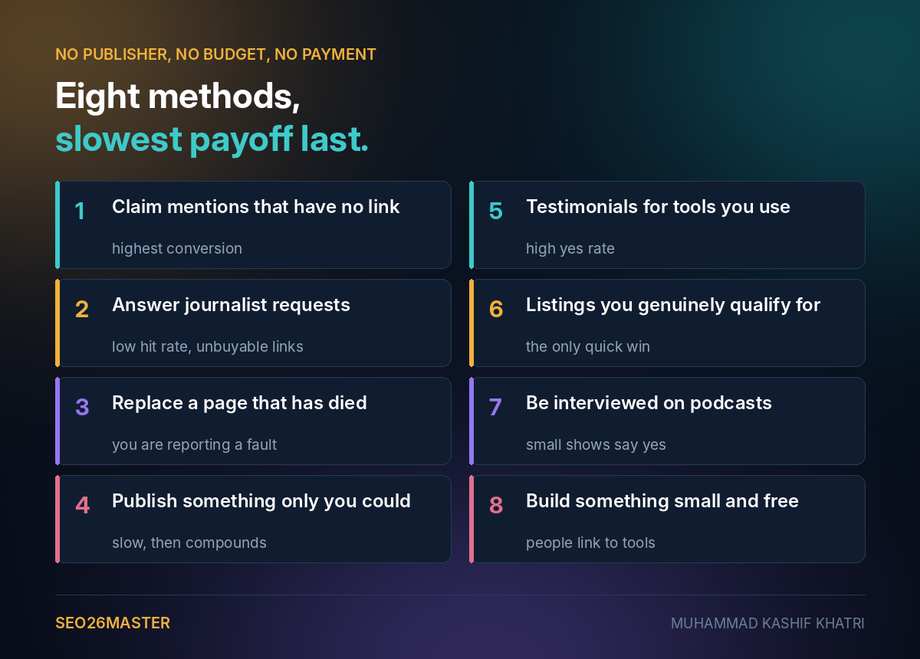
Eight ways to get backlinks without guest posting, roughly in order of how reliably they pay off for a small site.
1. Claim mentions that already exist without a link
Somebody has already written your brand name somewhere and not linked to it. A directory listing, a round up post, a customer's blog, a news story.
This converts better than anything else here, and the reason is simple. The writer already decided you were worth mentioning. You are not asking them to agree with you. You are asking them to finish a job they started.
How to find them. Paste this into Google, swapping in your own details:
"Your Brand Name" -site:yourdomain.comThe second part tells Google to leave out your own website, so you only see other people's pages. Then click Tools, then Any time, then Past year, to see recent mentions first. Open anything where your name sits there as plain text rather than as a link.
Then set up a free Google Alert for your brand name. New mentions will arrive in your inbox instead of being discovered a year late.
The email. Three sentences. Thank them for the mention, give the exact page address you would like it to point to, and say why that helps their reader. No attachment, no sales pitch, no paragraph about your services.
Honest success rate. The best in this article. A well written request of this kind converts several times better than a cold email, because you are not cold.
Time cost. An hour to find them, five minutes per email.
2. Answer journalist requests
Reporters publicly ask for expert sources every day. You reply with something usable, they quote you, and the quote carries your name and usually a link.
Read this part before you follow any other guide. HARO, the service nearly every article on this subject still recommends, does not exist any more. It was renamed Connectively, and its owner Cision closed it on 9 December 2024. Any guide telling you to sign up for HARO was written before that date and never checked since.
What to use instead. Several platforms took its place, including Qwoted, Featured, SourceBottle and Help a B2B Writer. Journalists also post requests publicly on X and Bluesky. Check that any platform is still running before you invest time in it, because this corner of the industry changes fast.
The free version that needs no platform. Search X for your subject along with the words journalists use:
journorequest seo
prrequest marketing
The email. Answer the question in your first two lines. Journalists work to deadlines and decide from the opening sentence whether to keep reading. Put your credentials at the bottom, never the top.
Honest success rate. Low. Most replies go nowhere. The ones that land give you links on sites that would not sell you a placement at any price.
Time cost. Fifteen minutes a day, most of it producing nothing.
3. Replace a page that has died
Somewhere in your field, a useful page has gone offline. The sites that linked to it still have a dead link sitting on their page. You offer them your working replacement.
You are not asking for a favour here. You are reporting a fault.
How to find them. Two routes.
The first. Think of a site in your field that has gone quiet or disappeared. Put its address into any backlink tool, which is software that shows you which sites link to a given page, and look at who was linking to it.
The second. Search for the pattern directly:
"your topic" + "resources" + inurl:linksThat finds resource pages, which are pages built as a list of useful links. Then run those pages through a free broken link checker, which is a tool that opens every link on a page and reports the dead ones.
The email. Name the broken link and say where on their page it sits. Offer your replacement in one line. Make it easy for them to act without replying.
Honest success rate. Moderate, and it climbs when your replacement page is genuinely useful.
Time cost. Two or three hours to build the list, then ordinary outreach.
4. Publish something only you could publish
This is the one method here that keeps growing after you stop working on it. Original numbers from your own business, your own tests, or your own accounts. Not an opinion piece. A figure nobody else has.
You do not need a survey of ten thousand people. One honest number, with your method shown beside it, gives writers something to quote. Writers quote things that are easy to check.
What this looks like in practice. The prices you actually paid. The reply rate you actually got. The thing you tried that failed, with the numbers showing it failed. A sample of one hundred sites in your field, counted properly.
Honest success rate. Nothing for months, then links start arriving without you asking. It is the slowest method here and the only one that keeps paying later.
Time cost. A day to produce something real. Then patience.
5. Write testimonials for tools you genuinely use
Software companies publish customer testimonials, and almost every one carries a link back to that customer's website. You already use five or six tools. Most of them would like a quote from a real user.
How to do it. Open the tool's website and look for a testimonials or customers page. If it has one, email support or the founder with a two line testimonial already written, plus your name, your role and your website. A testimonial ready to publish beats an offer to write one.
Honest success rate. High, because you are giving them something they want.
The limit, and it matters. Only do this for tools you actually pay for and actually like. A testimonial for a product you have never used is a lie with your name on it, and being trusted is worth more to you than one more link.
Time cost. Twenty minutes each.
6. Get listed where your business genuinely belongs
This is not directory submission. These are real listings that match something true about you.
Your industry association. Your local chamber of commerce. The supplier whose website lists its partners. The software whose website lists its agencies. The conference whose website lists its speakers. The university whose alumni page lists its graduates. The client whose website lists its suppliers.
Most businesses have five or six of these sitting available and have claimed none of them.
Honest success rate. Very high, because you either qualify or you do not.
The limit. There are only so many. You will finish this list in a week, and then it is done until your business changes.
Time cost. An afternoon.
7. Be interviewed
Podcasts need guests every single week, and the shownotes for each episode, which are the written summary published alongside it, almost always carry a link to the guest's website. Smaller shows in your field will often say yes to somebody with specific knowledge and no audience at all.
How to pitch. Listen to two episodes first. Then email the host with a subject you could talk about for forty minutes that they have not already covered, and name the episode you listened to. Hosts can tell instantly who has listened and who has pasted the same email to fifty shows.
Honest success rate. Better than most people expect on small shows. Close to zero on large ones.
Time cost. An hour per pitch, an hour per recording.
8. Build something small and free
A calculator, a checker, a template, a spreadsheet. Something that does one job and needs no signup.
People link to tools far more readily than to articles, because a tool helps their reader whether or not they agree with the writer. I built a free guest post site checker for exactly this reason, and it does a job I was already doing by hand.
The trap to avoid. Do not hide a keyword rich link inside a widget and hand it out. A widget is a piece of code other sites paste into their own pages, and that exact tactic is named in Google's spam policies. I covered it as number 8 of the eleven examples in what Google counts as a link scheme.
Honest success rate. Slow, then steady, as long as the tool is genuinely useful.
Time cost. Days or weeks, depending on what you build.
Which methods should you skip?
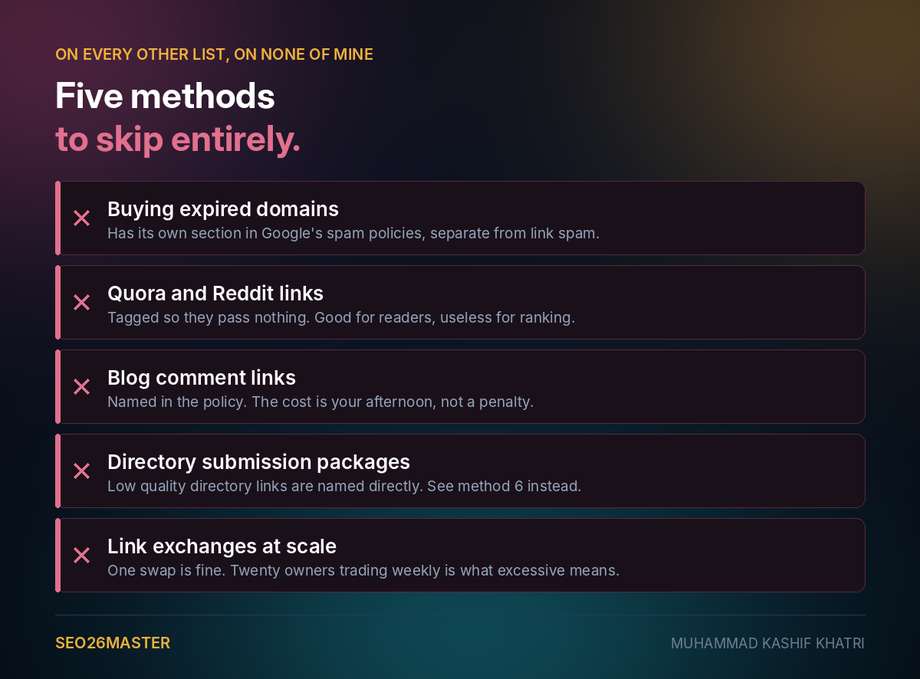
These five appear on most lists for this subject. Here is why they are on none of mine.
Buying expired domains. This one needs its own paragraph, because it is recommended openly and it has a section of its own in Google's spam policies, separate from link spam. Google's definition:
"Expired domain abuse is where an expired domain name is purchased and repurposed primarily to manipulate search rankings by hosting content that provides little to no value to users."
Google even gives examples, one of which is "Casino-related content on a former elementary school site". If a tactic matters enough for Google to name it separately, it does not belong on a beginner's list.
Quora and Reddit links. Worth doing for readers, worth nothing for ranking. Links posted by users on those platforms carry a tag that stops them passing any value, and Google's spam policy separately names forum posts and signatures with keyword links in them. Answer questions there because the people reading might become customers, not because of the link.
Blog comment links. Named in the same policy. What they really cost you is the afternoon, because the links themselves are simply not counted.
Directory submission packages. Five hundred general directories that accept anybody. Google's policy names low quality directory and bookmark links directly. Method 6 is the version of this that works.
Link exchanges at scale. One swap between two businesses that genuinely work together is fine. A group chat where twenty owners trade links every week is exactly what the policy means by excessive link exchanges.
What should the outreach email actually say?
Short, specific, and sent twice. Here is the shape, using the unlinked mention case because it converts best:
Subject: that mention of [Brand] in your [article title] piece

Hi [name],

Thanks for mentioning [Brand] in [article title].

If it is useful for your readers, the page that explains [the specific thing
they mentioned] is here: [URL]

Either way, thanks for the mention.

[Your name]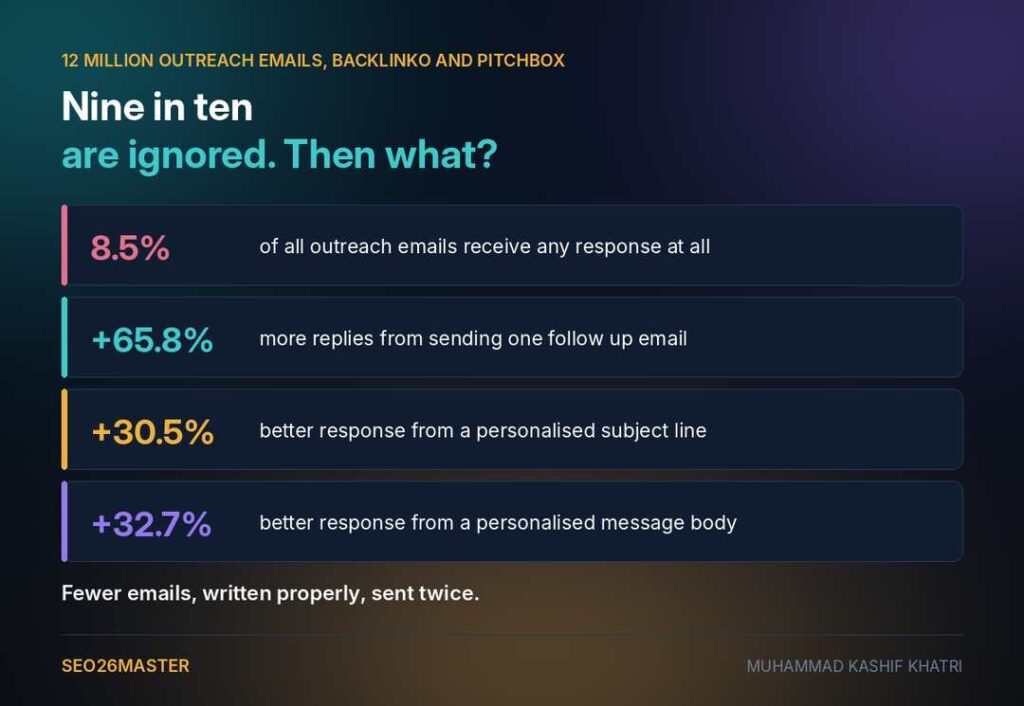
Four things make the difference, and three of them come straight from that study of 12 million emails.
Send one follow up. It raised replies by 65.8%. Wait four or five days, keep it to two lines, and never send a third.
Personalise the subject line. 30.5% better response rate in the data.
Personalise the message. 32.7% better. Personalising means naming the specific thing they wrote, not dropping their first name into a template.
Give a reason that serves their reader, not you. Every editor can tell the difference between somebody who wants a link and somebody who is improving their page.
How many of these do you actually need?
Fewer than you think, and that is Google's own position rather than mine. Gary Illyes of Google Search said in April 2024 that very few links are needed to rank pages, and that Google has made links less important over time. I quoted both of his statements in full in what makes a backlink high quality.
So the target is not fifty links. For most small sites it is five or six placements on sites that genuinely matter in their field, plus the listings from method 6, plus whatever your own published numbers earn you over the next year.
How long does this take?
An honest timeline for building backlinks without guest posting, starting from nothing, working two or three hours a week.
Week one. Method 6, the listings you already qualify for. These are the only quick wins in this article. Take all of them before anything else.
Weeks two and three. Method 1, the mentions that have no link, plus the Google Alert so that new ones find you.
Month two. Methods 3 and 5, dead links and testimonials. Both are list building followed by ordinary emails.
Month two onwards, every day. Method 2, journalist requests. Fifteen minutes a day, mostly producing nothing, occasionally producing something no money could buy.
Whenever you can. Method 4. The sooner you publish one honest number, the sooner it starts earning.
Expect very little in the first six weeks. That is not failure. That is what this work looks like.
What this article cannot tell you
I cannot give you the success rate for your field. The 8.5% figure covers 12 million emails across every industry. Yours will be higher or lower depending on your field, your name, and whether anybody has heard of you.
That study is from 2019. Outreach has become harder since, not easier. Treat those numbers as the best case rather than the typical one.
Journalist request platforms keep changing. HARO ran for years and then closed with little warning. Check that any platform is still alive before you build a habit around it.
I sell guest post placements. You have just read an article arguing against my own product, which is either a good sign or a strange business decision. Judge the methods on whether they work, not on who wrote them.
What to do next
Do method 6 this week. Open a document and list every organisation that could honestly list you. Your association, your chamber of commerce, your suppliers, your clients, any conference you have spoken at. Then work through them. It is the only part of this article that produces links in days rather than months.
Then run the brand search from method 1 and count how many people have already written your name without linking to it. Most businesses are surprised by that number.
And if you decide a paid placement is the right move after all, check the site before you pay with the free guest post site checker, or send me the page you want to rank and the search you want to rank for.
Frequently asked questions
Can you rank without any backlinks at all?
For low competition searches, often yes. Google's Gary Illyes said in 2024 that very few links are needed to rank pages. For competitive commercial terms links still matter, but the number needed is smaller than most agencies sell.
Is link building without guest posting slower?
Usually yes, and it lasts longer. Paid placements appear within weeks. Unlinked mentions, journalist quotes and cited numbers arrive slowly, then keep arriving without further spending.
Do nofollow links from Reddit and Quora help at all?
They pass no ranking value, because the tag in the page code stops it. I explained what those tags do, and why there is no dofollow version of them, in dofollow vs nofollow for guest posts. They can still send you readers, and those readers sometimes write about you on sites that do pass value.
Is HARO still the best way to get journalist links?
HARO no longer exists. It became Connectively and Cision shut it down on 9 December 2024. Qwoted, Featured, SourceBottle and public requests on X are the current routes, and any guide still recommending HARO has not been updated in over a year.
How many outreach emails should I send before giving up on a method?
At least fifty, each with one follow up, before you judge it. At an 8.5% reply rate, ten emails returning nothing tells you nothing at all.
Sources quoted in this article
Leave a Reply