
A link scheme means building links for the sole purpose of pushing a website up Google's rankings. People worry about it because Google can decide those links do not count, and in rare cases can act against the site itself.
Here is the first thing worth knowing if you are searching for the Google link scheme rules. Google does not use that phrase any more.
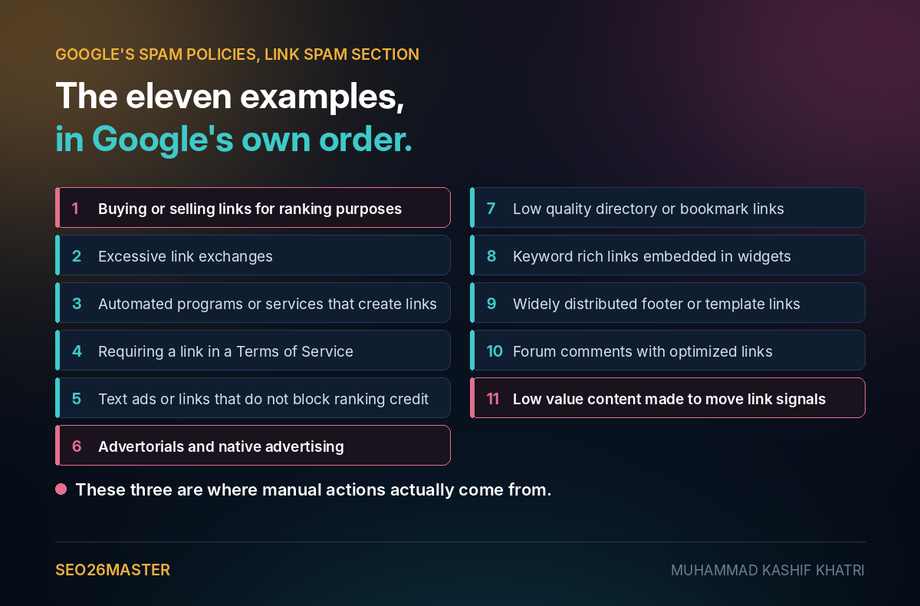
I checked the live page today. The words "link scheme" and "link schemes" do not appear anywhere on Google's spam policies for Google web search. The section is now called Link spam, and it lists eleven examples.
Almost every page ranking for this subject is a short glossary entry that describes those eleven in its own words and never shows them to you. This article does the opposite. All eleven are quoted here, word for word, in Google's order. Under each one you get what it actually means if you buy links, sell links, or run a site other people pay to appear on.
The short version
- Google renamed this. What people call a link scheme, Google calls link spam.
- There are eleven listed examples. Most have nothing to do with buying guest posts.
- Google says sites that break these rules "may rank lower in results or not appear in results at all".
- Most bad links are simply ignored, not punished. The money is wasted, the site usually is not harmed.
- Paid links are allowed when the link is tagged as paid. That exception is written into the policy itself.
What is a Google link scheme?
In Google's current wording it is link spam, which means any link created mainly to move a ranking rather than to help a reader. Google's definition is one sentence:
"Link spam is the practice of creating links to or from a site primarily for the purpose of manipulating search rankings."
Two parts of that sentence matter, so read them slowly.
Links to or from a site. This is not only about links pointing at you. If you sell placements on your own website, or you link out in a way designed to pass ranking value, the policy covers you as well.
Primarily for the purpose of. The test is purpose, not format. A paid link is not automatically spam. A link in a footer is not automatically spam. What Google is describing is why the link exists, and the eleven examples below are the usual shapes that reason takes.
One term you will meet throughout this article is ranking credit. It means the ranking value a link passes to the page it points at. A link that carries rel="nofollow" or rel="sponsored" in the page code does not pass it. A link with no tag at all does.
Why can you not find the Google link scheme page any more?
Because Google retired the name along with the page it lived on.
On 13 October 2022 Google replaced the Webmaster Guidelines with Google Search Essentials. The old Quality Guidelines became the spam policies, and the separate Link schemes page was folded into a section called Link spam. Old bookmarks still work, but they send you to the new page. That is why so many people think the rules changed.
The rules barely changed. The name did. If you are reading a guide that still quotes a Google page called Link schemes, it was written before October 2022 and nobody has checked it since.
What happens to a site that breaks this policy?
Google states the consequence at the top of the same page. Sites that break the policies "may rank lower in results or not appear in results at all". It also explains how it finds them, through automated systems and "human review that can result in a manual action".
Those are two very different outcomes. Keep them apart in your head.
The automated one, which is what nearly everybody gets. The link is spotted and no longer counted. Google said this plainly when it announced its December 2022 link spam update, describing it as "leveraging the power of SpamBrain to neutralize the impact of unnatural links on search results". Neutralize, not punish. Your site is not damaged. Your money is simply gone.
A manual action, which is rare and serious. Manual action means a human reviewer at Google has looked at your site and applied a penalty. Google tells you when this happens. You find it in Search Console under Security and Manual Actions. If that report is empty, no person at Google has done anything to your site.
What are the eleven things Google counts as link spam?
Here is the full list, in Google's order. Each one is quoted first, then explained.
1. Buying or selling links for ranking purposes
Google's wording, including its three sub points:
"Buying or selling links for ranking purposes. This includes: Exchanging money for links, or posts that contain links. Exchanging goods or services for links. Sending someone a product in exchange for them writing about it and including a link."
What this means in practice. This is the widest item on the list and it covers most of the guest post market. Notice that money is only the first of three. Sending a reviewer a free product in return for a link is named just as clearly as paying cash.
Now notice the last three words of the first line. For ranking purposes. Google is not banning business. It is describing what the link was bought to do. The exception later in the same policy exists because of those three words.
The thirty second check. Ask one question about any placement you are paying for. If that link passed no ranking value at all, would you still buy it? If the answer is no, this bullet describes you, and the tagging question further down is the one that decides whether you are inside the rules or outside them.
2. Excessive link exchanges
"Excessive link exchanges ("Link to me and I'll link to you") or partner pages exclusively for the sake of cross-linking"
What this means in practice. Two words carry this one. Excessive, and exclusively.
One link swap between two real businesses that genuinely work together is not what Google is describing. What it describes is volume and purpose. If you are in a group chat where twenty site owners trade links every week, that is excessive. If you have a page called Partners whose only reason to exist is holding links to other sites, that is exclusively for the sake of cross linking.
The thirty second check. Open your own partners or resources page. Would a customer ever read it? If the only people who have ever opened it are the owners of the sites listed on it, Google has probably worked that out too.
3. Using automated programs or services to create links to your site
"Using automated programs or services to create links to your site"
What this means in practice. This is every backlink generator and every blast package. It is any tool that promises a few thousand links while you sleep, and any software that creates profile and comment links in bulk.
This is the easiest item on the list to avoid, and also the one sold most often, because the output looks impressive inside a tool. Hundreds of new linking sites appear within days. Almost none of them are ever counted.
The thirty second check. If the seller cannot name the exact sites before building the links, the links are automated. A real placement can always be named in advance.
4. Requiring a link as part of a Terms of Service
"Requiring a link as part of a Terms of Service, contract, or similar arrangement without allowing a third-party content owner the choice of qualifying the outbound link"
What this means in practice. Almost nobody reads this one, and it is aimed at business owners rather than SEOs.
Are you a theme developer, a plugin author, a web designer, a photographer, or a franchise? Does your contract or licence say the client must keep a credit link back to you? Then this bullet is about you. The credit itself is not the problem. The problem is taking away the client's choice to add rel="nofollow" or rel="sponsored" to that link.
How to stay clear. Keep the credit requirement if you want it. Just add one line to the contract saying the client may tag the link. That sentence moves you out of this bullet.
5. Text advertisements or text links that do not block ranking credit
"Text advertisements or text links that don't block ranking credit"
What this means in practice. Look at the word Google chose. Block. Google is not objecting to the advertisement. It is objecting to an advertisement that passes ranking value because nobody added a tag.
A paid banner, a sponsored text link in a sidebar, a recommended partner slot. All of these are ordinary advertising. They turn into link spam at the exact moment they are left untagged.
The thirty second check. Open the page where your paid link sits. Press Ctrl+U to see the page code, then Ctrl+F and search for your own web address. Either rel="sponsored" or rel="nofollow" is sitting there beside it, or it is not.
6. Advertorials and native advertising
"Advertorials or native advertising where payment is received for articles that include links that pass ranking credit, or links with optimized anchor text in articles, guest posts, or press releases distributed on other sites."
What this means in practice. This is the item that names guest posts directly, and press releases alongside them. It is also the only one that describes two separate problems in a single sentence.
The first is a paid article whose links pass ranking credit. The second is optimized anchor text. Anchor text just means the words you can click on, and optimized means those words are the commercial phrase you want to rank for. Read it again and you will see the second problem does not depend on payment at all. An article using your money keyword as the clickable words is named here whether the publisher charged you or not.
There is a second thing hiding in the same clause. Niche edits, also sold as link insertions, are links with chosen anchor text inside articles, so this bullet covers them too. Google never uses the words “niche edit” anywhere on the page, which some sellers present as proof that the tactic is safer. It is not, and I set out why in niche edits vs guest posts.
I went through this one at length in dofollow vs nofollow for guest posts, because it is the item that should be shaping how this whole industry operates, and mostly is not.
The thirty second check. Look at the last five placements you bought. If three or more use your target keyword as the clickable words, this pattern is already sitting in your link profile.
7. Low quality directory or bookmark site links
"Low-quality directory or bookmark site links"
What this means in practice. The words doing the work are low quality, not directory. Real directories still exist and still count. Your industry association, your local chamber of commerce, a trade body that checks its members, a city business register. These are listings that match something true about your business.
What this bullet describes is the submission list. Five hundred general directories that accept anybody, bookmark sites nobody has used since 2011, and the free listings bundled into cheap SEO packages.
The thirty second check. Does the directory ever reject anybody? If there is no standard for getting listed, being listed proves nothing.
8. Keyword rich links hidden inside widgets
"Keyword-rich, hidden, or low-quality links embedded in widgets that are distributed across various sites"
What this means in practice. A widget is any piece of code you give other websites to paste into their pages. A calculator, a weather box, a visitor counter, a badge, a review score, an infographic embed code.
The tactic is simple. Put a keyword rich link inside the code, give the widget away free, and collect a link from every site that installs it. Because the link travels inside the code, the site owner often has no idea it is there. That is where Google's word hidden comes from.
How to stay clear. If you hand out a widget, do one of three things. Leave the link out, tag it, or make it clearly visible and let the site owner delete it without breaking the widget.
9. Widely distributed links in footers or templates
"Widely distributed links in the footers or templates of various sites"
What this means in practice. A template is the shared design that puts the same footer and sidebar on every page of a site, or across every site a designer builds. So this is the web designer's credit link multiplied by two hundred clients. It is also the theme footer, the hosting badge, and the powered by line.
One footer link from a site you genuinely built is nothing at all. The same link in the footer of every site you have ever touched, using a commercial phrase as the clickable words, is exactly the pattern described here. Notice how close this sits to bullet 4. Those two describe the same arrangement from two sides, the contract that demands the link and the trail it leaves across the web.
The thirty second check. Search your own brand name in Google together with "powered by" or "web design by" in quotation marks. If dozens of sites come back using the same clickable words, that trail already exists.
10. Forum comments with optimized links
"Forum comments with optimized links in the post or signature"
What this means in practice. Two separate places are named here, the post and the signature, and most people only think about the post.
Taking part in forums is not the problem. Being a genuinely useful member of a community, with a link in your signature, has been normal for twenty years. What this describes is optimized links, meaning the clickable words are your commercial keyword instead of your name, and the posts themselves exist only to carry them.
The thirty second check. Read your last ten forum posts with the link covered up. If they still say something useful, you are fine. If they were written to hold the link, this bullet describes you.
11. Low value content made to move link signals
"Creating low-value content primarily for the purposes of manipulating linking and ranking signals"
What this means in practice. This is the one that describes private blog networks, usually shortened to PBNs. A PBN is a group of websites one person owns and uses to link to clients, while pretending the sites are unconnected.
Every other item on this list is about the link. This one is about the page the link sits on. That is why a PBN article that reads perfectly well can still be caught. The article was not written because somebody wanted to read it. It was written so a link could exist, and across a whole network that purpose becomes visible in ways a single article can hide.
It is also the item that matters most right now, because mass produced content has become cheap. A group of sites publishing thin articles every day is easier to spot in 2026 than it was in 2016, not harder.
Which of these actually gets sites penalised?
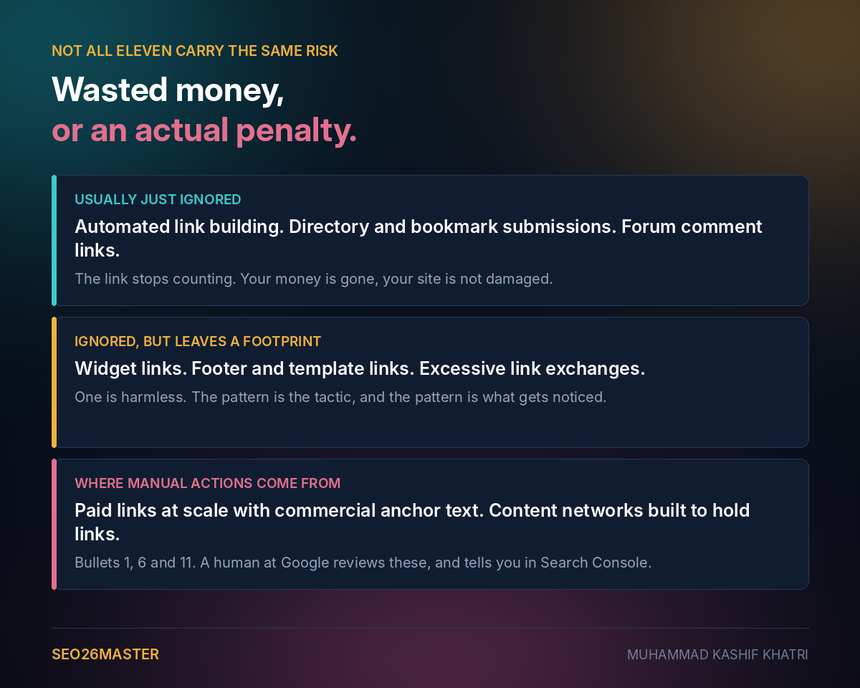
The eleven do not carry equal risk, and any guide that treats them as equal is not telling you the truth.
Usually just ignored. Automated link building, directory and bookmark submissions, forum comment links, profile links. Google has had the most practice at spotting these. They waste your money rather than damage your site.
Ignored, but they leave a trail. Widget links, footer and template links, excessive link exchanges. One or two are harmless. The pattern is what gets noticed. And the pattern is the whole point of the tactic, which is the trap in it.
The ones that bring real trouble. Paid links at scale using commercial keywords as the clickable words, and networks of sites built to hold links. These are the two patterns behind almost every manual action story you will read, and they are numbers 1, 6 and 11 on Google's list.
I should say where I stand, because it affects how you read that paragraph. I sell guest post placements. That puts me inside bullets 1 and 6 by definition, which is why the tagging question below is not a theoretical one for me.
If you would rather avoid bullets 1 and 6 altogether, there are eight ways to build links that involve no payment and no publisher at all. They are in how to get backlinks without guest posting.
Is buying links against Google's rules?
Not by itself, and the policy says so in its own closing paragraph. Google writes that buying and selling links is a normal part of the economy of the web for advertising and sponsorship purposes, and that such links are not a violation as long as they are qualified with a rel="nofollow" or rel="sponsored" attribute on the <a> tag.
Qualified is Google's word for tagged. That one paragraph is the entire difference between advertising and link spam, and it is the part sellers leave out of the pitch. A paid placement that is tagged is allowed by the written policy. A paid placement left untagged is the first bullet on the list.
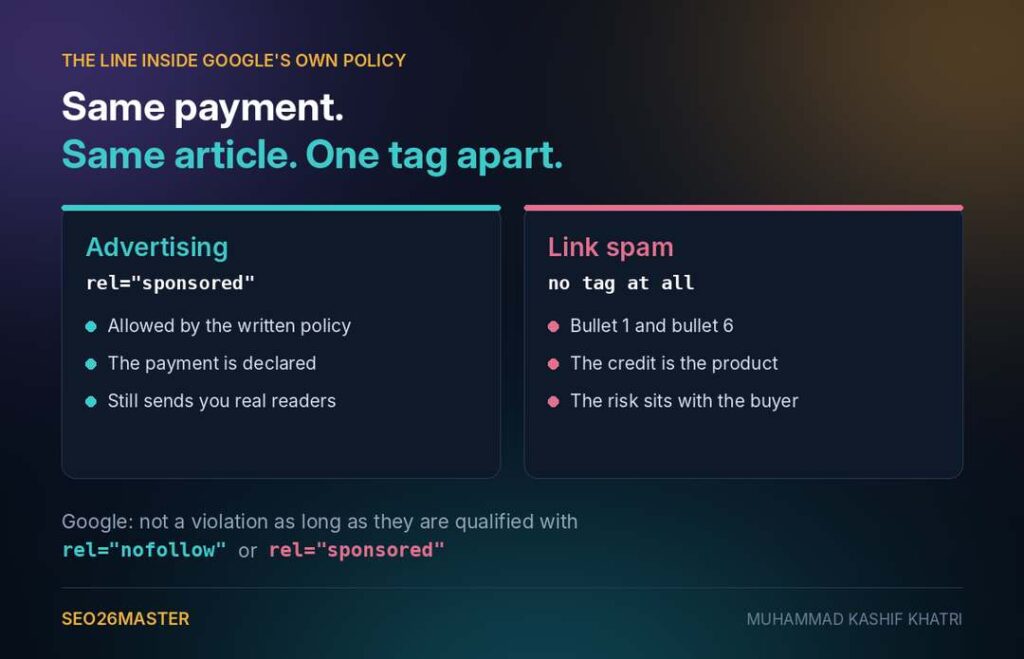
There is a question worth asking out loud here. When the link is left untagged, who is actually carrying the risk? You are, not the seller. Everything above describes your link profile, not theirs. If you want the longer version of how to judge a placement before paying for it, it is in what makes a backlink high quality.
How do you check your own site for link spam?
Four checks, in the order that is actually useful.
Check the manual actions report first. Open Search Console, then Security and Manual Actions. This takes ten seconds and answers the only question that truly matters. An empty report means no human at Google has acted against your site, and almost everything else you are about to worry about is theoretical.
Then look at the links going out of your site. Most people only check the links pointing at them. Open your footer, your sidebar, your page templates and your widgets, and find every link that leaves your site on every page. Bullets 5, 8 and 9 are all about links you are giving away, not links you are getting.
Then sort the sites linking to you by pattern, not by score. You are looking for the shapes on this list. Are dozens of sites linking from the same footer position? Did hundreds of profile links appear in the same week? Is there a cluster of sites publishing the same kind of thin article? Those are the signatures of bullets 9, 3 and 11.
Then read your own anchor text. Write down the clickable words used in your last twenty links. If your commercial keyword dominates that list, bullet 6 describes your profile, whether you paid for those links or not.
For the site by site version of this, run any site you are considering through the free guest post site checker before you pay, then use the process in how to vet guest post sites on the ones that pass.
What should you do if you find link spam pointing at your site?
In most cases, nothing at all. Ignored links are ignored, and removing a link that is already counting for zero changes nothing.
Two situations are different.
You have a manual action. Then the work is real. Remove or get tagged whatever you can, disavow the rest, keep a record of every attempt, and send a reconsideration request that honestly describes what you did. Disavowing means telling Google to ignore specific links pointing at your site. A reconsideration request is the message you send asking Google to review the penalty. Vague ones get rejected.
You bought links at scale and you know it. You do not have to wait for a penalty before cleaning up. This is the narrow case where a disavow file genuinely belongs, because you can list exactly what you paid for.
Otherwise, leave the disavow file alone. Most of the damage I see from that tool comes from people disavowing good links they did not recognise.
That last sentence deserves more than one line, because the tool is sold harder than almost anything else in this industry. Google’s own documentation sets two conditions for using it, joined by the word AND, and most articles quote only the first. The full case, with both published experiments and the thirty second check that settles it, is in the google disavow tool.
Does a link scheme always mean a penalty?
No, and the space between those two things is where most of the fear around this subject lives.
Breaking the policy means a link stops counting. A penalty means a human reviewer has acted against your site and told you so in Search Console. Google uses automated systems first and human review second, and the first outcome is thousands of times more common than the second.
This is not a reason to ignore the policy. It is a reason to be accurate about what it costs you. For most small sites the real cost of link spam is not a penalty. It is a year of budget spent on links that were never counted, and a year of not building the thing that would have worked.
What this article cannot tell you
I cannot tell you where the line sits. Excessive, low quality and widely distributed are Google's words, and Google has never put a number on any of them. Anybody who tells you the limit is five links a month, or forty percent branded anchors, is guessing.
I cannot tell you what Google actually detects. The policy describes what is not allowed. It does not describe what gets caught, and those are two different lists. Nobody outside Google has the second one.
Policies change, and this one changed recently. The whole page was rebuilt in October 2022 and the link spam section has been edited since. If you are reading this a year from now, open Google's page and check it against what I have quoted here.
What to do next
Take ten seconds and open Search Console, then Security and Manual Actions. That single report tells you whether any of this is urgent for your site or merely interesting.
If it is empty, your next move is not a cleanup. It is making sure the next thing you buy does not land in bullets 1, 6 or 11. The free guest post site checker handles the site by site part of that, with no signup.
And if you would rather hand the whole thing to somebody who reads the policy before placing anything, that is what I do for clients in the UK, the US, Canada and Australia. Send me the page you want to rank and the search you want to rank for.
Frequently asked questions
Is paying for a guest post a link scheme?
It is named in Google's policy under advertorials and native advertising. The same policy also says paid links are not a violation when they carry rel="sponsored" or rel="nofollow". The payment is not the problem. An untagged link that passes ranking credit is.
Are link exchanges always against Google's rules?
No. Google's wording is excessive link exchanges, or partner pages that exist only for cross linking. One link between two businesses that genuinely work together is not what the policy describes.
Does Google penalise the site that sells the links too?
It can. The policy covers links created to or from a site, and Google's December 2022 announcement said the credit passed by unnatural links is lost. A site selling untagged links is giving away the credit it has.
Is a footer credit link from my web designer a link scheme?
One is not. The same clickable words in the footers of two hundred client sites is the pattern Google calls widely distributed links in footers or templates. A contract that stops the client tagging that link is named separately in bullet 4.
How do I report a link scheme to Google?
Google accepts spam reports through its search quality report form. Be realistic about what follows. Reports feed into Google's systems rather than starting an investigation into your competitor, and reporting someone is never a faster route to ranking than fixing your own pages.
Sources quoted in this article
Leave a Reply