
To vet a guest post site, check the section your article will sit in, not just the domain. Google can judge a contributor section separately from the site hosting it. It has published the five questions it asks when it does: does the design match the host, does the quality drop below the main domain, is ownership acknowledged, is the stated authorship contested, and does the same content appear elsewhere. Run those five, plus three checks of your own, before any money moves. It takes about twenty minutes per site.
The rest of this explains each one, and quotes Google directly so you can check me.
I sell guest post campaigns. Read what follows with that in mind. I have tried to be exact about what Google says, and clear about where I am guessing.
What do the usual checks miss?
The standard checklist is not wrong. Domain Rating. Traffic trend. Indexed pages. Outbound links. Author bios. Run all of it. It catches the obvious disasters.
But every check on that list measures the whole domain. Your article will not live on the whole domain. It will live in a section, usually a blog or a contributor area.
A site can pass every item on that list and still run a contributor section that looks nothing like the publication hosting it. That is the case worth catching, and the standard list is not pointed at it.
What does Google ask about a contributor section?
Google's spam policies describe this exact situation. Here is the policy in its own words:
"The site reputation policy applies where third-party content is published on a host site mainly because of that host's already-established ranking signals, which it has earned primarily from its first-party content."
A guest post is third-party content on a host site. If the only reason it is there is the host's existing strength, that sentence is about your placement.
Google is careful to say this is not automatic:
"Having third-party content alone isn't inconsistent with the site reputation policy; it's only inconsistent if the third-party content is published on a host site mainly because of that host site's already-established ranking signals."
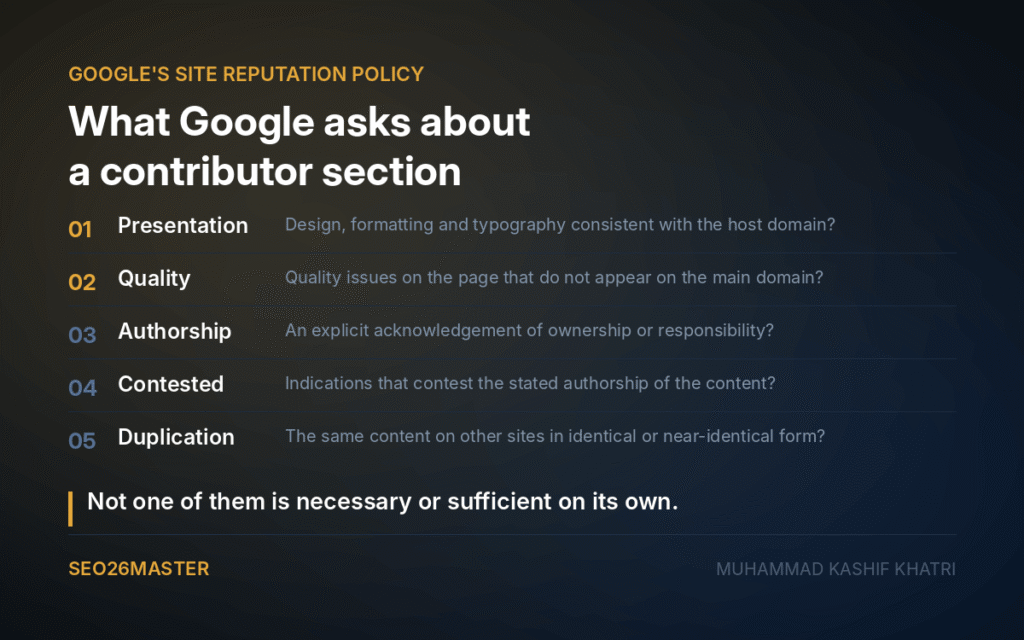
So the question is whether the section belongs. Further down the same page, Google lists what it considers. These are its words, not my summary of them:
- Presentation. Are "the graphic design, formatting, typography and UX features of the content" consistent with the host domain?
- Quality. Are "there quality issues present on the page that don't appear on the main domain"?
- Authorship. Is there "an explicit acknowledgement of ownership or responsibility for the content"?
- Contested authorship. "Are there indications that contest the stated authorship of the content?"
- Duplication. Does the content appear on other sites "in identical or near-identical form"?
Google then adds the line that keeps all of this honest. It says "not one of these factors is either necessary or sufficient on its own".
This is not a scoring system, then. It is a description of what a section looks like when it belongs to its site, and what it looks like when it has been parked there. Those five questions turn into three things you can do in about ten minutes.
Check one: does the section match the site?
Open the site's own editorial pages. Then open the contributor section.
You are not asking whether the contributor section is good. You are asking whether it is the same thing.
Start with the template. Same header? Same navigation? Same typography? Is there a path back into the site, or does the section sit on its own? Is its category visible anywhere in the main menu?
Then compare the writing in the same direction. Read one piece the site wrote itself. Then read three recent contributor pieces.
If the contributor pieces are thinner, more generic, or more obviously shaped around a link, you have found the gap. The absolute quality does not matter here. The distance between the two does.
Check two: who does the host say is responsible?
Google's authorship test is narrower than "do the bylines look real", and the difference matters.
It asks for an explicit acknowledgement of ownership or responsibility. So look for the acknowledgement, not the photograph.
Does the post say who wrote it, and in what capacity? Does the site say anywhere that contributor pieces are contributor pieces? Is there a disclosure, an editorial policy, a contributor page?
A section where every post is bylined to someone who exists nowhere else, with no statement from the host about what those posts are, has no acknowledged owner.
Check three: does the piece exist elsewhere?
Take a distinctive sentence from a recent contributor post. Wrap it in quotation marks. Search it.
If the same article comes back on several domains, you are looking at a distribution channel. One reprint with a canonical tag is a different thing. Read what you find rather than counting results.
Can you reach the section from the homepage?
Start at the homepage and try to click your way to the contributor section. No search box. No direct URL.
If you cannot get there, those pages are orphaned, and that has a specific consequence. Google's crawl budget documentation names popularity as a factor in how often a URL gets recrawled. A page nothing links to and nobody visits accumulates none of it. It gets crawled once, then slides down the queue.
I have written separately about what happens to a guest post six months after it publishes. The short version: the link stays live while everything that made it work quietly stops.
This check is not on Google's list. I include it because it predicts the same outcome by a different route, and because it takes thirty seconds.
Will the link actually be followed?
Ask before you pay, and know what the correct answer is.
Google's guidance on qualifying outbound links says to "mark links that are advertisements or paid placements (commonly called paid links) with the sponsored value". It adds that "links marked with these rel attributes will generally not be followed".
That puts every seller in one of two positions.
A site following Google's guidance marks your link sponsored. The ranking benefit you are paying for does not pass.
A site ignoring it gives you a followed link, and carries the risk of having done so.
Google treats these attributes as hints rather than absolute instructions, so neither outcome is perfectly predictable. But the choice a site has made tells you what the section is for. Most sellers will not volunteer it. Ask, and get the answer in writing.
Is there an editor, or just a form?
A site with a real editorial process will return work, ask for changes, and say no.
If a site accepts everything, nothing is holding the section's quality up. Google's first two questions will eventually describe it.
I have written about why guest posts get rejected, from the editor's side. A site that has never rejected anything is not being generous with you. It is telling you what the section is for.
What happens to a site that fails?
Here I want to be careful, because this policy is easy to overstate.
Enforcement so far has landed on large publishers monetising their reputation at scale. The known cases are major media brands running coupon and product-review sections. I have not seen a site reputation manual action reported against a small niche blog. I am not predicting that the DR 40 site in front of you will get one.
My claim is narrower. Google's five questions are the clearest public description of how a contributor section gets judged against its host. That makes them the best vetting checklist available, whether or not enforcement ever arrives.
When it does arrive, the outcome depends on where the searcher is.
Outside the European Economic Area, a manual action applies to the affected portion of the site rather than the whole domain.
Inside the EEA, that changed on 30 August 2026. Google no longer applies the manual action's impact there. In its wording, "the relevant pages may be categorized as separate from the main domain but won't be subject to the impact of manual action", which "will allow the different parts of the site to rank independently of each other, on their own merits".
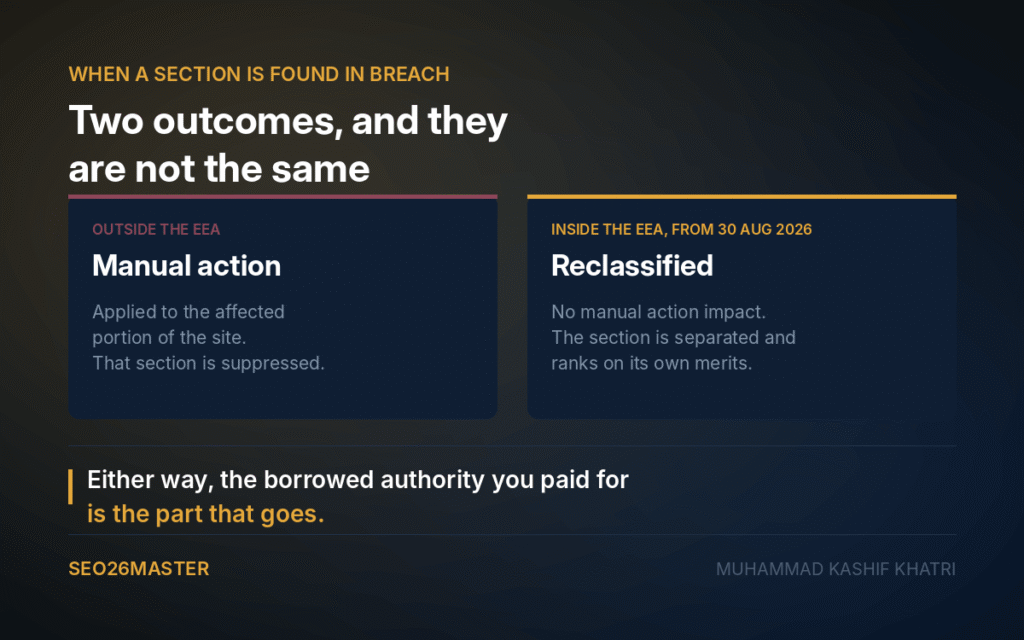
Those two outcomes are genuinely different. A manual action suppresses the section. Reclassification leaves the pages live, ranking on whatever they can earn alone. The second is survivable. The first is not.
In both cases the specific thing you paid for, the host's accumulated strength, is what gets taken away.
What this does not tell you
It does not make a paid placement compliant.
Google's link spam policy gives these as separate examples of link spam:
"Buying or selling links for ranking purposes. This includes: Exchanging money for links, or posts that contain links"
"Advertorials or native advertising where payment is received for articles that include links that pass ranking credit, or links with optimized anchor text in articles, guest posts, or press releases distributed on other sites"
Read precisely, the policy prohibits paid links that pass ranking credit. A paid placement whose link is marked sponsored is not the thing being prohibited. A paid placement with a followed link is exactly the thing being prohibited, and that is what most of this market is buying and selling.
So these checks buy you risk management, not compliance. They separate sites that will read as publications from sites that will read as channels. That difference decides whether a placement holds its value or quietly stops working. No checklist can promise more than that.
The whole check, in order
- Open the contributor section next to the site's own pages. Compare template, navigation and typography.
- Read one of the site's own articles and three contributor articles. Look for the quality gap, not the quality level.
- Look for an explicit statement of who owns or is responsible for contributor content.
- Search a distinctive sentence from a contributor post in quotation marks.
- Try to reach the section from the homepage without search or a direct URL.
- Ask whether the link will be followed or marked sponsored, and get it in writing.
- Check whether the site has ever returned a submission.
That is about twenty minutes per site. On a list of thirty sites it is ten hours before a single article is written, which is why most people skip it and find out afterwards.
I run this on every site before I recommend one, and clients approve the list before anything is bought. If you would rather hand that over, that is what the guest post campaigns are. If you would rather do it yourself, you now have the whole method.
Muhammad Kashif Khatri is an editor at ILLUMINATION and four other Medium publications, and runs guest post campaigns at SEO26MASTER.
Sources
- Spam policies for Google web search | Google Search Central
- Qualify your outbound links to Google | Google Search Central
- Update to the Site Reputation Policy | Google Search Central Blog
- Google Updates Site Reputation Abuse (Parasite SEO) Policy | Search Engine Journal
- Google Won't Enforce Its Site Reputation Policy Manual Actions In Europe | Search Engine Roundtable
Leave a Reply